
A founder pays $15,000 for a strategy engagement, gets a polished 60-slide deck, and six months later nothing has changed. The problem wasn’t the analysis. Nobody could actually use it. That gap between smart advice and real results is what makes a good management consultant. It’s also why credentials on a résumé tell you almost nothing about who will help your business and who will hand you an expensive paperweight. This article breaks down the seven traits that separate consultants who move the needle from those who just bill hours.

What is a management consultant and what do they actually do
A management consultant is an outside advisor a business brings in to diagnose a problem and recommend a fix. That’s the plain version. In practice, a management consultant spends most of the work interviewing people and pulling apart data. They map how work actually flows versus how leadership thinks it flows, then build a plan the client can execute.
Management consulting covers a wide range: strategy, operations, finance, technology, and organizational design. Some engagements last a week, others a year. The common thread is that the consultant sits outside the business’s daily chaos, which is exactly where their advantage comes from. Internal teams normalize their own dysfunction. A good consultant doesn’t. It’s also worth understanding the difference between business consulting and management consulting before you decide what kind of help you actually need.
The Institute of Management Consultants USA maintains a code of ethics for management consultants that spells out standards around confidentiality, objectivity, and only taking work you’re qualified to do. That last point matters more than people expect. Much of what separates a good consultant from a bad one is knowing what they don’t know.
For founders, the useful model is this: you hire a management consulting partner to see what you can’t see from inside the building. And to give you a path forward you can actually walk. If you’re unsure whether you even need one yet, it helps to look at why small businesses hire consultants in the first place.
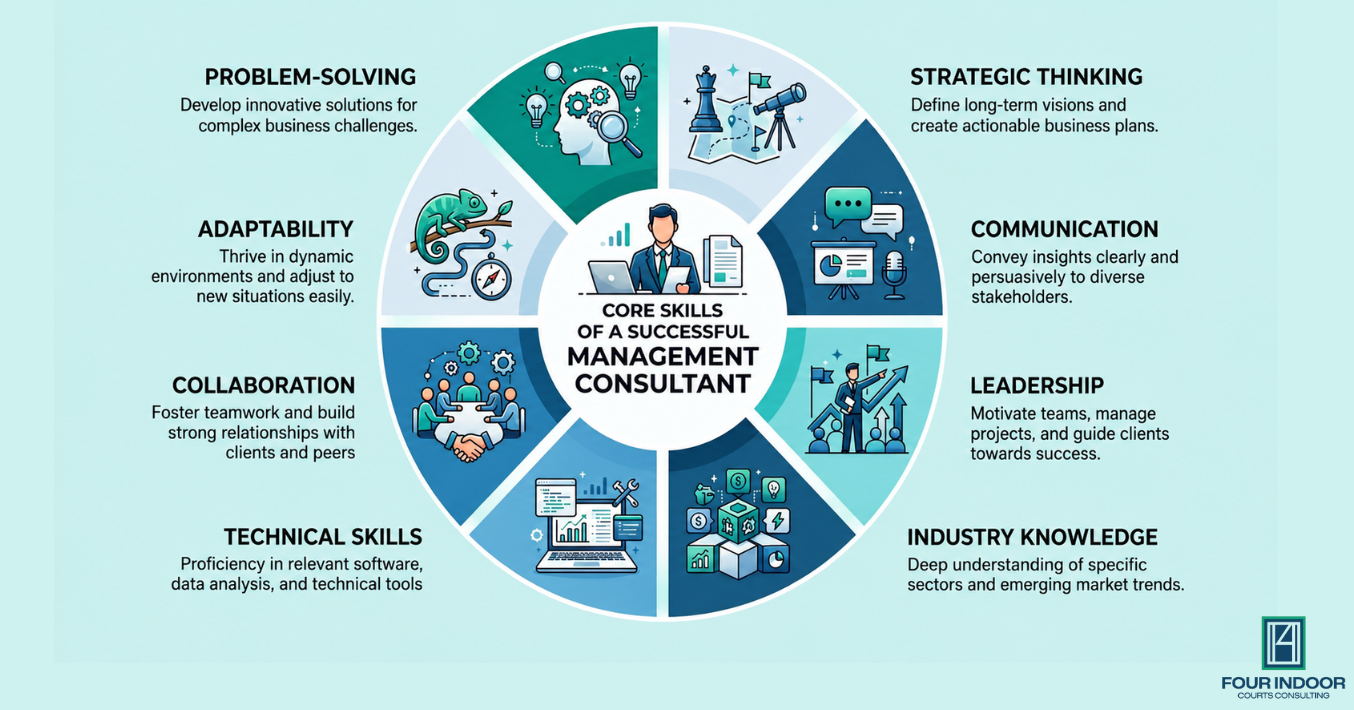
Why the right traits matter more than credentials in consulting
An MBA from a top school gets a résumé past the first filter. It does not guarantee the person can sit across from a stressed founder, ask the right question, and hear the answer underneath the answer. Credentials measure what someone studied. Traits measure what they can do with it under real conditions.
Here’s why this matters: consulting problems are messy, and messy problems don’t respond to textbook frameworks alone. A common pattern is the newly minted consultant who applies the same five-forces analysis to every situation because that’s the tool they trust. The result is analysis that’s technically correct and practically useless. Business challenges rarely fit the case-study shape they were trained on.
Many assume the most credentialed hire is the safest. In reality, the traits that predict success in management consulting (curiosity, judgment, the ability to build trust) don’t show up on a diploma. In its analysis of the consulting industry, Harvard Business Review argues the value clients pay for is increasingly about insight and execution, not credentialed access to information anyone can now find.
That’s the frame for everything below. The qualities of a good consultant are learnable, observable, and far more predictive than the letters after a name. For a deeper breakdown, see the core skills every management consultant needs.
Analytical and problem-solving skills
Strong analytical skills are the floor, not the ceiling. Every management consultant needs to take a tangled situation, pull it into pieces, and figure out which piece is actually causing the pain. That’s the difference between a consultant who says “your margins are down” and one who says “your margins are down because your two largest accounts renegotiated terms in Q3 and nobody flagged it.”
Problem-solving skills in consulting start with correct diagnosis. When engagements fail, it’s often because the consultant solved the wrong problem, competently. Analytical thinking without root-cause discipline just produces confident wrong answers faster.
Good data analysis matters, but so does knowing when the data is lying to you. Numbers can point at a symptom while the real cause sits one layer down. Sharp analytical skills treat every metric as a question, not a conclusion, which is core to what makes a good management consultant.
Consider a distribution company watching order errors climb. The obvious move is to blame the warehouse team. Real problem-solving skills trace it back and find the errors spike every time sales overrides the inventory system. That’s a process gap no headcount change would fix. This is often the moment to consider hiring a process improvement consultant. Critical thinking means resisting the easy answer, and disciplined data analysis surfaces the real trigger.
This is where structured analytical thinking and critical thinking skills earn their keep. It turns a founder’s vague sense that “something’s off” into a specific, fixable cause.

Communication, storytelling, and persuasion skills
The best analysis in the world dies if the client can’t follow it. Communication skills carry insight across the gap between the consultant’s head and the client’s decision. A consultant who can’t explain their reasoning plainly is just hoarding it.
Storytelling isn’t fluff here. It’s how you make a room of busy executives care about a finding buried in a spreadsheet. When a consultant frames a recommendation as “here’s what happens to cash flow if we change nothing,” that’s storytelling in the practical sense: sequencing facts so the stakes land. The root cause of most stalled recommendations isn’t bad logic. It’s a failure to make the logic feel urgent to those who have to act.
Communication skills also mean listening. The consultants who build the strongest client impact ask more than they tell, especially early. They read the room, notice which stakeholders quietly resist, and adjust. Persuasion without listening is just pressure, and pressure gets nodded at and ignored.
Clear communication ties directly to execution, and it’s among the consulting skills that most predict whether advice sticks. A recommendation the client can repeat back in one sentence gets implemented. One that needs the deck reopened does not. Storytelling, done well, makes a plan portable across a whole organization long after the consultant leaves.
Strategic thinking and business/commercial acumen
Strategic thinking is the ability to connect a specific fix to the business’s bigger direction. A good consultant doesn’t just plug the leak in front of them. They ask whether plugging it moves the company where it’s trying to go. That’s the difference between operational firefighting and real strategic planning.
Business acumen keeps recommendations grounded. A consultant with strong business acumen knows a technically perfect solution the client can’t afford or staff is worthless. Strategic thinking has to survive contact with budgets, timelines, and the team that exists, not the one on the org chart.
Commercial awareness also means understanding how the client makes money and where the pressure comes from. Commercial awareness of the client’s margins, sales cycle, and competitive squeeze produces advice that fits reality. A consultant without it hands over strategy that reads well and works nowhere.
Here’s the mechanism: strategic thinking connects today’s decision to next year’s position. So operational efficiency gains can build toward steadier growth instead of a one-time bump. This is where management consulting proves its worth, keeping that thinking priced and staffed for the real world.
For founders scaling past $1M, a fractional COO model shows its value. It’s worth understanding what a fractional COO actually is before you commit. You get senior strategic thinking and operational judgment applied to your business without a full-time executive salary. Four Indoor Courts provides exactly this kind of fractional COO support, pairing strategic planning with hands-on operational execution.
Adaptability and continuous learning
No two engagements look alike, which is why adaptability separates working consultants from struggling ones. A consultant walks into a manufacturer one month and a SaaS startup the next. The frameworks might carry over. The specifics never do. Learning agility, the speed at which someone gets useful in an unfamiliar context, is one of the most underrated consulting skills there is.
Continuous learning isn’t a nice-to-have in this field. It’s survival. Tools change, markets shift, and last year’s playbook ages fast. A management consultant who stopped learning three years ago is charging premium rates for stale advice. Curiosity is the engine. The good ones are genuinely interested in how a business they’ve never seen actually works.
Adaptability also shows up mid-engagement. The plan meets reality, reality wins, and the consultant adjusts without losing the thread. Rigid consultants treat the original scope as scripture. The best ones treat it as a hypothesis and update as evidence comes in.
With strong learning agility, a consultant reaches useful conclusions faster in each new industry. They’ve built the meta-skill of learning quickly rather than memorizing one sector. That mix of curiosity and continuous learning is what keeps a consultant valuable across a career, not just a quarter.

Client relationship management and trust-building
A consultant can be brilliant and still fail because the client doesn’t trust them enough to act. Client relationship management isn’t schmoozing. It’s the foundation that lets hard recommendations land. When you tell a founder their favorite process is the bottleneck, they only hear it if they trust you.
Trust gets built through small consistencies: showing up prepared, admitting what you don’t know, and never pretending a guess is a finding. The consultants with the strongest relationship skills are often the ones most willing to disagree with the client, because they’ve earned the standing to do it. Agreement isn’t the goal. Honest counsel is.
Managing stakeholders is a big part of this. Any real engagement has multiple stakeholders with different fears and incentives, and a good consultant maps those early. The CFO wants cost control, the head of ops wants fewer fires, the founder wants their weekends back. Ignoring any one of them sinks the work.
Strong collaboration matters too. The best engagements feel like a partnership. The consultant works alongside the client’s people, transferring knowledge instead of hoarding it, so the client impact survives after they leave. Leadership shows up here as the ability to guide without commanding, since the consultant rarely has formal authority and has to earn every yes through genuine collaboration.
Organization, time management, and attention to detail
Consulting engagements run on deadlines, and missed ones erode trust fast. Time management keeps multiple workstreams, interviews, and deliverables from colliding. A consultant juggling three clients without solid organizational skills starts dropping details, and dropped details are how credibility leaks away.
Attention to detail is the quiet trait that separates careful analysis from embarrassing errors. A single transposed number in a financial model can send a client toward the wrong decision. When a consultant presents a recommendation, the client assumes the underlying work is clean. Attention to detail is what makes that assumption safe.
Organizational skills also govern how an engagement is structured. The good consultants break a three-month project into visible milestones so the client always knows where things stand. That structure shows respect for the client’s time and money, and it prevents the slow drift that kills so many engagements.
Here’s a practical test of these qualities of a good consultant: ask how they’d sequence the first 30 days of work. Vague answers signal weak organizational skills. A crisp, milestone-based answer signals someone who manages time and detail as deliberately as they manage analysis. Both matter, because the sharpest insight arrives worthless if it shows up late or riddled with careless mistakes.
Drive, resilience, and tenacity
Consulting wears people down. Clients resist, data goes missing, the sponsor changes their mind, and the consultant still has to deliver. Resilience keeps someone effective through that friction instead of quietly disengaging when the work gets hard.
Tenacity shows up especially in the diagnosis phase. The real cause of a business problem is often buried under layers of “that’s just how we’ve always done it.” A consultant with genuine tenacity keeps asking why until they reach the root cause. They push past the point where a less driven one would have accepted the first plausible story and moved on.
Drive is also what turns a recommendation into an implemented change. Plenty of consultants deliver the report and vanish. Those who create lasting client impact push through the messy middle of execution, where enthusiasm fades, and old habits pull the team backward. That drive, paired with close collaboration with the client’s team, is one of the defining traits of a management consultant. It’s unglamorous work, and resilience carries it.
None of this means grinding without limits. The most durable consultants pace themselves, because burnout produces sloppy thinking and missed detail. Resilience is sustainable steadiness, not heroics. A successful management consultant treats tenacity as a long-game trait: enough persistence to see change through, and enough self-management to stay sharp on the next engagement.
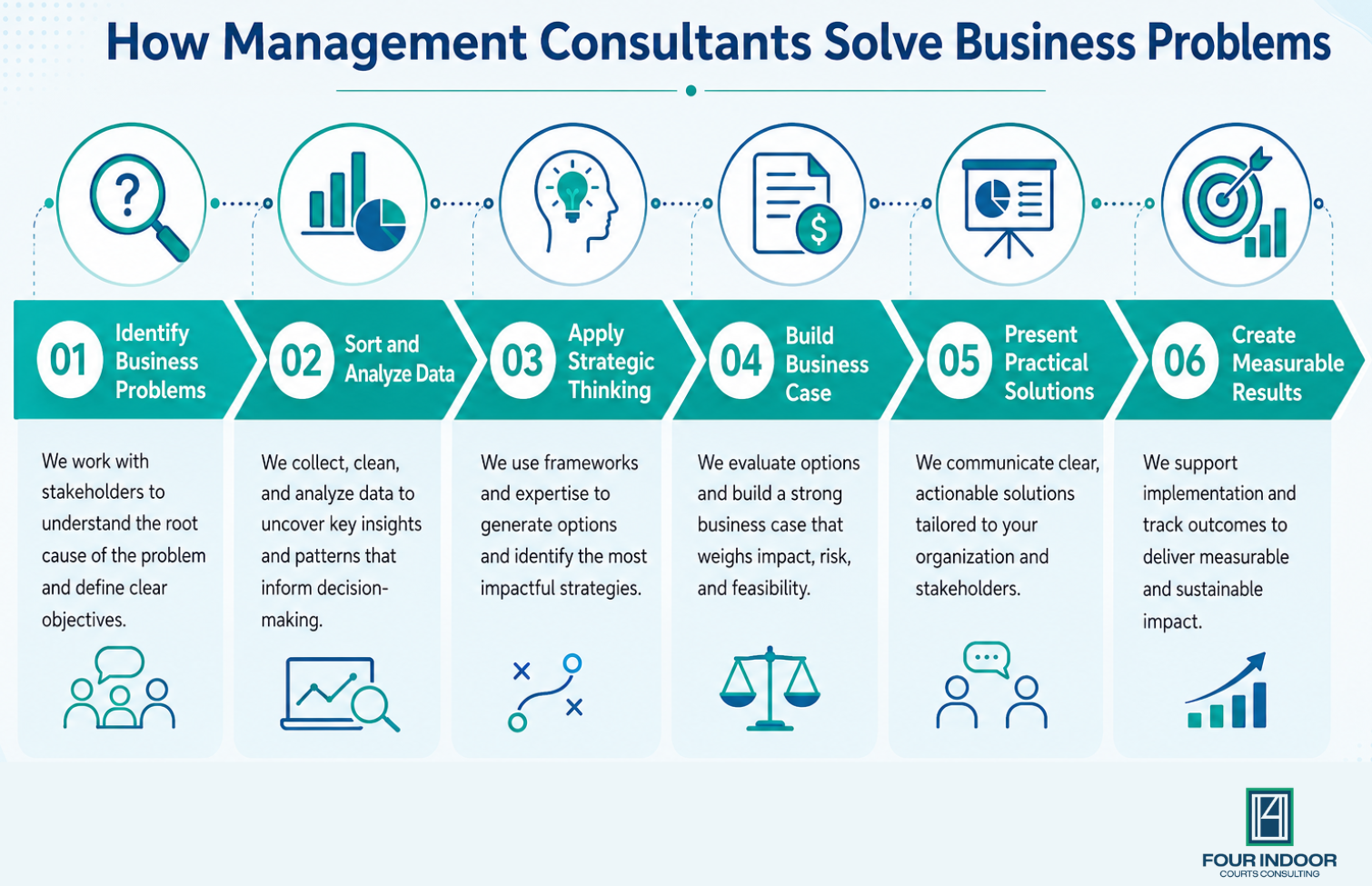
How to evaluate these traits when hiring a consultant for your business
Interviews reward talkers, so don’t rely on them alone. Ask a candidate to walk you through a real problem they diagnosed. Not the win, but the messy part where their first hypothesis was wrong. How they describe that moment tells you more about their analytical thinking and honesty than any polished case study. It’s a fast read on what makes a good management consultant.
Test for root-cause instinct directly. Describe a problem in your own business and watch whether they jump to solutions or start asking questions. The great-vs-good consultant divide shows up right here. A good consultant asks what’s underneath the symptom before proposing anything, and applies real commercial awareness before pricing a fix.
Check references for the traits that don’t demo well, like resilience and follow-through. Ask past clients whether the consultant stayed present during execution or disappeared after the deck. The great vs good consultant gap often lives in that answer, and so does lasting client impact. Also weigh fit for your stage. A consultant built for enterprise transformation may not suit a founder scaling past $1M, where the answer is often practical operational leadership. If you’d like a low-pressure way to gauge fit, a free 30-minute Readiness Audit can surface where your friction actually sits. Because these engagements vary by industry, business size, and jurisdiction, verify any regulatory or financial claims with a qualified professional before acting.
If your business has outgrown its systems and you need senior operational judgment without a full-time hire, a clarity call can help pinpoint where the friction sits and which business challenges to tackle first. Book a strategy meeting with Four Indoor Courts to talk through your operational challenges and explore your options for whether fractional COO support fits where your business is headed. Results vary based on leadership execution, market conditions, and how the work gets implemented.
FAQs
Q1. What skills matter most for a management consultant?
A1.
The core skills are analytical problem-solving (breaking complex issues into data-backed strategies), clear communication with active listening, and adaptability under pressure. The strongest consultants also diagnose root causes rather than treating surface symptoms.
Q2. What separates a great management consultant from an average one?
A2.
Great consultants translate ambiguous problems into clear, actionable insights and identify the underlying cause instead of the obvious symptom. Average ones deliver reports; strong ones drive decisions the client can actually implement.
Q3. How does a good consultant actually add value beyond giving advice?
A3.
They provide objective, outside analysis that surfaces blind spots internal teams miss, transfer specialized knowledge to the client’s team, and tie recommendations to measurable outcomes like reduced costs or improved retention. Value shows up in execution, not just the slide deck.
Q4. Is $100 an hour a fair rate for a management consultant?
A4.
For a small business, $100/hour is on the lower-to-mid end and often reflects a newer or generalist consultant. What matters more than the rate is whether the engagement produces quantifiable operational improvements that outweigh the cost.
Q5. What are the seven C's of consultancy?
A5.
The seven C’s commonly refer to Client, Clarify, Create, Change, Confirm, Continue, and Close, a framework covering the arc of an engagement from understanding the client to closing out results. It structures the relationship, not a substitute for actual expertise.
Q6. What is the rule of 3 in consulting?
A6.
The rule of 3 is the habit of structuring recommendations, findings, or arguments into three clear points because audiences retain and act on three items more easily than a longer list. It keeps consulting communication sharp and decision-ready.

Founder of Four Indoor Courts Consulting, Leah Norris helps founders and growing businesses create operational clarity through fractional COO leadership, KPI-driven analytics, and scalable operational strategy. With a background spanning operations, finance, analytics, marketing, and technology, Leah specializes in helping businesses improve visibility, streamline processes, strengthen accountability, and build the operational structure needed for sustainable growth.