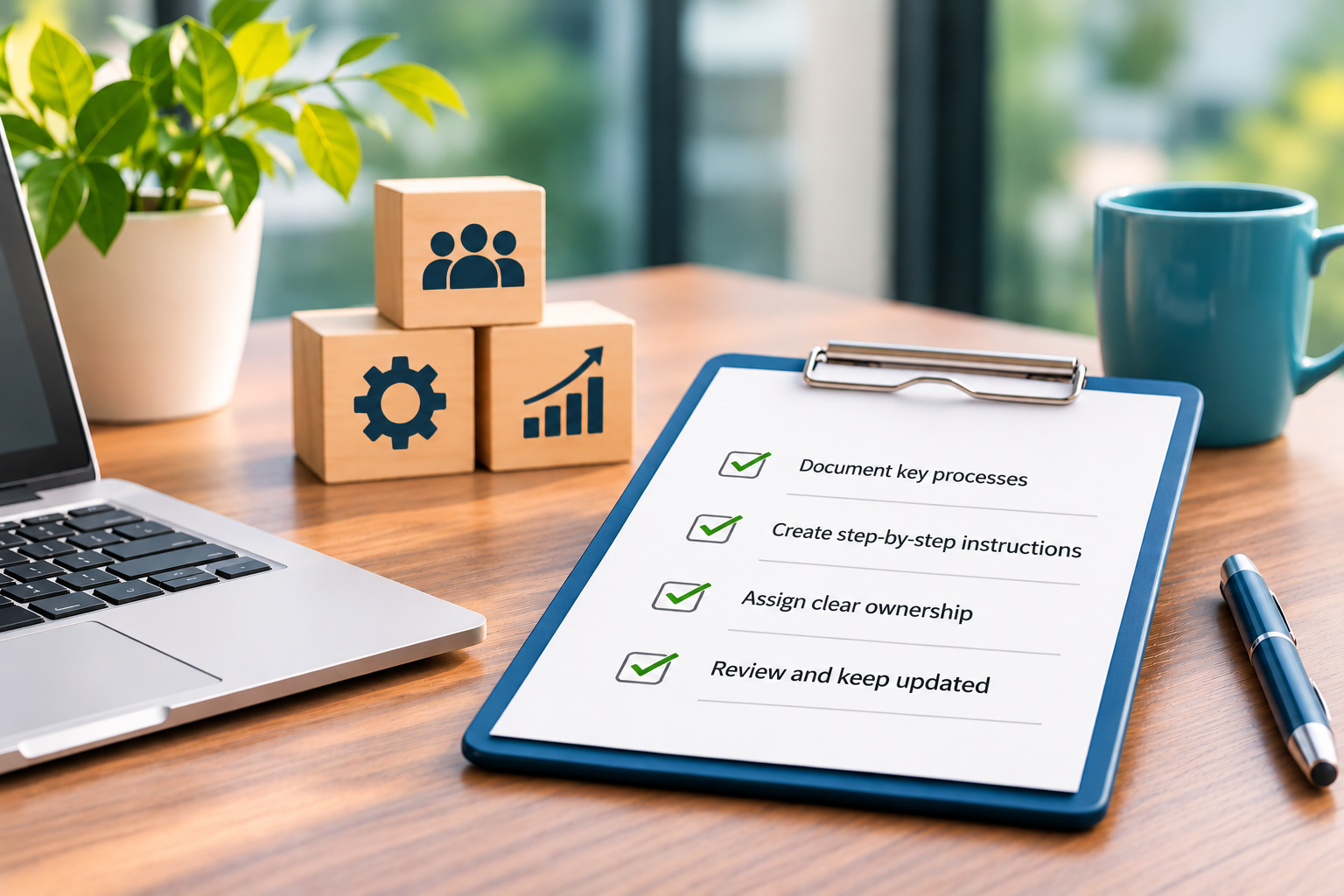
A founder takes a two-week vacation. By day four, three employees have texted asking how to handle refund exceptions. The warehouse is backed up because nobody remembers the approved shipping vendor, and a client is threatening to leave over a missed deadline. This is what founder dependency looks like in practice. It almost always traces back to processes that live in one person’s head instead of in written standard operating procedures. This article covers how to spot that dependency, build the SOPs that fix it, and roll them out so your team actually uses them.

What founder dependency is and why SOPs are the fix
Founder dependency is when a business cannot run without the founder making or approving most decisions. Revenue might be climbing, but every bottleneck routes back to one person, limiting operational efficiency and making growth harder to sustain.
Standard operating procedures break that pattern by moving knowledge out of one person’s memory and into documents the team can follow without asking. When you write down the process for onboarding a client, closing the books, or handling a complaint, others can own it. Documenting the business processes behind daily work transfers decision-making authority away from the founder, which is the whole mechanism. For a broader look at the case for this work, SCORE explains why SOPs matter for small businesses and the risks of leaving processes undocumented as a company grows.
The U.S. Small Business Administration explains why written systems matter for owners who want to manage and grow their business without being the single point of failure. SOPs are the operational layer underneath that advice, turning “ask the founder” into “check the document,” an early step toward operational clarity.
Signs your business is too dependent on the founder
Watch for these patterns. The team pauses work when you’re unavailable. Decisions pile up in your inbox waiting for approval. New hires take months to become useful because training happens through osmosis, not documentation. You can’t take a full week off without checking in daily.
Another tell: your best people keep “the way we do things” in their heads. When an experienced employee leaves, a chunk of your business systems walks out the door with them, creating fresh operational bottlenecks elsewhere.
Founder overwhelm often gets mislabeled as a staffing problem. Many founders assume they just need better employees. In reality, capable people can underperform inside undocumented business processes because they’re guessing at what good looks like. Gallup’s research on employee engagement, covered in its State of the Global Workplace report, points to clarity of expectations as a core driver of performance. SOPs supply that clarity. If accountability feels fuzzy across your team, the gap is often documentation, not talent. One operator’s experience shows how far this can go before it’s addressed: a founder who nearly exited before fixing her operations found that the business itself, not the market, was holding her back.
What a standard operating procedure is in business
A standard operating procedure is a written set of instructions for completing one specific, repeatable task the same way every time. That’s it. An SOP document isn’t a policy, a mission statement, or a job description. It answers one question: how does this particular thing get done here?
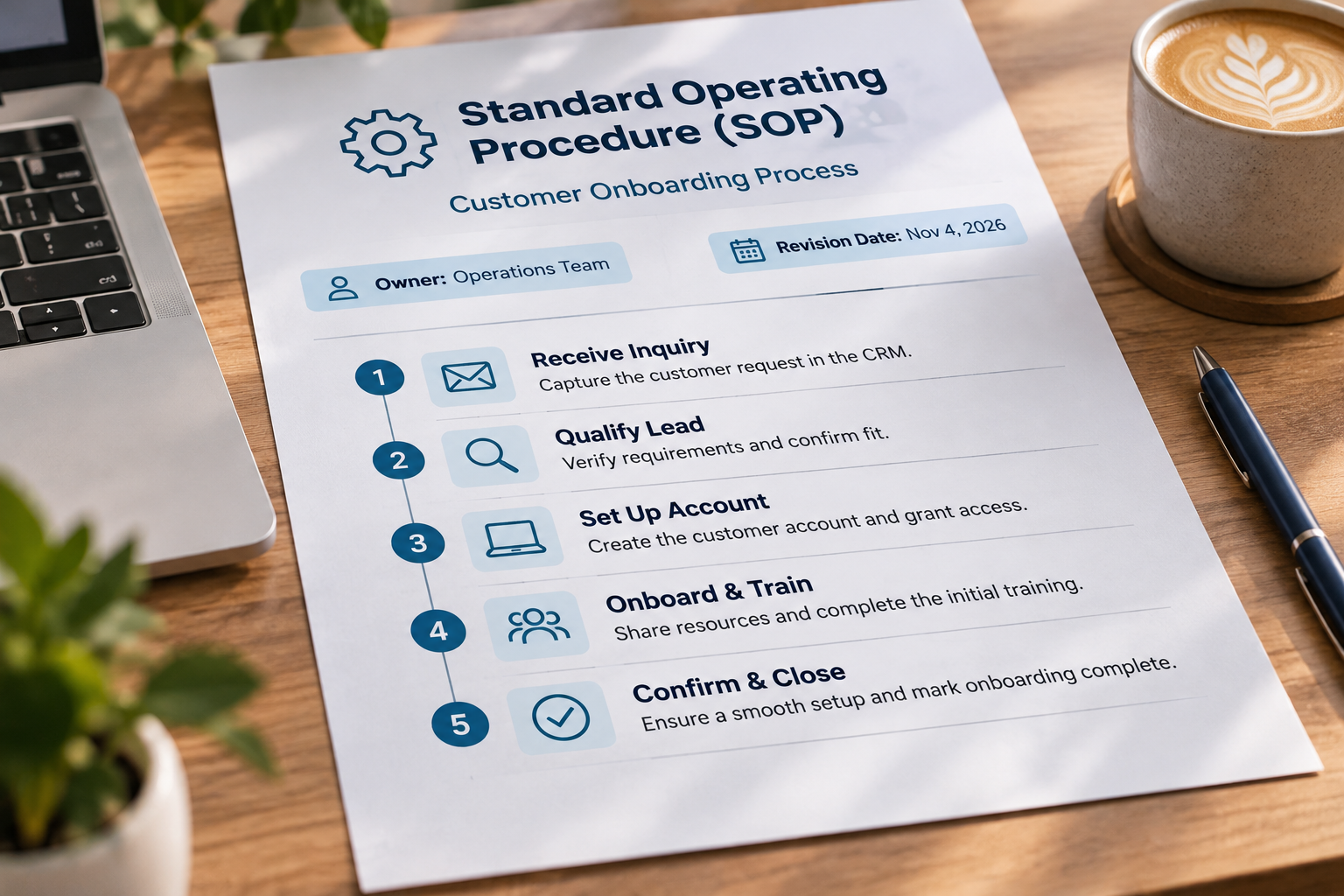
The components of an SOP are fairly standard across most types you’ll encounter: a title and reference ID, the purpose, the scope, any tools or materials required, the step-by-step instructions, the person who owns it, and a revision date. That last pair, owner and revision date, separates a living procedure from a forgotten file. Without someone accountable for updates and a date that prompts review, a procedure can drift out of sync with the actual work and people quietly abandon it. Organizations pursuing formal quality certifications will recognize this structure from ISO 9001 standards for documented quality procedures, which require similar documentation discipline at a larger scale.
People confuse SOPs with process documentation. A process map shows how a whole workflow moves across departments and handoffs. An SOP sits underneath that map, covering one task within it, and the types of SOP you choose (checklist, flowchart, hierarchical) depend on which task inside that workflow you’re documenting. A single order fulfillment workflow might rely on four or five standard operating procedures: taking the order, checking inventory, packing, shipping, and confirming delivery. Understanding this distinction keeps your SOP development focused and stops one bloated document from trying to do everything.
Which SOPs to build first to reduce founder dependency
Don’t try to document everything at once. Start where the founder is the bottleneck most often. The fastest way to find these is to track, for one week, every question your team brings to you and every decision that waits for your sign-off. Those recurring interruptions are your first SOPs.
Prioritize tasks that are high-frequency and currently founder-owned: client onboarding, quoting and pricing approvals, hiring steps, invoicing, and handling the common exceptions that otherwise land on your desk. These can deliver a meaningful drop in founder dependency per hour spent writing a SOP, because the tasks you touch most often drain the most of your time when they route back to you.
Next, document anything that would cause real damage if the person who does it left. Payroll, key client relationships, and critical vendor processes belong here, especially once scaling challenges start exposing how thin that coverage really is. This is where a free 30-minute readiness audit or a bottleneck identification session can help save time, since an outside fractional COO may spot founder-owned chokepoints faster than someone inside the business who has normalized them. Four Indoor Courts runs this kind of assessment, often as fractional COO support, to help pinpoint which workflows may be holding the founder back, and offers a free Readiness Audit to assess your operational gaps for founders who want an outside read on where to start. Fix those first, and operational efficiency can improve, supporting steadier growth instead of more firefighting.
Common SOP formats (checklists, step-by-step, flowcharts, hierarchical)
Not every task needs the same format, and picking the wrong one is why some SOPs go unread. The main types of SOPs cover almost everything you’ll need.
Checklists work for simple, linear tasks where the order matters and the risk is forgetting a step: opening the office, closing out a sale, prepping for a client call. They’re the lightest-weight option and often the most used.
Step-by-step lists suit tasks that need a bit more instruction per step, like processing a return or setting up a new account. Each step gets a short explanation, not just a box to tick.
Process flowcharts fit tasks with decision points, where the next action depends on a yes-or-no answer. Refund approvals and support escalations are natural flowchart candidates because they branch.
Hierarchical lists handle complex procedures with sub-steps nested under main steps, useful for detailed technical work. Match the format to the task’s complexity, since an effective SOP pairs the right format with the right task, which is why people actually reach for it, and why a well-matched, effective SOP tends to outlast whatever software it was built in.
Step-by-step process for writing an SOP
Writing an SOP works best when you document the task as it’s actually performed, not how you imagine it should go. Start by watching or interviewing the person who does the work daily; they know the shortcuts and exceptions a manager’s assumptions miss. If you want a structured starting point, a 7-step framework for writing SOPs walks through each stage in more depth.
First, define the goal and scope: what task this covers and where it starts and stops, since clear SOP goals keep the document from sprawling into neighboring tasks. Second, list the tools and inputs needed. Third, record each step in plain language, in the order it happens. Fourth, flag decision points and exceptions. Fifth, assign an owner and set a revision date. Sixth, have someone unfamiliar with the task follow the draft and fix whatever confused them.
Picture a bookkeeper who writes an invoicing SOP from memory, confident it is complete. A new hire follows it next month, hits a step that assumes access to a report nobody granted them, and stalls for two days waiting on the founder, the exact dependency the SOP was supposed to remove. That last test, having a fresh reader follow the draft, is the one most people skip, and it’s one of the most valuable. Writing an SOP in isolation means encoding your own assumptions, so the document only makes sense to you, defeating the purpose. A fresh reader exposes gaps. Keep each SOP document to one task; if it runs past a page, split it.

Standard operating procedure examples and templates
A standard operating procedure example makes the structure concrete. Take client onboarding: title and ID at the top, purpose (get a new client set up and billing within five business days), scope (applies to all new accounts), tools (CRM, contract template, invoicing software), then numbered steps from signed contract through kickoff call, owner listed as the account manager, and a quarterly review date.
A second standard operating procedure example: monthly invoicing. Purpose, scope, the step-by-step list of pulling billable hours, generating invoices, sending them, and logging payment, with the finance lead as owner.
You don’t need to build the skeleton from scratch when writing an SOP. A solid SOP template already includes the header, purpose, scope, procedure, and approval fields. Word, Smartsheet, and Confluence all offer free versions. Pick one SOP template and use it across every procedure so your team recognizes the layout instantly, which can speed up team training for all stakeholders. The template is just scaffolding; the value is in the content you put inside it.
Rolling out SOPs to your team and driving adoption
Writing the SOP document is half the job. Adoption is where most process documentation dies. The common pattern: a founder spends a weekend documenting workflows, shares a folder, and nothing changes because nobody was asked to actually use them.
Roll out in small batches tied to real work. Introduce the client-onboarding SOP the next time someone onboards a client, not in a vague all-hands announcement. Have the owner of each procedure walk the team through it once, then step back.
Build the SOP into the workflow so following it is the path of least resistance, not an extra step. Link the document inside the tool where the work happens. Good team training turns key SOPs into short lessons with completion tracking, so you can see who’s actually absorbed them, and that same layer supports process improvement instead of it fading after rollout week. This matters because adoption tracks the path of least resistance: when the document lives where the work happens, following it often costs less effort than asking the founder.
This is also where accountability gets real: a named owner per procedure means a responsible party keeps it current and answers questions from other stakeholders, removing the founder from that loop. For founders who want ongoing support turning written SOPs into daily habits, day-to-day operational guidance to implement SOPs can help bridge the gap between a finished document and a team that actually works from it. Adoption follows ownership, not enthusiasm.
Measuring SOP results and the ROI of reduced founder dependency
You can’t prove SOPs worked on a feeling. Measure it. One useful signal is the volume of questions and approvals routed to the founder each week. If that number drops, founder dependency may be shrinking, and your systems could be holding.
Track a few KPIs tied to the processes you documented: time to onboard a new client, error or rework rates, time for a new hire to reach full productivity. Better data visibility across these KPIs can help show which SOPs are working and which need a rewrite, feeding ongoing process improvement. An SOP with a rising error rate needs attention, not a team that needs a lecture.
The potential payoff shows up as reclaimed founder time and reduced key-person risk. A founder who gets time back each week can spend it on strategic planning and decision-making instead of firefighting. For firms refining KPI tracking and SOP review and update cadence, fractional COO support and operations consulting can help build the measurement layer so improvement is more visible. Sustained growth depends on seeing what’s actually happening across your business structure, not guessing, and results will still vary based on leadership execution and how consistently the team follows through.

Common SOP mistakes and objections founders raise
The biggest mistake is writing SOPs nobody maintains. A procedure without a revision date can go stale within a year as tools and processes change, and stale instructions are often worse than none because people stop trusting the whole system. The fix is the scheduled SOP review and update cycle baked into every document.
The second mistake is over-documenting. Hundreds of pages of hierarchical lists for tasks that need a five-item checklist just create friction. Match detail to complexity.
Founders raise fair objections. “We’re too small for this” overlooks that SOPs are often easier to build before growth and scaling challenges pile up. “We’re too busy” misses that the busyness is often the founder overwhelm SOPs are meant to relieve. And “we just need better employees” can mistake a business systems problem for a personnel one. Good people inside bad processes still struggle. SOPs give your team the operational clarity to perform without waiting on you, which is key to reducing founder dependency.
If your business is growing faster than your systems can support, the hard part is often seeing which processes create friction. You can explore your options in a free 30-minute readiness audit with Four Indoor Courts to find where founder dependency is slowing your growth and which SOPs to build first.
FAQs
Q1. What should a standard operating procedure actually include?
A1.
A usable SOP includes a title and ID, purpose, scope, required tools or materials, step-by-step instructions, the owner responsible, and a revision date. Skipping the owner and revision date is why most SOPs go stale within a year; nobody is accountable for updating them.
Q2. Is there a free SOP template in Word or similar tools?
A2.
Yes, Word, Smartsheet, and Atlassian/Confluence all offer free SOP templates built around the same basic structure: header info, purpose, step-by-step procedure, and approvals. The template matters less than whether someone actually maintains it after it’s filled out.
Q3. How detailed should an SOP be before it becomes useless?
A3.
An SOP should be detailed enough that someone unfamiliar with the task could follow it without guessing, but not so long that staff avoid opening it. If a procedure needs more than one page to explain a single task, it usually needs to be broken into sub-procedures instead.
Q4. What's the real difference between an SOP and process documentation?
A4.
Process documentation maps an entire workflow across departments, roles, and handoffs, while an SOP is a narrow set of instructions for one specific, repeatable task. In practice, a business process map might reference five or six SOPs underneath it.
Q5. What if we write SOPs and employees still don't follow them?
A5.
This usually means someone who doesn’t do the task wrote the SOP, rather than building it by watching or interviewing the person who does it daily. SOPs built around how work actually happens, including the shortcuts experienced staff already use, get followed far more consistently than ones written from a manager’s assumptions.
Q6. Is it worth writing SOPs for a business that's still changing its processes constantly?
A6.
Early-stage or fast-changing teams often resist SOPs because the process itself isn’t stable yet. In that case, document the current best-known version and set a short review cycle; the goal isn’t permanence- it’s reducing reliance on one person’s memory.

Founder of Four Indoor Courts Consulting, Leah Norris helps founders and growing businesses create operational clarity through fractional COO leadership, KPI-driven analytics, and scalable operational strategy. With a background spanning operations, finance, analytics, marketing, and technology, Leah specializes in helping businesses improve visibility, streamline processes, strengthen accountability, and build the operational structure needed for sustainable growth.