
A founder scaling past $1M in revenue doesn’t usually hit a wall because sales dried up. They hit it because approving every invoice, answering every client escalation, and remembering every undocumented process has become a full-time job on top of running the company. That’s the moment operational efficiency stops being an abstract idea and starts costing real money, missed deadlines, and sleep. This article walks through six practical steps on how to improve operational efficiency, plus how to measure progress and when outside operational leadership earns its keep.

What operational efficiency is and why it matters for scaling founders
Operational efficiency is the relationship between what your business produces and what it spends to produce it. Spend less time, labor, and cash per unit of output, and your efficiency goes up. Simple to say, harder to feel when you’re the one holding everything together.
Here’s what many founders don’t realize: revenue growth and operational efficiency aren’t the same thing. You can grow the top line while margins quietly shrink, because every new client adds friction your business systems can’t absorb. The U.S. Small Business Administration’s guidance on managing business operations makes a related point: structure and consistent processes help small businesses grow without breaking. That guidance pairs well with the U.S. Small Business Administration’s guidance on managing business finances, since operational drag often shows up in the numbers before anywhere else.
The reason this matters for scaling founders is mechanical. Growth without systems creates friction, and friction compounds. A workflow that worked fine at 20 clients leaks time at 80 because it was never designed; it just happened. The same number of handoffs that felt invisible at low volume turns into a daily queue once each one repeats dozens of times, which is the causal chain most founders only notice after margins slip. Scaling exposes weaknesses in business processes, often in undocumented systems that were invisible at low volume. Part of getting ahead of this is simply identifying bottlenecks before they stall your growth, rather than waiting until they’re undeniable.
Better operational efficiency gives you three things that matter at this stage: more predictable margins, a business less dependent on you personally, and room to focus on strategy instead of firefighting. That’s the foundation for sustainable growth, and it’s where operational clarity pays for itself.
How to measure operational efficiency (ratio, formula, and the metrics that matter)
You can’t improve what you can’t see. Before chasing fixes, you need a baseline, and that starts with the operational efficiency ratio.
The simplest operational efficiency formula is operating expenses divided by revenue. Most benchmarking tools report this same operational efficiency ratio. If you spend $700,000 in operating expenses to generate $1,000,000 in revenue, your ratio is 0.7, meaning 70 cents of every dollar goes to running the business. Lower is generally better. Track that figure over time, and you’ll see whether growth is making you leaner or heavier.
The ratio is the headline, but it hides the story. That’s why operational efficiency metrics, sometimes framed as key performance indicators for operations, drill into specifics: cycle time per order, cost per transaction, error rates, revenue per employee, and on-time delivery percentage. These metrics tell you where the waste actually lives. A single ratio misleads because it averages your best and worst processes into one number, hiding the exact function that’s bleeding time. Deloitte’s operations research consistently ties disciplined measurement to stronger operational performance, a theme that also runs through Harvard Business Review’s coverage of operations strategy.
How to measure operational efficiency in practice: pick three to five numbers tied to your biggest cost centers, record them monthly, and watch the trend. A single snapshot tells you almost nothing. The trend tells you whether your process improvement efforts are working, separating data-driven decisions from guessing. Picture a founder who checks one month’s numbers, sees a dip, and panics into a hiring decision; without the trend line, they can’t tell a seasonal lull from a structural problem, and the wrong fix costs a full salary.
Step 1: Map and document your core processes to expose bottlenecks
Most operational problems start when nobody can describe how the work actually gets done. The process lives in someone’s head, and that someone is usually the founder.
Mapping changes that. Here’s the sequence:
- List your core business processes end to end: sales, onboarding, fulfillment, billing, support.
- For each one, write every step in order, including every handoff between people.
- Mark where work waits, gets re-done, or depends on one specific person.
- Flag those marks as operational bottlenecks, because that’s exactly what they are.
What actually happens when you do this: delays you’ve been blaming on “busy season” or “bad hires” turn out to be structural. Consider a services firm where every proposal waits on the founder’s personal sign-off. Deals stall, prospects go cold, and the lost opportunity can outweigh the time the review was supposed to save.
Many assume better people will fix slow processes. In reality, a broken workflow makes good people look slow. Mapping gives you operational visibility into the real cause, the only honest starting point for any process improvement or operational improvement work. Firms like Four Indoor Courts build this documentation directly with founders, turning tribal knowledge into processes a team can actually run, often following a 7-step business process optimization strategy to keep the work structured.
Step 2: Select the right KPIs and build operational visibility
A dashboard with forty metrics is just noise with better formatting. The goal isn’t more data; it’s the few numbers that drive decisions.
Good KPIs share three traits: they connect to a business outcome, someone owns them, and they change behavior when they move. Revenue per employee tells you about productivity. Cycle time tells you about speed. First-pass yield tells you about quality. Choosing key performance indicators that map to the bottlenecks found in Step 1, rather than whatever your software graphs by default, is a core part of improving operational efficiency.
The issue usually isn’t effort; it’s visibility. Teams work hard on the wrong things because nobody can see where the business is actually losing time or money. Well-chosen KPIs fix that by making performance clear to everyone, not just the founder.
Build the visibility layer in stages. Start with manual tracking in a spreadsheet if you have to. The point is consistency, not sophistication. Once the KPIs prove useful, automate the reporting so numbers refresh without someone rebuilding the sheet every Monday.
This is where operations management shifts from reactive to deliberate. When leadership sees the same metrics in real time, decisions get faster, and arguments get shorter. The mechanism is straightforward: a shared, visible number removes the debate about whose anecdote is right, so the team spends its energy on the fix instead of the diagnosis. That’s the quiet payoff of real operational visibility.
Step 3: Reduce operating expenses and eliminate waste
Reducing operating costs isn’t about cutting until it hurts. It’s about removing work that produces nothing of value.
Lean process thinking, the discipline behind methods like Six Sigma, names the targets directly: waiting, rework, overproduction, unnecessary motion, and over-processing. Walk your mapped workflows, and you’ll spot them. A report nobody reads. An approval step that’s never once caught an error. Three tools doing the job of one.
Here’s a disciplined way to approach reducing operating costs:
- List every recurring operating expense and every repeated manual task.
- Ask of each: if we stopped tomorrow, what would actually break?
- Cut or consolidate anything where the honest answer is “nothing.”
- Redirect the freed-up hours and dollars toward the bottlenecks that cap your revenue.
The root cause of bloated operating expenses is rarely one big line item. It’s dozens of small habits that made sense once and were never revisited. Resource allocation drifts, and nobody notices until margins slip.
One of the clearest operational efficiency examples: a distribution company discovers two staff spend a combined ten hours a week reconciling reports by hand because two systems don’t talk. Fixing the connection can recover meaningful labor costs each year, protecting the operating budget without touching headcount or quality.
Step 4: Standardize workflows with SOPs and automation
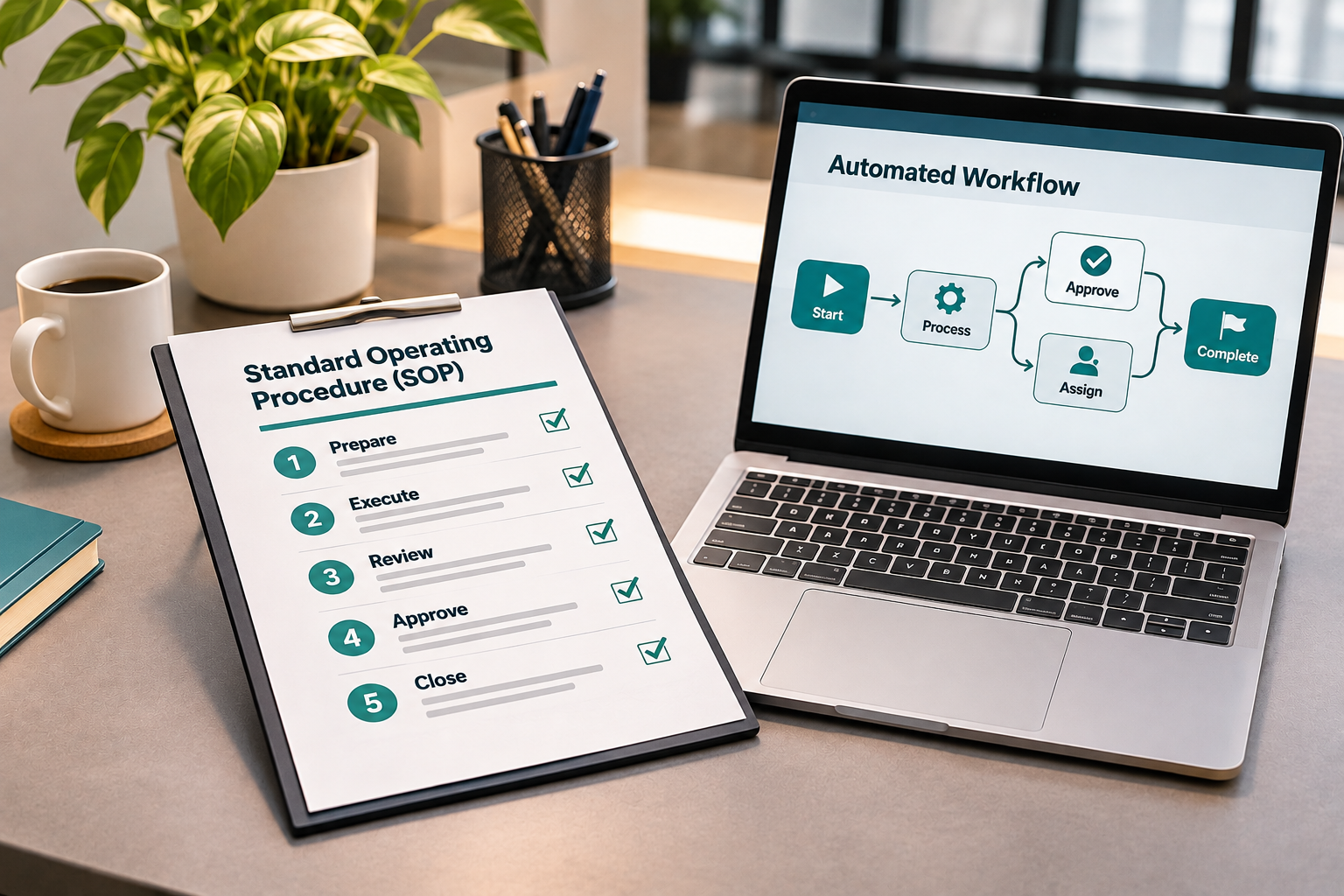
Documented processes stop being tribal knowledge the moment you turn them into a standard operating procedure. An SOP is the agreed way a task gets done, written clearly enough that a new hire can follow it without asking.
The order matters, and most people get it backward. Document first, automate second. Automating an undocumented workflow speeds up whatever mess already exists. Many assume automation is the fix. In reality, it’s an amplifier: feed it a clean process, and it saves hours; feed it a broken one, and it breaks faster.
A practical sequence:
- Turn each mapped process into a written standard operating procedure, including who owns each step.
- Test it by having someone else run the task from the document alone.
- Identify the repetitive, rules-based steps with no judgment required.
- Apply workflow automation to those steps only, leaving judgment calls to people.
Start with an SOP template so documentation stays consistent across teams. One accounts-payable automation pattern meaningfully cut manual entry time once the underlying process was finally written down. That’s workflow automation doing what it’s supposed to do.
This is process optimization at its most reliable: standardize, then automate. Four Indoor Courts handles SOP development and automation advisory in this exact order, which is why the gains tend to hold.
Step 5: Shift to data-driven decision-making over gut instinct
Founders get a long way on instinct. Then instinct starts missing, because the business got too big to hold in one head.
Data-driven decision-making doesn’t mean ignoring judgment. It means checking judgment against the numbers before you commit resources. Should you hire another fulfillment person? Gut says yes; you feel swamped. The data might show the real constraint is a scheduling bottleneck, and a modest software fix could address it more directly than a new salary.
What actually happens when teams stay gut-based is subtle: decisions get made confidently and wrong, and because nobody tracked the outcome, the same mistake repeats. The absence of data doesn’t feel like a problem. It feels like decisiveness. That’s the trap worth naming, because the cost stays hidden until a pattern of expensive missteps finally forces a look back, and by then the money is already spent.
To make the shift stick:
- Tie each recurring decision to a specific metric you already track.
- Write down what you expect to happen before you act.
- Review the actual result against your prediction a month later.
That last step builds the feedback loop that turns raw metrics into better instincts over time. This is also where operational effectiveness comes in: efficiency is doing things right, effectiveness is doing the right things, and data helps you tell the two apart. Over a few cycles, your gut gets calibrated, and data-driven decisions stop feeling like extra work.
Step 6: Add operational leadership to sustain the gains
Here’s the step most efficiency projects skip, and it’s why the gains fade. You can map, measure, cut, standardize, and track, but without someone owning operations, the system slowly reverts to founder-dependent chaos.
The problem for most SMBs is cost. A full-time COO runs well into six figures, hard to justify for a company past $1M but not yet at $10M. That gap is exactly where founder overwhelm lives, and it’s often the clearest sign, alongside visible founder overwhelm, that how to improve operational efficiency has become less a strategy question than a staffing one.
This is the case for fractional COO support. A fractional COO brings executive-level operations management on a part-time or project basis, owning the systems you’ve built so they don’t erode. Four Indoor Courts delivers this through tiered engagements, from day-to-day operational guidance to full strategy-to-execution alignment, depending on how much leadership your stage actually needs. For founders who need the deepest level of support, The Integrator engagement is built specifically for that full strategy-to-execution handoff.
The reason this sustains the gains is simple: systems don’t maintain themselves. Someone has to own operational clarity, enforce the SOPs, and watch the KPIs. That ownership turns a one-time cleanup into lasting operational improvement and sustainable growth.
The ROI of improving operational efficiency and when to bring in a fractional COO
The return on operational efficiency work shows up in two columns: money recovered and capacity freed. Reducing operating costs is the obvious half. The quieter, often larger half is the founder’s time redirected from firefighting to the strategic work only they can do, which is where business growth opportunities often come from.
A grounded example among many operational efficiency examples: a founder-led firm documents its onboarding, automates three repetitive steps, and adds a part-time operations owner. Manual errors drop, a new hire ramps up faster, and the founder reclaims hours each week. Costs vary, and results depend on execution, market conditions, and how consistently you put changes into practice. The pattern is common, though outcomes will differ by business.
So when do you bring in a fractional COO? When you’re the bottleneck, not your systems alone. When you’re making operations decisions reactively between everything else. When growth has outpaced your structure, and you need operational leadership without a full-time salary. The underlying logic is that a fractional owner closes the gap between knowing what to fix and having someone accountable for fixing it week after week, which is usually the part founders can’t do themselves while also running the business.
The honest version: if your friction is purely a staffing shortage, hire. If it’s missing structure, ownership, and operational clarity, fractional operational leadership tends to pay back faster and supports sustainable growth, because it fixes the system that generates the problems rather than throwing bodies at the symptoms. That’s the difference between operational effectiveness and just working harder, and it’s the practical core of how to improve operational efficiency past the $1M mark.

Ready to Improve Your Business Operations?
If your business is growing faster than your systems can support, the hardest part is usually seeing where the friction actually lives. Four Indoor Courts starts there, with a free 30-minute Readiness Audit that pinpoints your biggest operational bottlenecks before you spend a dollar fixing them. Book your clarity call with Leah Norris and get a clear read on where operational efficiency is slowing your growth.
FAQs
Q1. What does operational efficiency actually mean for a small business?
A1.
Operational efficiency is the ratio between the output your business generates and the resources, time, labor, cash it consumes to produce it. For a founder-led company, it usually shows up as fewer fires to put out, not a specific software metric or dashboard.
Q2. Is buying software enough to fix operational efficiency, or do I need outside help?
A2.
Software can cut manual error rates (one case saw errors drop from roughly 5% to near zero after automation), but it can’t fix undocumented processes or unclear ownership. Most founders need the workflow and SOP work done first; tools just execute a process that already makes sense.
Q3. What are the core pillars people mean when they talk about operational excellence?
A3.
The four pillars typically cited are process, people, technology, and governance, meaning documented workflows, trained accountable staff, the right tools, and consistent oversight. Skipping any one of these is usually why ‘efficiency projects’ stall out in smaller companies.
Q4. Is it worth investing in operational efficiency work if I'm under $1M in revenue?
A4.
It depends on where the friction actually lives; some small firms recoup ERP or process-improvement costs within 12-16 months, but only if the underlying workflow was broken, not just under-resourced. If your real bottleneck is founder bandwidth rather than systems, a tiered fractional engagement often pays off faster than a software purchase.
Q5. What if I automate a broken process, won't that just create bigger problems faster?
A5.
Yes, this is a real risk: automation speeds up whatever process you feed it, including a flawed one. That’s why process mapping and SOP documentation typically need to happen before you introduce any tool, not after.
Q6. What are the different types of efficiency founders should know about?
A6.
Economics generally distinguishes allocative, productive, dynamic, and social efficiency, essentially whether resources go to the right place, are used without waste, improve over time, and benefit stakeholders broadly. In practice, founder-led businesses mostly struggle with productive efficiency: getting more done with the staff and hours they already have.
Q7. Can you give a concrete example of what improved efficiency looks like day to day?
A7.
One accounts-payable automation case cut manual entry by close to 90% and doubled staff productivity on that task. At a smaller scale, it can be as simple as a founder no longer approving every invoice manually because a clear workflow and threshold now handles it.
Q8. What if my team resists new processes, does operational efficiency work even if people push back?
A8.
Resistance is common and usually signals unclear ownership rather than a flawed process itself. Efficiency gains tend to stick when you assign accountability to a specific role, not just document it in a manual nobody references.

Founder of Four Indoor Courts Consulting, Leah Norris helps founders and growing businesses create operational clarity through fractional COO leadership, KPI-driven analytics, and scalable operational strategy. With a background spanning operations, finance, analytics, marketing, and technology, Leah specializes in helping businesses improve visibility, streamline processes, strengthen accountability, and build the operational structure needed for sustainable growth.