
A founder crosses $1M in revenue, opens a second location, and six months later the original store is slipping because nobody is watching it anymore. That’s the pattern that quietly kills more growing companies than any missed market opportunity. The problem isn’t ambition. Most business expansion strategies get chosen on a whiteboard without anyone asking whether the current operation can carry the extra weight. This article walks through what expansion really involves, the main types of expansion, how to judge readiness, and how to grow without your systems buckling underneath you.

What business expansion actually means (definition and life-cycle stage)
Business expansion is the deliberate effort to grow revenue, market share, or reach by adding customers, products, locations, or channels. It marks a specific point in the company life cycle: the moment a proven model tries to do more of what already works, or something close to it. This isn’t the scrappy survival phase, and it isn’t a last-ditch pivot. It assumes your core offering has already found traction.
Most founders hit this stage somewhere past their first stable revenue plateau. The U.S. Small Business Administration covers the capital, licensing, and structural questions that surface here in its guide to growing your business, worth reading before you commit real capital. For a broader view of how companies move through formation, survival, and growth phases, the U.S. Census Bureau data on business formation and growth offers useful context on just how uneven that trajectory tends to be.
At this stage, the systems built for a smaller company start showing cracks. Revenue growth is the visible signal. Operational strain is the hidden one. The strain stays hidden because revenue keeps climbing even as the underlying processes fall behind, so the numbers look healthy right up until something breaks. For small business growth to hold, both the strategy and the structure underneath it need a well-planned process that can scale operations without buckling. This is often where it helps to get an outside look before committing resources, which is exactly what a free 30-minute Readiness Audit is designed to surface.
Why founders consider expanding and what signals readiness
Founders usually consider expanding for one of two reasons: they’ve hit market saturation in their current segment, or they see a growth opportunity they can’t chase at current capacity. Both are valid. The trap is treating desire as readiness.
Real readiness shows up in boring places: consistent cash flow, a customer base growing without constant founder intervention, documented processes that run when you’re on vacation, and reporting that tells you what’s happening without you having to ask three people. Deloitte’s work on how mid-market companies scale consistently points to internal operational discipline as a differentiator between companies that grow and companies that grow then stall. It’s also worth checking your situation against SCORE’s signs a business is ready to expand, which lays out a practical, no-nonsense checklist before you commit.
Here’s why that matters: expansion multiplies whatever state your operation is already in. If decisions bottleneck through you now, a second location won’t ease that load; it will double it. Many assume scale alone creates efficiency. In reality, it exposes every weak joint first and rewards you only if those joints hold. The best business expansion strategies account for this directly, sequencing growth around what the operation can carry rather than what the market appears to offer.

The main types of business expansion strategies explained
The clearest way to understand expansion strategies is the Ansoff Matrix, which maps four strategic paths by how much new risk each introduces.
Market penetration means selling more of what you already have to the market you already serve. It carries the lowest risk, because nothing new is unproven. Market development takes that same proven product into new markets, whether that’s a new region, a new segment, or expanding internationally. Product development builds new offerings for your existing customer base, using relationships you’ve already earned. Diversification- new products in new markets- is the highest-risk corner because both variables are unknown at once. The risk climbs with each step for a simple reason: every new variable you introduce is one more thing you have no operating history with, and no history means no reliable way to predict how it behaves.
There’s a second axis most founders skip: how you fund the growth. Organic growth uses internal resources and reinvested revenue. Acquisition buys a competitor or complementary business to shortcut the timeline, often requiring more upfront capital investment than founders expect. Each path has distinct advantages and disadvantages. Choosing the right strategy depends more on your operational capacity than on which path looks most exciting, so start by naming which type your business can actually execute.
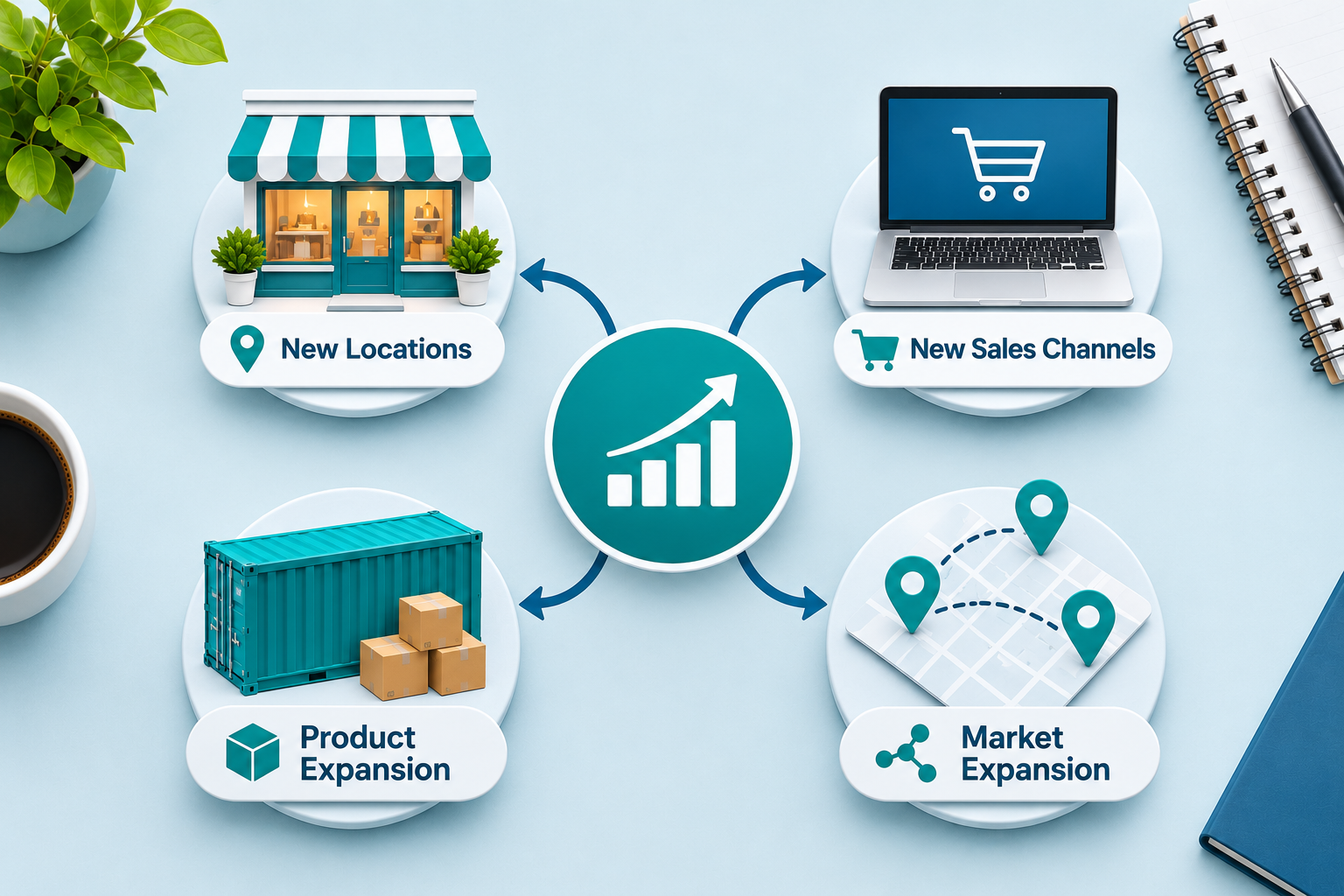
Market entry and growth methods (new markets, products, locations, channels)
Once you’ve picked a direction, the market entry methods are the practical mechanics of getting there. For new markets, you can open a physical location, license to a partner, franchise, or sell direct through distribution. For expanding internationally, options widen to joint ventures, local partnerships, or appointing in-market representatives who understand regulatory and cultural differences.
Channel expansion is often the most overlooked growth method. Adding e-commerce to a retail business, or wholesale to a direct-to-consumer brand, reaches a new customer base without the overhead of a new physical footprint. It’s a lighter way to pursue revenue growth when capital is tight.
Here’s the practical rule for choosing among market entry methods: pick the one that adds the least operational complexity for the revenue it unlocks. A franchise model offloads day-to-day operations to the franchisee. A company-owned second location keeps control but loads everything onto your existing team. Neither is wrong, but each demands a different level of business systems maturity before you commit.
Key factors to weigh before choosing an expansion strategy
Before committing, run an honest internal audit across three areas. First, financial capacity: can you fund the expansion without starving the core business of cash? Expansion often eats more capital than projected, and the home operation still needs feeding.
Second, operational bottlenecks: where does work pile up today? Who makes the decisions, and what happens when they’re unavailable? If your standard operating procedures live in your head instead of on paper, that gap will widen fast. Good strategic planning means documenting how the business actually runs before you duplicate it somewhere new, which is why it pays to identify operational bottlenecks before you scale rather than after you’ve already opened the next location. No growth strategy survives contact with undocumented processes or unresolved operational bottlenecks.
Third, product proof. Is your offering genuinely validated in its current market, or are you hoping a new market will rescue soft demand? Expansion rarely fixes a product that isn’t already selling.
Costs, licensing, tax treatment, and legal structure vary significantly by state and country, so verify specifics with your state’s business authority or a qualified advisor before building projections. Getting this groundwork right is what separates sustainable small business growth from an expensive stall.
Advantages and risks of expanding a business
The upside is real. Expansion can grow market share, spread fixed costs across more revenue, reduce dependence on a single market, and create a growth opportunity that compounds over time. Done well, it builds a more resilient company that isn’t hostage to one region or one product line.
The risks are equally concrete. Capital gets tied up. Management attention splits. The founder who was the glue in a single-location business suddenly can’t be everywhere, and quality slips where attention leaves. Consider a founder-led business that opens a third location while the first two still depend on daily owner involvement: a common outcome is all three performing worse than two did, with cash burning on the newest site for months before it turns.
The root cause of most failed expansions isn’t a bad market read. It’s a loss of operational visibility. The mechanism is straightforward: a founder can hold one location in their head, but once attention splits across three, no single person can track performance by memory, so problems that would have been caught at a glance now surface only in a month-end report. When leadership can’t see performance across locations in near real time, problems compound quietly until they’re expensive to fix. Operational efficiency, not optimism, is what protects the downside, and it’s a real test of whether expanding a business will pay off.

Real-world examples of expansion done well and poorly
Starbucks is the textbook case of disciplined global expansion strategies: it standardized its store systems, training, and supply chain before scaling internationally, so each new market inherited a proven operating model rather than an improvised one. The consistency came from infrastructure, not luck.
The cautionary side shows up constantly in retail and food. Companies that expanded too fast, chasing locations before their business systems could support them, ended up overextended, carrying debt and leases they couldn’t service when demand softened. The pattern repeats: aggressive footprint, thin operational backbone, collapse when conditions tighten.
A common failure among smaller companies is subtler. Picture a regional service business that wins in one city, assumes the model transfers cleanly, and opens in three new markets at once. Local labor costs, competition, and customer expectations differ in each, and with no key performance indicators tracking the new sites independently, leadership can’t tell which market is working until the cash is gone. The lesson: expansion succeeds on operational foundations, and global expansion strategies are no exception.
Why growth breaks operations and how to expand without breaking your ops
Growth doesn’t break operations gradually. It breaks them at a threshold. The informal coordination that worked at one location- a quick hallway conversation, a founder making every call- hits a wall the moment there’s a second site, a new product line, or a team too large to manage by memory. That’s when operational chaos sets in: inconsistent execution, slow decisions, and work that only the founder can unblock.
The fix is structural, not heroic. Document your standard operating procedures so they run without you. Build reporting that gives real operational visibility across every part of the business. Define clear accountability so decisions don’t all funnel through one person. A 7-step business process optimization strategy can give this unglamorous process-improvement work a concrete structure, and it’s part of what helps you scale responsibly.
This is the practical point where many business expansion strategies either hold or fall apart, and it’s usually a staffing and leadership question before it’s a strategic one. For founders who need operational leadership during this phase but can’t justify a full-time executive, a fractional COO fills the gap. The Architect fractional COO package brings executive-level operational leadership to help build the systems and accountability that make expanding a founder-led business more manageable. That’s the practical path toward sustainable growth: strategy on top, solid operations underneath.

If your business is growing faster than your systems can support, the strategic choice matters less than whether your operation can carry it. Four Indoor Courts works with founder-led companies to build the process improvements, SOPs, and reporting that help expansion hold together, through flexible fractional COO support instead of a costly full-time hire. Results vary based on leadership execution, market conditions, and operational implementation. If you want a clearer read on where operational friction would show up before you expand, book a free 30-minute readiness audit.
FAQs
Q1. What exactly is a market expansion strategy?
A1.
A market expansion strategy is a plan for growing revenue by reaching new customers or geographies with what you already sell, rather than building new products. It typically falls into one of the Ansoff Matrix categories: market penetration, market development, product development, or diversification.
Q2. What are the four main strategic paths businesses use to expand?
A2.
The four core paths are market penetration (selling more to your current market), market development (taking existing products into new regions or segments), product development (new offerings for current customers), and diversification (new products in new markets). Most founders choose penetration or development first since they carry less operational risk than diversification.
Q3. How is organic growth different from growing through acquisition?
A3.
Organic growth expands the business using internal resources, new hires, new locations, or improved sales processes, while acquisition growth buys that capacity by purchasing another company. Acquisitions move faster but require integrating two sets of systems and teams, which is often where the real strain shows up.
Q4. Is expanding into a new market actually worth the risk for a smaller company?
A4.
It depends on whether your current operations can absorb the added complexity; many expansions fail not because of bad ideas, but because they stretch a team and its systems too thin, too fast. If your reporting, staffing, and cash flow aren’t stable at your current size, adding a new market usually multiplies existing problems rather than solving them.
Q5. What if my expansion plan outpaces what my team can actually handle operationally?
A5.
This is one of the most common reasons expansions stall: growth exposes gaps in staffing, documentation, and decision-making that were manageable at a smaller scale. Before committing capital to a new location or market, stress-test your current operational capacity against the demands the expansion will add.
Q6. How do you decide which expansion strategy fits your business right now?
A6.
Start by auditing your financial capacity, current bottlenecks, and how proven your product is in its existing market before picking a direction. Businesses with strong internal systems can consider product development or new markets, while those still firefighting day-to-day operations are better served by deepening their current market first.
Q7. What usually causes an expansion strategy to fail even when the market opportunity looks solid?
A7.
Common causes include assuming what worked in one market will translate directly to another, underestimating local costs or competition, and expanding into multiple markets simultaneously before the first one is stable. Operationally, failures often trace back to leadership not having visibility into performance data until problems were already compounding.
Q8. Do I need a full operations leader in place before attempting expansion?
A8.
Not necessarily a full-time hire, but you do need someone accountable for operational decision-making during the expansion; many founders use fractional operational leadership to fill this gap without the cost of a permanent executive. Without that oversight, founders often end up managing both the core business and the expansion reactively, which is where execution breaks down.

Founder of Four Indoor Courts Consulting, Leah Norris helps founders and growing businesses create operational clarity through fractional COO leadership, KPI-driven analytics, and scalable operational strategy. With a background spanning operations, finance, analytics, marketing, and technology, Leah specializes in helping businesses improve visibility, streamline processes, strengthen accountability, and build the operational structure needed for sustainable growth.