
A founder hits $1.2M in revenue and suddenly can’t find a half-day without three decisions stacking up in their inbox. The work didn’t get harder. The systems that got them to a million just stopped holding the weight. That’s the moment most owners realize they need to clean up business processes, not hire faster or push the team longer. This article explains what process improvement actually involves, how to spot breakdowns early, and the practical order to fix them before growth turns small inefficiencies into expensive ones.

What it means to streamline business processes (definition)
Tightening business processes means removing the steps, delays, and duplicated effort that sit between a task starting and getting done well. It isn’t about working faster. It’s about designing a leaner process that takes fewer hands, fewer approvals, and fewer corrections to reach the same result.
A well-run process has three traits: each step adds value, the owner of each step is clear, and the sequence runs the same way every time regardless of who’s on shift. Process improvement trades informal “we just know how this works” habits for something repeatable. A 7-step process optimization strategy gives founders a structured way to work through this instead of guessing what to fix first.
Many founders assume this is a software problem. In reality, most friction comes from the process itself: a sign-off that three people touch, a form someone re-types into a second system, a handoff nobody owns. Fix the sequence first, then decide what tools help.
The discipline behind this has a name. The American Productivity & Quality Center publishes a well-known process classification framework that breaks any company into categories like operations, finance, and customer service. It’s a useful starting map for process mapping when you audit your processes. You don’t need their full model. You need the idea: business processes are definable, repeatable, and improvable, not mysteries only the founder understands.
Why streamlining matters for growing small and medium businesses
Growth without systems creates friction. A business doing $400K can run on memory and group chats. The same habits at $1.5M produce missed invoices, dropped client handoffs, and a founder who approves everything because nothing is documented. The issue usually isn’t effort. It’s operational visibility and the data visibility that comes from having systems you can actually see into.
Here’s what actually happens: revenue scales faster than the business structure supporting it. You add clients, staff, and complexity, and the resulting operational complexity stays informal unless someone manages it on purpose. Scaling exposes weaknesses that were invisible at a smaller size. Founders face these scaling challenges when they try to clean up workflows too late, after inefficiencies have already outpaced their ability to manage them.
The payoff shows up as operational efficiency and cost savings, but also as something harder to measure: fewer fires, clearer decision-making, and a team that doesn’t wait on the founder for routine calls. The U.S. Small Business Administration’s guidance on managing a growing business reinforces that documented systems and clear roles can help a small business handle more volume with less chaos.
Tighter processes also support the customer experience. When onboarding, delivery, and billing run the same way every time, clients feel the consistency that steady growth depends on. Scaling on broken processes just magnifies every weak point.
Warning signs your processes are breaking as you grow
The clearest signal: everything routes through the founder. If the business stalls the week you take off, decision-making is too centralized, and you’ve got a leadership bottleneck, not a staffing one.
Watch for these patterns. The same question gets asked three different ways and gets three different answers, which means you don’t have standard operating procedures. Work waits in queues, not because people are busy, but because a single approval holds everything up. That’s a classic bottleneck.
Other signs are quieter. Staff re-enter the same data into two systems. Two people unknowingly handle the same task, a duplication problem nobody flagged. Reports take days to assemble because data lives in five places, leaving you with poor visibility into numbers you can’t fully trust.
Many founders read these signs as a people problem and conclude they need better employees. In reality, most of the time the people are fine and the process is broken. Good staff running a bad workflow still produce bad outcomes. Founder overwhelm and burnout often come together, and both point to the same root cause: the business outgrew its systems. Spotting operational bottlenecks before they break under growth separates a manageable fix from a full rescue. Catch this early, and fixing it is a project. Catch it late, and it’s a rescue.

The benefits of streamlined processes (efficiency, cost, quality, team morale)
A tightened-up process pays back in four directions at once, and founders usually underestimate at least two of them.
Efficiency is the obvious one. When you cut redundant steps and remove manual data entry, the same team handles more work without longer hours. Team productivity rises because people spend their time on judgment calls instead of copying numbers between tools.
Cost savings follow. Fewer errors mean fewer do-overs, fewer refunds, and less time spent chasing mistakes. A cleaner process also reduces the hidden cost of founder time, which is one of the most expensive resources in any small business.
Quality improves because consistency improves. When delivery follows a documented sequence, clients get the same standard every time, and customer experience stops depending on which team member happened to handle them. That reliability can support repeat business and referrals.
The benefit founders forget is morale. People don’t quit because the work is hard. They quit because the work is frustrating, unclear, and full of avoidable rework. A tighter process gives staff clear ownership and fewer bottlenecks, which makes the job feel manageable. Operational clarity is a retention tool as much as an efficiency one, and it builds the visibility a founder needs to trust the numbers without chasing them down.
Put together, process improvement across these four areas creates the visibility a founder needs to lead instead of firefighting, and the structure a business needs to scale thoughtfully.
How to identify real bottlenecks and inefficiencies
A bottleneck is wherever work piles up waiting on one person, one tool, or one decision. Find those choke points, and you’ve found most of your wasted time.
Start by tracking elapsed time, not active time. A task might take ten minutes of actual work but sit three days in a queue. That three-day gap is the bottleneck, and it’s invisible if you only measure effort. Ask your team one question: “What do you wait on most?” The answers surface the real friction fast.
In most growing businesses, bottlenecks hide behind the founder. If every quote, refund, or hire needs your sign-off, you are the constraint, even though it doesn’t feel that way day to day. Centralized approval feels like control. It’s actually a brake, and it adds operational complexity nobody notices until volume rises.
Separate the bottlenecks that stem from unclear roles from those caused by genuinely redundant tasks. A handoff that stalls because nobody owns it is a clarity problem. A step that exists only because “we’ve always done it” is a redundancy problem. They need different fixes.
Measuring progress here is simple: pick the three slowest handoffs in your business operations and time them for a week. The data usually points straight at the inefficiencies you’ve been tolerating.
Auditing and mapping your existing workflows
Before you change anything, map your business processes as they truly run. Not the official version. The actual version, including the workarounds and the “oh, we also have to email accounting first” steps nobody wrote down.
Process mapping is straightforward: pick one process, list every step from trigger to completion, and name who does each step and what tool they use. Do this one workflow at a time. Client onboarding and invoicing are good first candidates because their breakdowns hit cash flow and customer experience directly.
Consider a consulting firm that assumes client onboarding is a tidy five-step handoff from sales to delivery. When someone finally maps it, the process turns out to be eleven steps, with two team members separately re-entering the same intake details and a contract that sits unsigned for days because no one owns the follow-up. The consequence is a late first deliverable and a client who already feels the disorganization in week one.
When you audit your processes, look for four things at each step: delays, duplication, decision points that stall, and data that gets re-entered. Mark every spot where work crosses between people or systems, because handoffs are where most errors live.
The reason mapping matters before fixing: you can’t clean up workflows you can’t see. The gap between the assumed process and the real one is where inefficiency hides, and you close it by watching how the work actually moves.
This audit is also where process documentation begins. The map you build becomes the first draft of how the work should run. For founders without time to run this themselves, Four Indoor Courts maps current workflows and flags bottlenecks as part of its operations and process improvement work, so the audit produces an action list rather than just a diagram.

Step-by-step approach to streamlining a process
Once you map a process, improvement follows a repeatable order. Skip the order, and you’ll automate problems instead of solving them.
First, define the outcome the process must produce and the one metric that proves it worked, like days-to-onboard or invoice-to-payment time. Without a target, you can’t tell improvement from motion.
Second, remove steps that don’t serve that outcome. Every approval, form, or handoff has to justify itself. If it only exists out of habit, cut it.
Third, consolidate handoffs as part of cleaning up the process. Each time work passes between people, it slows down and increases the risk of error. Reduce duplication by merging steps and assigning a single owner where you can.
Fourth, standardize what’s left so the business runs on a consistent structure instead of memory. Write down the sequence so it runs the same way regardless of who’s doing it. This is where standard operating procedures get drafted.
Fifth, bring in workflow automation only for the steps that are now clean and repetitive. Business process automation belongs at the end of this sequence, not the start.
Sixth, measure against the metric you set in step one. If days-to-onboard dropped, keep going. If not, your map missed something.
Run this loop on one process, prove it works, then move to the next. Trying to fix every workflow at once is how founders stall out.
Eliminating low-value tasks, duplication, and redundant steps
Most processes carry weight they don’t need. The fastest wins in process improvement come from deleting work, not improving it.
Start with duplication. When two systems hold the same information, someone keeps them in sync by hand, and that manual data entry is pure waste plus a source of errors. Pick one source of truth per data type, and the duplicate effort disappears. This single move often reclaims hours a week.
Next, hunt redundant tasks. A status report nobody reads. A second approval that always rubber-stamps the first. A weekly meeting that could be a shared dashboard. These low-value tasks accumulate quietly as a business grows, and no one person notices because each felt reasonable when it started.
Then address low-value work that can’t be deleted but shouldn’t eat your best people’s time. Routine data pulls, scheduling, and reminders are candidates for workflow automation later, once the process is clean.
The mechanism behind the payoff: every step you remove also removes a chance for something to go wrong and a point where work can stall. Fewer steps mean fewer bottlenecks by definition. A leaner process isn’t just faster; it’s more reliable, and it adds up to real operational efficiency across the business. When you reduce duplication and cut redundant steps, you shrink the surface area where errors and delays live. That’s why elimination beats optimization almost every time.
Standardizing and documenting processes (SOPs)
A process that only lives in one person’s head isn’t a process. It’s a liability. The day that person is sick, quits, or goes on vacation, the work stops.
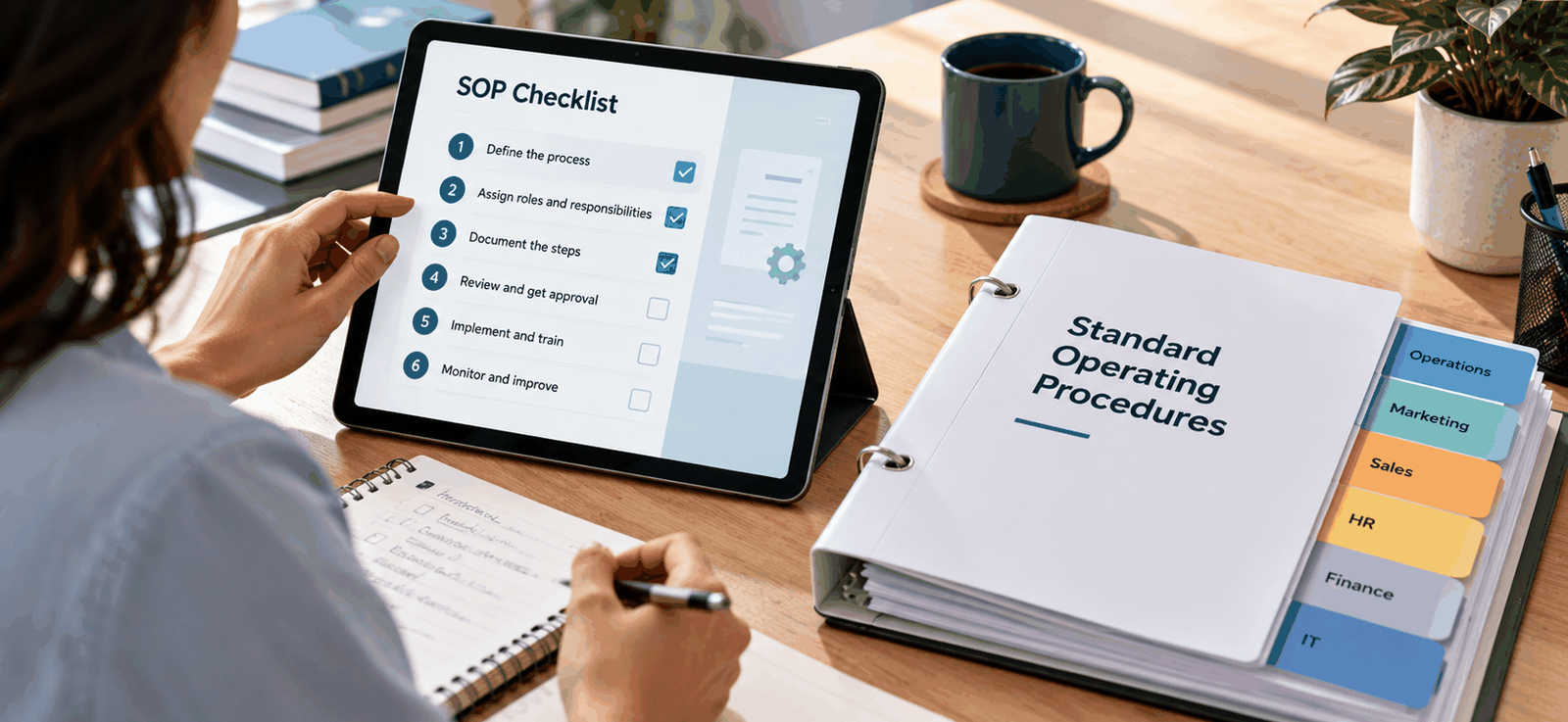
Standard operating procedures fix this. An SOP is simply the agreed way a task gets done, written clearly enough that someone new can follow it. When you standardize your processes, you remove the “it depends on who’s doing it” variability that quietly erodes quality as a team grows.
Good process documentation doesn’t need to be elaborate. A short checklist works: the trigger that starts it, the steps in order, the owner, and the definition of done. Store it where the team actually works, not in a folder nobody opens. Project management software is a reasonable home for these, since the SOP can live next to the tasks it governs.
The reason this matters more as you scale: every new hire is a test of your documentation. With clear SOPs, onboarding can take days. Without them, it can take months of shadowing and the founder answering the same questions on repeat. Standardizing your processes is what lets you hand off work with confidence and gives the whole team shared operational clarity.
Four Indoor Courts supports business process documentation and SOP development as part of building the business structure a founder-led company needs to delegate without losing quality or control.
The role of automation and when to apply it
Automation is the last step, not the first. This is the mistake that costs founders the most: buying a tool to fix a mess, then discovering the tool just runs the mess faster.
Here’s the rule. Map, clean, and document a process before you automate it. Business process automation applied to a broken workflow doesn’t solve the breakdown; it scales it. Automate a bad handoff, and you’ve just built a very efficient way to keep making the same error.
Once a process is sound, automation earns its keep. The right targets are repetitive, rule-based steps: sending onboarding emails, routing a signed contract, syncing a payment record, generating a recurring report. Workflow automation works best where humans add no judgment, only typing, and it’s a natural extension once you’ve standardized your processes.
Measure the result. If an automated step reduced errors or freed up hours, keep it. If it added a layer nobody understands, it failed. Automation should make business operations simpler to run, not harder to troubleshoot. Four Indoor Courts advises on where process automation fits once the underlying workflow is ready for it.
When to bring in operational leadership to streamline before growth breaks you
There’s a predictable point where a founder can no longer fix the systems alone, and it usually arrives right as the business is doing well enough to be busy and messy at the same time.
The signal isn’t a revenue number, though it often shows up near $1M. It’s when the founder becomes the operational bottleneck, and there’s no time to fix the systems because the systems are what’s consuming the time. That’s the trap: you need operational clarity to free up hours, but you have no hours to build it. SCORE’s analysis of why growing businesses fail points to poor planning and lack of operational structure as recurring causes, not lack of effort or demand.
This is where fractional operational leadership fits. A fractional COO brings senior operational experience to map your business processes, implement systems, and cut through operational complexity so founders can make clearer decisions, without the cost of a full-time executive. Four Indoor Courts, led by Leah Norris, provides exactly this for founder-led businesses approaching or scaling past $1M, pairing process improvement with KPI frameworks and a stronger business structure. For founders who need both strategic direction and hands-on execution, The Integrator package for aligning strategy with execution is built specifically for that gap.
Many founders assume operational leadership is only for larger companies. In reality, the earlier you install structure, the less growth has to break before someone fixes it. Bringing in support while things are strained, not fully chaotic, helps you scale deliberately instead of reactively. A good starting point is a free 30-minute Readiness Audit, which helps pinpoint exactly where the friction is before committing to a larger engagement.
If your business is growing faster than its systems can support, a conversation with Four Indoor Courts can help you clean up business processes by pinpointing where operational friction is slowing progress and what to fix first. You can book a clarity call with Leah Norris to explore your options and map a practical plan before the next stage of growth. Results vary based on leadership execution, market conditions, and operational implementation.
FAQs
Q1. What does it actually mean to streamline a business process?
A1.
It means cutting steps that don’t add value, like duplicate approvals or redundant data entry, so a workflow runs faster with fewer errors. For a founder-led business, this usually starts with mapping how work really happens today, not how it’s assumed to happen.
Q2. Is streamlining worth the disruption if my team is already stretched thin?
A2.
The short-term disruption is usually smaller than the ongoing cost of founder overwhelm and reactive firefighting, especially once a business crosses $1M in revenue. Starting with one high-friction process instead of overhauling everything at once limits the disruption while still producing a visible win.
Q3. What's another term people use instead of 'streamlining' in a business context?
A3.
Common alternatives include process optimization, workflow improvement, and operational efficiency, all of which describe the same goal of removing friction from how work gets done. You’ll also see ‘business process management’ (BPM) used as the broader discipline that houses these efforts.
Q4. What's a real example of business process management (BPM) in action?
A4.
A common BPM example is a service business automating client onboarding, contract routing, intake forms, and welcome emails through one system instead of manual handoffs between sales and operations. The goal is a documented, repeatable sequence rather than each team member handling onboarding their own way.
Q5. What if automation tools don't fix our operational problems?
A5.
Automation only helps if the underlying process is sound; automating a broken or undocumented workflow just speeds up the breakdown. That’s why mapping and clarifying roles come before introducing tools like Zapier or Power Automate, not after.
Q6. What are the core business processes most founders need to streamline first?
A6.
Most operational consultants point to five areas: sales, operations/delivery, finance, HR/people management, and customer service. Founders scaling past $1M typically see the fastest payoff by streamlining delivery and finance first, since breakdowns there directly affect cash flow and customer experience.
Q7. How many ways are there to improve business practices, and where should a small business start?
A7.
Lists of ‘ways to improve business practices’ commonly include documenting SOPs, consolidating handoffs, automating repetitive tasks, and clarifying ownership, but a founder-led business doesn’t need to tackle all of them at once. Picking the one or two processes causing the most visible friction, like client onboarding or invoicing, creates faster traction than a full operational overhaul.
Q8. Can a small team streamline processes without hiring a full operations role?
A8.
Yes, many founders start with fractional operational support, someone who maps current workflows, flags bottlenecks, and builds lightweight systems without the cost of a full-time COO. This approach works especially well for businesses approaching $1M in revenue that aren’t ready for a full executive hire yet.

Founder of Four Indoor Courts Consulting, Leah Norris helps founders and growing businesses create operational clarity through fractional COO leadership, KPI-driven analytics, and scalable operational strategy. With a background spanning operations, finance, analytics, marketing, and technology, Leah specializes in helping businesses improve visibility, streamline processes, strengthen accountability, and build the operational structure needed for sustainable growth.