
A founder lands a contract that doubles order volume. Then she watches fulfillment fall apart because every shipment still needs her personal sign-off. That is what a business bottleneck looks like in practice. Not a dramatic failure, but a quiet ceiling on how much work moves through the system. Growth does not cause this. It exposes it. This article walks through what bottlenecks are in business, the types you will hit, and how to fix bottlenecks before scaling turns a small constraint into a company-wide jam.

What a business bottleneck is (definition and plain-language meaning)
The meaning of a bottleneck in business operations is straightforward. It is the single point in a workflow where demand for output exceeds the capacity to produce it. So everything downstream waits. Picture the neck of a bottle. No matter how wide the body is, liquid only escapes as fast as the neck allows. Your business works the same way.
This matters because of throughput. Your slowest step sets total output, full stop. You can hire faster salespeople, speed up production, and add customers. But if invoices sit for a week on one approver, cash flow moves at that speed. Fixing any other step is wasted until you address the constraint. The mechanism is simple: output cannot exceed the rate of the single slowest step, so gains elsewhere just pile more work in front of the same jam.
The idea has deep roots in operations theory. The Theory of Constraints, explained in detail by the American Society for Quality, holds that every system has at least one constraint limiting its performance. That is the bottleneck meaning in business operations at work. When founders hit them, they assume they need more people. In reality, most are about flow, not force.
Early warning signs your business has a bottleneck
You rarely get a clean alert. The early warning signs of a bottleneck show up as small frustrations everyone tolerates. Watch for work piling up in one spot. A shared inbox that is always full. A task board where one column never empties. A specialist whose queue never shrinks while colleagues wait.
Other tells are quieter. Deadlines slip in a predictable pattern, always around the same handoff. Customers ask for status updates because nobody can see where their order is. Team members complain they are “waiting on approval” more than working. These workflow bottlenecks show up as repeated friction, not sudden failure.
Idle time is the signal people miss. If part of your team waits with nothing to do while another part drowns, the busy step is your constraint. Gallup’s work on the State of the Global Workplace ties stalled work to disengagement. Poor operational visibility lets these signs hide, so catching early warning signs of a bottleneck can mean the difference between a quick fix and a scaling crisis.
Types of bottlenecks (process, resource, capacity, people)
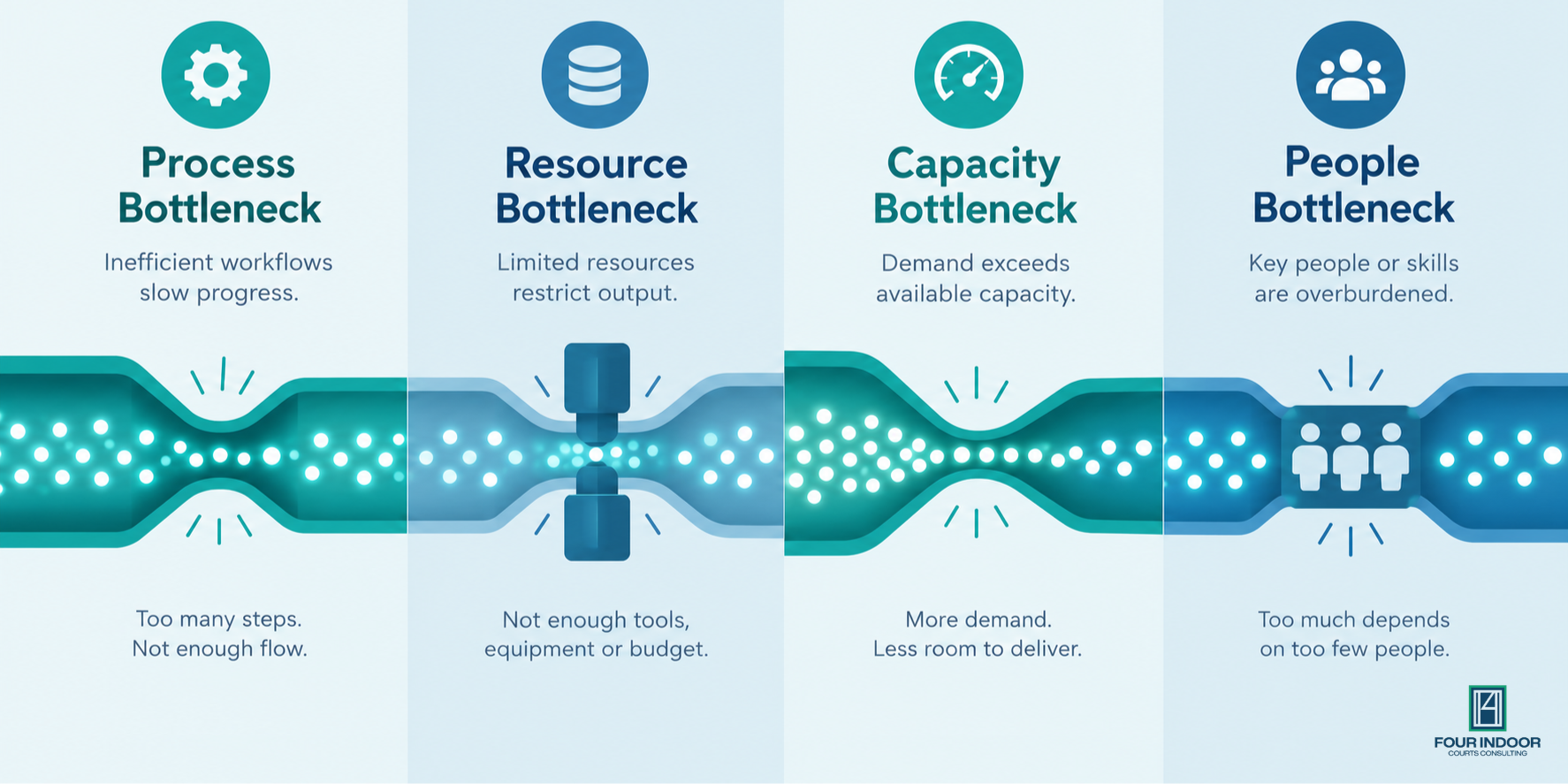
Not every jam has the same cause. Knowing the types of bottlenecks tells you where to look. There are four common categories.
Process bottlenecks come from the workflow itself. Too many approvals, redundant handoffs, or steps that exist only because “that’s how we’ve always done it.” These process bottlenecks are the most common by far, and usually the cheapest to fix. A 7-step business process optimization strategy is often enough to clear them without adding a resource.
Resource bottlenecks happen when a specific tool, system, or piece of equipment cannot keep pace. One shared printer, one licensed software seat, one truck. When these resource bottlenecks appear, capacity is often the wrong diagnosis. Capacity bottlenecks are broader: an entire team or line can’t process demand. Production bottlenecks are the classic version, where one machine gates output.
People bottlenecks are the trickiest. Expertise or decision authority sits with one person, so everything routes through them. When that person is out sick, the work stops. Knowing which operational bottleneck you face keeps you from throwing money at capacity when the real issue is a broken process. A quick bottleneck analysis usually reveals the category before you spend a dollar.
The founder-dependency bottleneck (why growth breaks the systems that got you here)
In most companies approaching $1M in revenue, the biggest bottleneck in business sits in the founder’s chair. Not because founders are slow. Because the informal business systems that worked at five people quietly collapse at twenty. Every decision, every approval, every “let me check first” flows through one person already working sixty-hour weeks.
Growth without systems creates friction. The founder becomes the single approval step, the only person who knows the client history, the final word on pricing. That founder dependency caps the whole business at whatever one exhausted human can process in a day. Informal systems rely on a person’s memory and presence, so once volume outgrows one head, every gap becomes a delay. Revenue climbs while structure stays frozen. The scale is easy to underestimate, but the U.S. Census Bureau Annual Business Survey shows how many owner-operated firms are navigating this transition.
This founder overwhelm quietly stalls promising companies. It is one of the sharpest scaling challenges owners face. The fix is not more hustle. It is distributing decisions into repeatable business systems, so the company runs without the founder in every loop. Four Indoor Courts builds this structure through operations consulting and process improvement, helping founders move from being the bottleneck to leading above it. Escaping overwhelm starts with admitting the founder is the constraint.
How to spot bottlenecks using data, metrics, and process mapping
Learning how to identify bottlenecks comes down to making invisible work visible. Start with flowcharts and process mapping. Draw your core process end to end. Every step, every handoff, every approval. The picture alone usually exposes where things pile up.
Then trace real jobs. Follow three or four actual orders from request to delivery and note where each sits waiting. The step where work consistently accumulates is your constraint. This beats guessing, because founders almost always guess wrong about where the delay lives. Consider a services firm where the founder is certain sales is the weak point: trace five projects and the real hold-up turns out to be a single onboarding approval that stalls every job for days, capping revenue no new leads can fix.
Layer in data and metrics analysis. Cycle time per step, queue length, and wait time between handoffs turn a hunch into evidence. If one step’s queue is always full while the next sits idle, you have found it. This bottleneck analysis is the heart of identifying bottlenecks: pairing the map with the numbers.
For deeper work, the 5 whys technique digs past symptoms to the root cause. Ask “why” five times about a delay and you often reach the real driver. Building flowcharts and process mapping this way creates lasting operational visibility instead of one-time firefighting. This kind of disciplined review is central to optimizing your small business operations for sustainable growth rather than lurching from crisis to crisis.
The hidden costs of bottlenecks rarely show up as a line item. That is exactly why they are dangerous. The most expensive one is people. When work backs up at a single choke point, the person or team there absorbs the pressure, and employee burnout follows. A common pattern: the one operations lead who “handles everything” quits after eighteen months, taking undocumented knowledge and leaving a $40,000 hiring hole.
Trust erodes next. Customers who wait on delayed orders stop assuming you will deliver, and that reputation damage does not reverse quickly. Internally, teams lose faith when the same handoff fails every month and nothing changes.
Then there is opportunity cost. The contract you could not take. The market you could not enter. The growth you turned away because operations could not keep up. When production bottlenecks stall fulfillment, these missed opportunities carry a profitability impact no spreadsheet captures. Many founders don’t realize these costs compound. Every month a constraint stays unaddressed, employee burnout deepens, capital ties up in unfinished work, and the gap between revenue and operational efficiency widens.

How to fix and prevent bottlenecks (efficiency, delegation, automation, systems)
Once you know where the constraint sits, fixing bottlenecks follows a clear order. Here is the sequence that works.
- Confirm the true constraint with your process map and metrics before changing anything. That way, you fix the real bottleneck, not a symptom.
- Simplify the process first. Cut redundant approvals, remove unnecessary handoffs, and clarify who owns each step. Most workflow bottlenecks come from workflow, not capacity.
- Apply delegation to move decisions off the overloaded person. Give your team clear authority and criteria so work no longer waits on one approver.
- Use automation for repetitive, rules-based steps like invoicing, scheduling, or status updates that machines handle faster than people.
- Add capacity at the constraint only after the steps above. That might be another team member, another machine, or a redistributed workload.
- Build standard business systems and documentation so the fix holds, and you prevent bottlenecks from reappearing elsewhere.
This order matters. Adding capacity to a broken process just makes the mess bigger, because you pay to run a flawed workflow faster. Knowing how to fix bottlenecks with delegation and process improvement raises operational efficiency without new headcount. To prevent bottlenecks long-term, review your process map quarterly. As you grow, the constraint moves. Fixing one often reveals the next.
Why fixing bottlenecks matters before you scale (ROI and outcomes)
Scaling a business with an unresolved bottleneck is like flooring the accelerator with the handbrake on. You burn fuel and go nowhere. The cause is simple. Scaling multiplies volume, and volume hits your slowest step hardest. Double your leads while your fulfillment constraint stays fixed, and you may not double revenue. You could just double the backlog.
The ROI of process improvement before scaling is concrete. Every unit of throughput you free up at the constraint flows straight through the rest of the system. A fix at the right point can improve output across the whole operation. That is why this work tends to carry an outsized profitability impact compared to general efficiency projects.
There is a distinction worth naming: long-term vs short-term bottlenecks. A short-term one is a temporary surge you can staff around. A long-term one is structural and will break under scaling pressure. Treating a structural constraint as temporary is how companies stall at $2M.
Sustainable growth depends on solving these before you accelerate. This is what business bottlenecks come down to when you scale: unaddressed constraints that decide whether volume compounds or collapses. To scale responsibly means widening the neck of the bottle first, then pouring faster. Clear operational bottlenecks now, and you can scale responsibly while sustainable growth has room to compound instead of collapse.
When to bring in fractional operational leadership (getting started with a Readiness Audit)
You do not need a full-time COO to solve this. Most founders approaching $1M cannot justify one anyway. That is the gap a fractional COO fills: senior operational leadership on a part-time basis, focused on the specific bottleneck holding your business back. This is exactly the model behind The Integrator fractional COO package, which puts experienced operational leadership beside you without a full-time salary.
The signal it is time is usually clear. You are the constraint, the team waits on you, and you cannot find strategic hours to fix any of it because you are buried in daily resource bottlenecks and friction. That is founder overwhelm dressed up as “just being busy,” and the founder dependency at its core caps growth. Many founders assume they need better employees. In reality, they need better business systems and clearer accountability, not new hires.
A good starting point is a Readiness Audit: a structured look at your core processes to find the single constraint capping throughput before you invest effort anywhere. Four Indoor Courts offers a free 30-minute Readiness Audit with Leah Norris. It maps where operational friction is slowing progress and whether fractional COO support fits. It is a diagnostic, not a pitch. If you want to see where your own operations stand, you can book a free 30-minute Readiness Audit to pinpoint your constraint. The right engagement depends on your stage and industry, so results vary based on execution and market conditions.

If your business is growing faster than your systems can support, the fastest way to find where the friction lives is a conversation with someone who spots these patterns daily. Book a free clarity call with Four Indoor Courts to identify the constraint capping your throughput and map a practical path forward, before scaling turns a small bottleneck into a company-wide problem.
FAQs
Q1. What is a simple example of a business bottleneck?
A1.
A common example is a single approval step where every invoice waits on one manager’s sign-off, so work piles up while that person is busy or out. The same pattern shows up when one machine, one specialist, or the founder personally is the only path forward for a task.
Q2. What are the most common types of bottlenecks small businesses face?
A2.
The usual culprits are capacity bottlenecks (a machine or team that can’t keep pace), staffing bottlenecks (expertise trapped in one overloaded person), and process bottlenecks (too many handoffs and approvals). In founder-led businesses, the founder themselves is often the biggest bottleneck.
Q3. How do I tell if my business is actually bottlenecked?
A3.
Follow a few real jobs from start to finish and watch where work-in-progress accumulates, where the queue is always full, and where other steps sit idle waiting. If one step is constantly busy while everything upstream backs up, that step is your bottleneck.
Q4. How do you fix a bottleneck once you find it?
A4.
Since roughly 58% of constraints come from inefficient processes rather than lack of capacity, start by simplifying the workflow, cutting redundant approvals, and clarifying ownership. If the constraint is genuinely capacity, redistribute the load, add resources at that step, or automate it: improving other steps won’t help until the bottleneck itself moves.
Q5. Isn't a bottleneck just a small delay I can work around?
A5.
No:the bottleneck sets the ceiling for your entire system’s output, so it caps total throughput no matter how efficient everything else is. It also drives up cost by piling work-in-progress upstream, tying up capital and creating storage, handling, and rework.
Q6. What's the difference between a bottleneck and a constraint?
A6.
A constraint is any factor limiting your business from reaching its goal, whether it’s a policy, equipment, or market demand. A bottleneck is a specific process point where work accumulates because capacity is too low for demand; in short, it’s the constraint that’s currently limiting flow.
Q7. Do I need expensive software to find bottlenecks?
A7.
Not to start. Process-mapping tools like Lucidchart or Miro make delays and excess handoffs visible for free or cheap, and process-mining platforms like Celonis are only worth it once you have enough event-log data to justify them.
Q8. Is fixing bottlenecks worth it if I'm already stretched thin as the founder?
A8.
Often the founder is the bottleneck, so addressing it directly reclaims your strategic time rather than adding to your workload. A structured diagnostic- like a fractional COO mapping your core processes- identifies the single constraint holding back throughput before you invest effort anywhere else.

Founder of Four Indoor Courts Consulting, Leah Norris helps founders and growing businesses create operational clarity through fractional COO leadership, KPI-driven analytics, and scalable operational strategy. With a background spanning operations, finance, analytics, marketing, and technology, Leah specializes in helping businesses improve visibility, streamline processes, strengthen accountability, and build the operational structure needed for sustainable growth.