

A founder takes a two-week vacation. She returns to three stalled deals, an unpaid vendor threatening to walk, and two employees waiting on a decision only she can make. Nothing broke while she was gone. Everything just stopped, because everything routed through one person. That is what unmanaged risk looks like in a growing company. It is exactly why business risk management matters long before you hit enterprise size. This article explains what risk management is, the main types of risk you face, and how to handle them. It also covers the specific danger founder-dependency creates as you approach $1M in revenue.

What is business risk management (definition and core concept)
Business risk management is the disciplined practice of identifying what could hurt your company. You judge how likely and how damaging they are, then decide what to do about each one before it becomes a crisis. It covers financial uncertainty, operational challenges, market shifts, legal exposure, and reputational damage. The core idea is simple. You cannot eliminate risk, so you manage it on purpose instead of reacting after the fact.
Without it, decisions get made in a panic. A supplier fails, a key employee quits, a lawsuit lands, and the founder scrambles. A structured approach replaces that scramble with a plan you already thought through. Building a small business continuity plan is one practical way to formalize that thinking before disruption hits.
For a formal reference point, the International Organization for Standardization’s ISO 31000 guidance lays out principles that apply to any organization, large or small. It frames risk not as pure threat but as anything that creates uncertainty around your business objectives. That is a healthier lens for founders who need to take some risks to grow. The reason that framing matters is practical: if you treat every risk as something to eliminate, you freeze, and a company that never takes calculated bets never grows.
How risk management works as a process
Risk management works as a loop, not a checklist you complete once and file away. You set the context, identify what could go wrong, analyze each threat, and decide how to respond. Then you monitor whether your response held up. Then you run it again, because your exposures change as you grow.
The risk management process starts with risk identification: naming specific threats rather than vague worries. Next comes risk analysis, where you score each risk by how likely it is and how much damage it would cause. That scoring lets you prioritize. You spend energy on the few risks that could actually sink you instead of the many that would barely register.
A repeatable process removes personal bias. Two people running the same risk management process on the same business should reach similar conclusions. That consistency matters because gut-driven risk decisions track whatever the founder fears most that week, not what actually threatens the business. The U.S. Small Business Administration’s guidance on preparing for emergencies shows how even a basic version of this cycle protects continuity when disruption hits.
Why risk management matters for businesses
Companies rarely fail from one dramatic event. They fail from small, ignored risks that compound. A cash flow gap nobody flagged. A single client who was 40% of revenue and left. A process only one person understood. Business risk management matters because it forces you to see these exposures while you still have time to act.
There is a growth angle too. Investors, lenders, and acquirers all look at how well you understand and control your risks. A business that can show documented risk management strategies tends to be viewed as more valuable. It also tends to borrow more easily than one running on the founder’s memory.
Many assume risk management is about avoiding every threat. In reality, it is about choosing which risks are worth taking. Growth requires calculated bets. Sound risk management means knowing which bets you are making, protecting the business from the ones that could end it, and consciously accepting smaller ones rather than by accident.

The main types of business risk (financial, operational, strategic, compliance, reputational)
Knowing the types of risk helps you avoid blind spots. Most founders overweight the one they fear most and ignore the rest. Five categories cover the ground.
Financial risk is anything that threatens your money: cash flow shortfalls, rising debt, customers who don’t pay, or margin erosion. Operational risk covers the day-to-day breakdowns, failed processes, supply chain gaps, equipment failure, and human error. Strategic risk is about direction: entering the wrong market, misreading a trend, or choosing the wrong entity when you incorporate. Compliance risk is legal and regulatory exposure, from tax filings to employment law to industry rules. Reputational risk is damage to how customers and partners see you, often triggered by one of the other four.
These types of risk connect. A compliance risk that goes public becomes a reputational risk. An operational risk that drains cash becomes a financial risk. Isolated risk maps fail because risks rarely stay in their lane: one untreated exposure sets off the next, so treating each category alone misses how they cascade. That is why business risks are best mapped together.
The risk management process: identify, analyze, mitigate
The working core of the risk management process is three moves you repeat: identify, analyze, mitigate. Get these right, and the rest of the framework supports them.
Risk identification means listing concrete threats across every category, ideally with your team. Founders miss risks that live inside functions they don’t touch daily. Write them down. A risk you never named cannot be managed.
Risk analysis scores each one. A common method is likelihood times impact, plotted on a simple heat map so serious risks stand out from the trivial ones. This risk assessment step turns a long, scary list into a short, ranked one.
Risk mitigation is your response. For each priority risk, you decide what to do, then assign an owner and a deadline. Mitigation without an owner is a wish. This step fails so often because teams identify risks in a meeting, feel productive, and never assign anyone to act. Documented ownership separates real risk mitigation from a nice conversation. This habit distinguishes disciplined business risk managers from reactive ones.
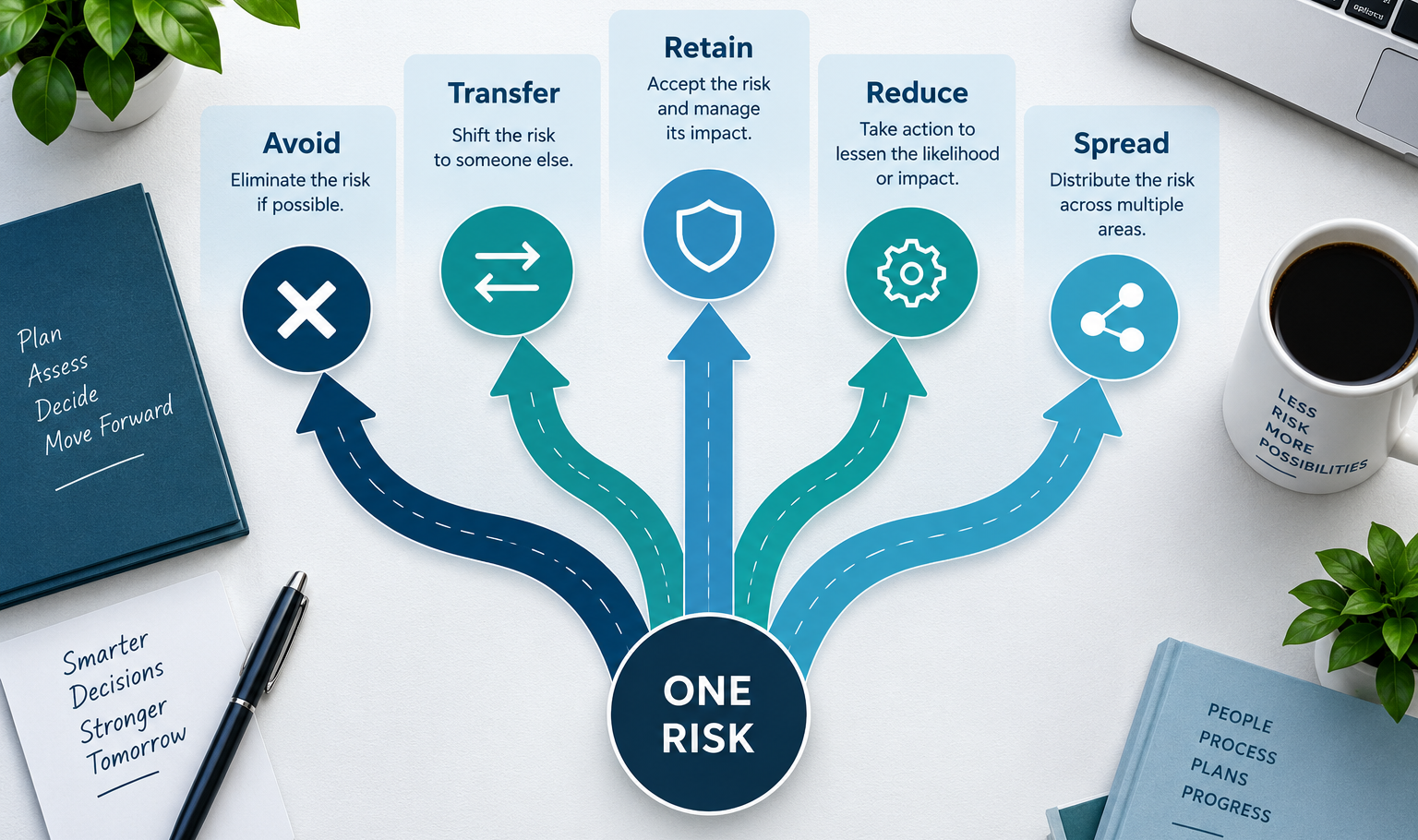
Common risk management techniques and strategies (avoid, transfer, retain, reduce, spread)
Once you have prioritized risks, you pick a response. Five classic risk management techniques exist, and the right choice depends on each risk’s likelihood and impact.
Avoiding risk means not doing the activity at all, such as declining a client whose payment terms would wreck your cash flow. Transferring risk shifts the burden to someone else, most commonly through insurance, but also through contracts that assign liability to a vendor. One common form for founder-led companies is key person insurance, which protects the business against the loss of an individual it depends on. Retaining risk means accepting it consciously because the cost of treating it exceeds the potential loss, which is fine for small, unlikely threats. Reducing risk lowers the odds or the damage through better systems, backups, and controls. Spreading risk splits exposure across multiple options, like diversifying suppliers or customers so no single failure is fatal.
Good risk management strategies mix these. You might reduce operational risk with a documented process, transfer liability risk with insurance, and spread revenue risk by broadening your client base. No single technique is enough because most real risks have more than one failure mode, so preventing loss usually comes from combining several risk management techniques rather than relying on one.
Real-world business risk examples
Concrete examples make the categories real. Consider a retailer that carried one wholesale account for 55% of revenue. When that account switched suppliers, the retailer had 60 days of runway and no backup pipeline. That is concentrated financial risk meeting a strategic risk: the failure to spread revenue across customers.
Picture a distribution company whose entire fulfillment ran through a warehouse manager who never documented anything. When he left for a competitor, order accuracy collapsed for six weeks and two large clients churned. That is operational risk and key-person risk hitting at once, with a reputational risk following close behind. The story of the dog daycare founder who nearly walked away from her business shows how quickly these concentrated dependencies can push an otherwise healthy company toward the edge.
A common pattern: a small business skips its quarterly sales tax filings during a busy stretch, assuming it will catch up. Penalties and interest stack, and a routine compliance risk turns into a five-figure surprise. None of these companies lacked effort. They lacked visibility into which risks were building while they were focused elsewhere.
What founder-dependency is and why it is a business risk
Founder-dependency is when a business cannot function normally without the founder personally involved in decisions, relationships, or daily work. It feels like dedication. It operates like a liability.
Founder-dependency is a genuine business risk, not just a lifestyle problem. It concentrates every risk category in one person. If the founder is sick, burned out, or unavailable, operations stall, decisions freeze, and client relationships wobble. This is textbook key-person risk, and buyers and lenders treat it as such. A company that depends entirely on its founder is harder to sell, harder to finance, and more fragile under stress.
Founder-dependency also caps growth. When every decision routes through one person, that person becomes the operational bottleneck. Revenue can climb while the founder’s capacity stays fixed. Eventually the gap produces burnout, dropped balls, or both. The root cause is structural, not personal: the business never moved knowledge and decision rights out of one head and into systems it owns. Sustainable growth requires reducing founder-dependency, which means transferring knowledge, decisions, and relationships into business systems the company owns.
Assessing operational and key-person risk in a small business
Assessing key-person risk starts with an uncomfortable question: what breaks if a specific person, often the founder, disappears for a month? Run that scenario for each critical role. The answers form your operational risk assessment.
Look for undocumented knowledge, single points of contact for key clients, passwords and access held by one person, and decisions that only one individual can make. Each is a concentration of risk. The goal of this risk assessment is operational visibility: seeing exactly where the business is fragile before that fragility is tested. Much of this comes down to building an org chart that distributes responsibility so critical work no longer sits with a single person.
Founders often mistake this for a personnel problem and think they need better employees. In reality, it is usually a systems problem. The knowledge lives in heads rather than in documented business systems the company controls. This is where identifying the right KPIs and building performance tracking helps. Four Indoor Courts works with founders to surface these operational bottlenecks and design the reporting that makes hidden risk visible. Naming the risk is the first step toward reducing it.

Building systems and structure to reduce founder-dependent risk
Reducing founder-dependency means moving what lives in the founder’s head into structures the business can run without them. That means documented processes, a clear organizational chart, defined decision rights, and reporting anyone on the leadership team can read.
Start with the highest-risk dependencies you found in your assessment. Document the process, assign a real owner, and give that owner the authority to act. These are the core risk mitigation moves that keep a single absence from stalling everything. Then build simple reporting so performance stays visible without the founder having to check everything. Operational visibility is what lets a founder step back without the business stalling.
This is deliberate work, and it competes with the daily firefighting that founder-dependent companies are known for. That is the trap: the busier you are, the less time you have to build the systems that would make you less busy. Consider a founder pulling 60-hour weeks who keeps promising to document the sales handoff “next month,” then loses a deal because the one person who knew the process was out sick during a close. The firefighting itself is what blocks the fix. Bringing in flexible fractional leadership to de-risk your growth can help break that cycle. Four Indoor Courts designs management systems and team structures that help owner-operators scale responsibly. Results vary based on leadership execution, market conditions, and how consistently you use the systems. Compliance and legal exposures also vary by state and industry, so verify specifics with a qualified professional or the relevant regulator for your business.
If your business is growing faster than your systems can support, a clarity call can help pinpoint where founder-dependency and operational challenges are quietly slowing you down. Four Indoor Courts offers senior operations leadership without the cost of a full-time executive, turning practical risk management into plain-language next steps. If you would rather start with a diagnostic, you can claim your free 30-minute Readiness Audit or book a clarity call to map your operational risks and leave with a prioritized plan.
FAQs
Q1. What exactly is business risk management?
A1.
Business risk management is a structured process for identifying, assessing, and responding to threats that could damage your operations, finances, reputation, or strategic goals. For founders, it turns vague worry about ‘what could go wrong into a prioritized, documented plan of action.
Q2. What are the four main types of business risk?
A2.
The four core categories are strategic (bad market bets or misread trends), operational (process failures, supply chain breakdowns, employee errors), financial (cash flow, debt, credit exposure), and compliance (regulatory or legal violations). Most small businesses under $1M feel operational risk first because their systems break before their strategy does.
Q3. How does the risk management process actually work step by step?
A3.
Following ISO 31000, the process runs as follows: establish context and risk appetite, identify risks, analyze their likelihood and impact, evaluate and prioritize, treat them, then monitor and review. It’s cyclical, not one-and-done, so you revisit it as your business grows and exposures shift.
Q4. What's the difference between risk management and risk assessment?
A4.
Risk assessment is the diagnostic phase: identifying what could go wrong and scoring likelihood times impact, often producing a risk register or heat map. Risk management is the broader ongoing system that uses those findings to assign owners, apply treatments, and monitor results over time.
Q5. Do I really need a formal risk plan if I'm a small business owner?
A5.
You don’t need enterprise frameworks like COSO ERM, but you do need a simple documented plan that names your top risks, who owns each one, and your response if it happens. Without it, risk decisions default to the founder’s gut: which is exactly the founder-dependency that stalls growth past $1M.
Q6. Isn't risk management just extra bureaucracy that slows us down?
A6.
Done wrong, it becomes paperwork nobody reads; done right, it removes the reactive firefighting that actually slows you down. The goal is operational visibility: knowing which threats deserve attention now versus which you can accept, so you make faster, calmer decisions rather than more of them.
Q7. What does a risk manager typically earn and what qualifications do they need?
A7.
Dedicated risk managers in the US generally earn six figures and usually hold a business, finance, or management degree, often with certifications tied to frameworks like ISO 31000. Most sub-$1M businesses can’t justify that full-time hire, which is why fractional operational leadership is often a better fit for building the systems first.
Q8. What are the most effective strategies for managing business risk?
A8.
Start by defining your risk appetite, then treat risk holistically across the whole business rather than in isolated silos, using a repeatable framework like ISO 31000 or FAIR. The four core responses are avoid, reduce, transfer (such as insurance), and accept, chosen based on each risk’s likelihood and impact.

Founder of Four Indoor Courts Consulting, Leah Norris helps founders and growing businesses create operational clarity through fractional COO leadership, KPI-driven analytics, and scalable operational strategy. With a background spanning operations, finance, analytics, marketing, and technology, Leah specializes in helping businesses improve visibility, streamline processes, strengthen accountability, and build the operational structure needed for sustainable growth.