
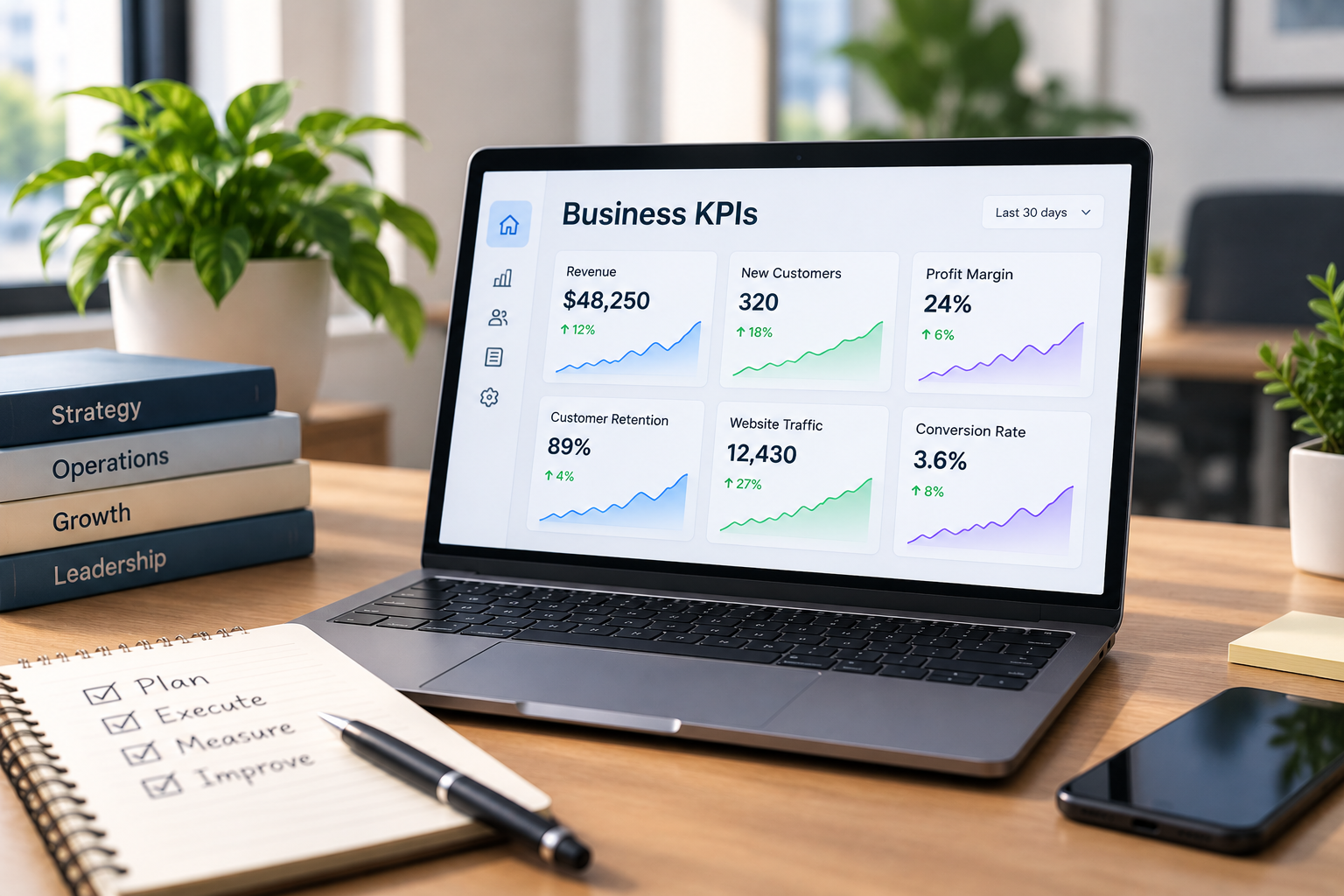
A founder near $1M in revenue can pull forty numbers from six different tools and still not know if next month’s payroll is covered. That’s the paradox of most dashboards: more data, less clarity. The right business KPIs cut through that noise. They tell you what’s working, what’s breaking, and what needs a decision this week. This guide covers which numbers matter, how to pick a handful that move the needle, and how to track them without building a report no one uses.

What KPIs actually are (and why they matter for founders specifically)
So what is a KPI? A key performance indicator is a number tied to a goal you care about. You measure it on a regular schedule, with a target attached. That last part matters. A key performance indicator without a target and a review date is just a statistic in a spreadsheet.
Founders feel this differently than corporate managers do. When you approve spend, chase collections, and decide whether to hire, business KPIs become your early warning system. The reason is simple: growth hides problems. Revenue can climb while margins quietly erode. By the time you feel it in the bank account, you’ve lost months you could have used to correct course.
The U.S. Small Business Administration’s guidance on managing business finances makes the same point. Consistent financial tracking separates founders who scale responsibly from those who react to crises. Good KPIs for small businesses give you operational visibility before a problem shows up on the income statement. That head start is the whole point. Staying disciplined about monitoring your business finances and performance is what keeps that visibility sharp. Keep in mind that specific reporting, tax, and compliance requirements vary by state and industry, so check with your local regulatory authority or accountant on which financial figures you’re actually obligated to track.
KPIs vs. metrics: knowing which numbers actually deserve your attention
This is where founders get stuck. Every tool you use spits out business metrics: page views, email opens, task counts. It’s tempting to treat them all as important. They aren’t. The metrics vs. KPIs distinction is simple. A metric is any measurable value you can track. A KPI is a metric you’ve chosen because it’s tied to a specific business objective.
Put another way, all KPIs are business metrics, but almost no metrics are KPIs. Website traffic is a metric. Traffic that converts into qualified leads at a target rate is a KPI. The difference is intent. Once you understand metrics vs. KPIs, you stop drowning in dashboards. You start watching the handful of performance metrics that predict whether you hit your goals. If you want a deeper walkthrough, our guide on how to identify the right KPIs for your business breaks down the selection process step by step.
Many founders assume more tracking equals more control. In reality, the opposite is true. Every extra number you monitor pulls attention from the ones that matter. Harvard Business Review’s work on measurement and management makes a related case. Tracking the wrong things quietly steers behavior in the wrong direction. Choose deliberately.

The core KPIs founders approaching $1M should track (efficiency, growth, health, cash)
At $1M, a few types of KPIs matter more than the rest. Group them into four categories, and you cover most of what threatens a growing business.
Financial KPIs come first. Revenue growth rate, net profit margin, and cash flow runway tell you whether growth is actually profitable. They also show how long you can operate without new income. Growth KPIs like customer acquisition cost and lead-to-close rate show whether you can scale demand affordably.
Then come efficiency KPIs and health KPIs. Efficiency KPIs like order fulfillment time or team utilization expose operational bottlenecks before they choke throughput. Health KPIs such as customer retention and net promoter score reveal whether the customers you win actually stay. These operational numbers tie directly to optimizing your small business operations for sustainable growth, since the metrics only matter if you can act on the bottlenecks they reveal.
A few KPI examples in action: a services firm might track billable utilization, while a product company watches inventory turnover. These types of KPIs vary by model. Picture a distribution company hitting $1.2M that ignores cash conversion. Revenue looks great, but slow-paying clients tie up $80K in receivables, and one delayed shipment leaves it unable to make payroll. The revenue number lied. The cash KPI would have told the truth weeks earlier.
Leading vs. lagging indicators: seeing problems before they hit revenue
Revenue is a lagging indicator. It tells you what already happened. By the time revenue drops, the cause happened weeks or months ago. This is why founders who only watch financial results are always reacting, never steering.
Leading indicators point forward. They measure the behaviors that produce future results: demo bookings, proposal volume, pipeline coverage, and onboarding completion rates. The mechanism is straightforward. If leading indicators slip this week, lagging indicators often slip next quarter. Watch the front of the funnel, and you get time to act.
The strongest KPI systems pair the two. For every lagging metric like revenue, attach a leading one you can influence today. Sales KPIs show this well. Closed revenue lags, but qualified meetings booked lead. Marketing KPIs follow the same logic. Signed customers lag, while cost per qualified lead leads.
Many founders assume that watching revenue closely gives them control. In reality, revenue is the number you can influence least directly. You move it by moving the leading indicators that feed it. That’s the difference between watching the scoreboard and playing the game.
How to choose the right 4-6 KPIs without drowning in dashboards
Learning how to choose the right KPIs is mostly an exercise in restraint. Small businesses perform best with 5 to 8 company-wide numbers reviewed weekly, plus 2 to 3 per department. More than that and you’re managing a report, not a business.
Start with your business objectives. What do you actually need to achieve this quarter? For each objective, ask one question: what single number tells me if I’m winning? That’s your candidate KPI. This is the core of developing KPIs. Goals come first, numbers second, never the reverse.
Here’s a filter for choosing the right KPIs. Keep only metrics you’d change a decision over. If a number moves and you’d do nothing differently, it’s not a KPI for you. Cut it.
For small-business KPIs, weight toward cash flow, retention, and one operational metric that reflects your biggest constraint. Founders often confuse OKRs vs. KPIs here. OKRs set the ambitious goal. KPIs measure ongoing health. You need both, but don’t turn every objective into a dashboard. Pick the vital few, and build the discipline to actually look at them.
How to implement and track KPIs in your business (the getting-started steps)
Knowing how to implement and track your KPIs is where most founders lose momentum. The system doesn’t have to be fancy. It has to be used.
Start with four steps. First, define each KPI precisely: name it, write the exact formula, and set the target. Second, assign an owner. Every KPI needs one person accountable, or it drifts. Third, centralize the data. A single spreadsheet or dashboard that pulls your key numbers beats five tools nobody opens. Fourth, set a review cadence: weekly for operational KPIs by department, monthly for financial KPIs.
The cadence is what makes data-driven decisions real. A dashboard reviewed every Monday morning creates a rhythm. Numbers slip, someone notices, a decision follows. When you master how to implement and track your KPIs, a dashboard checked quarterly stops being decoration.
This is often where founders need outside help building the reporting layer. Four Indoor Courts offers data and analytics support to set up the business systems that turn scattered numbers into a KPI view a leadership team can act on. The tooling matters less than the habit, but the right business systems make the habit stick.

What good KPIs look like: SMART criteria and common tracking mistakes
What makes a good KPI comes down to the SMART criteria: Specific, Measurable, Achievable, Relevant, and Time-bound. “Grow revenue” fails every test. “Grow monthly recurring revenue to $95K by the end of Q2” passes all five. The second version gives you a clear target and a deadline to measure against.
A good key performance indicator also delivers measurable value tied to a real business objective, and it has a named owner. Without ownership, even a well-defined metric goes stale.
The common mistakes are predictable. Tracking vanity metrics that flatter but don’t inform. Measuring activity (calls made) instead of outcomes (deals closed). Collecting numbers no one reviews. And the classic: so many KPIs that none get attention.
Here’s what actually happens when founders track vanity metrics. The team optimizes for the number, not the result, because people manage to whatever they’re measured against. Reward “emails sent” and you’ll get more emails, not more revenue. Knowing what makes a good KPI means always asking whether the metric measures the outcome you want. Fix that, and your performance metrics start driving behavior instead of just describing it.
Why founders stall on KPIs, and how a fractional COO builds the operational visibility layer
Most founders don’t stall on KPIs because they lack ambition. They stall because setting up the tracking, cleaning the data, and holding the weekly review competes with running the actual business. Founder overwhelm wins, and the dashboard never gets built.
The issue usually isn’t effort. It’s operational visibility. When one person holds every number in their head, the team has no shared view to act on. Decisions stay bottlenecked at the top. Founder overwhelm compounds because growth without systems creates friction. KPIs are exactly the system that friction reveals is missing.
This is the gap a fractional coo fills. Rather than hiring a full-time executive you can’t yet justify, a fractional coo builds the reporting layer, sets the review cadence, and installs accountability so the numbers can help change behavior. Four Indoor Courts provides this kind of fractional COO support through The Advisor fractional COO service to founders looking to scale past $1M. The focus is operational visibility and sustainable growth, not one-off strategy decks. Why KPIs matter becomes obvious once someone owns them. Founders get their strategic bandwidth back, and the business runs on data instead of instinct.
If your reporting lives in your head and every operational decision routes through you, a free 30-minute Readiness Audit with Four Indoor Courts can pinpoint where the visibility gaps slow your growth. Book a free 30-minute Readiness Audit to see what to fix first. Results vary based on leadership execution, market conditions, and operational implementation. Still, sustainable growth starts with clarity on the right KPIs as you scale past $1M.
FAQs
Q1. What are the 5 main KPIs every business should track?
A1.
Most businesses benefit from tracking revenue growth rate, gross or net profit margin, cash flow and runway, customer acquisition cost, and customer retention rate. These five span financial health and customer performance, giving founders a balanced view of both profitability and sustainability.
Q2. What are some concrete examples of business KPIs?
A2.
Common examples include revenue growth rate, gross profit margin, monthly recurring revenue, customer lifetime value, churn rate, and cash conversion cycle. The right mix depends on your industry and model, but financial and customer KPIs apply to nearly every business.
Q3. How do I choose the right KPIs for my specific business goals?
A3.
Start with clear SMART objectives, then select KPIs that directly measure progress toward them, mixing lagging indicators (outcomes like revenue) with leading indicators (behaviors that drive those outcomes). Choosing metrics that map to a goal prevents the common trap of tracking numbers that look impressive but change nothing.
Q4. What are the top 3 KPIs for a founder near $1M in revenue?
A4.
For founders scaling past $1M, the highest-leverage KPIs are usually revenue growth rate, net profit margin, and cash flow runway, because they reveal whether growth is actually profitable and how long the business can operate without new income. Adding one operational metric, like on-time delivery or team utilization, shows where systems break under growth.
Q5. Should a small business track different KPIs than a large company?
A5.
Yes. Small businesses should keep it lean: experts recommend 5-8 company-wide KPIs reviewed weekly, plus 2-3 departmental metrics, with a focus on cash flow, retention, and scalability. Large companies track broader, more complex KPI sets tied to multiple stakeholder demands and strategic layers.
Q6. What if I'm tracking KPIs but nothing in my business is improving?
A6.
That usually means your KPIs measure activity instead of outcomes, or you don’t review the data on a cadence that drives decisions. Growth improves when KPIs create accountability: assign an owner, set a review rhythm, and pair each lagging metric with a leading one you can actually influence.
Q7. How does tracking KPIs actually drive business growth?
A7.
KPIs turn broad goals like ‘increase revenue’ into measurable targets, so teams know exactly what to aim for and can spot slipping metrics early enough to adjust course. The value isn’t in the numbers themselves: it’s the clarity, accountability, and faster decisions they create across the business.

Founder of Four Indoor Courts Consulting, Leah Norris helps founders and growing businesses create operational clarity through fractional COO leadership, KPI-driven analytics, and scalable operational strategy. With a background spanning operations, finance, analytics, marketing, and technology, Leah specializes in helping businesses improve visibility, streamline processes, strengthen accountability, and build the operational structure needed for sustainable growth.