
Revenue is climbing past $1M, and somehow the business feels harder to run than it did at $400K. The founder answers the same operational questions ten times a day. Projects stall without them, and nothing scales cleanly. That is the exact moment most owners start looking at fractional COO services, a way to get a senior chief operating officer without the $250,000+ full-time executive cost that makes no financial sense yet. This article walks through what a fractional COO does, what it costs, when you need one, and how the role turns a founder’s vision into systems that run without them.

What is a fractional COO
A fractional COO is a chief operating officer who works with your business part-time, usually 10 to 20 hours per week, instead of joining as a permanent full-time hire. The role carries the same weight as a traditional operating executive. It owns business operations, builds business systems, and takes pressure off the founder. The difference is the engagement model, not the seniority. If you’re still weighing the fundamentals, it helps to understand what a fractional COO actually does for small businesses before deciding whether the model fits your stage.
Most founders are experts in their product or service, not operations. That gap is normal. The Small Business Administration’s guidance on managing business operations reflects how quickly operational demands outpace an owner’s bandwidth as revenue grows.
What actually happens is that the systems that carried a business to $1M stop working at $2M. A part-time COO steps in with strategic leadership and practical execution. It gives founders their time back and installs the structure a growing company needs to support ongoing growth. Think of it as senior executive leadership sized to what the business can support right now.
Cost savings vs. hiring a full-time COO
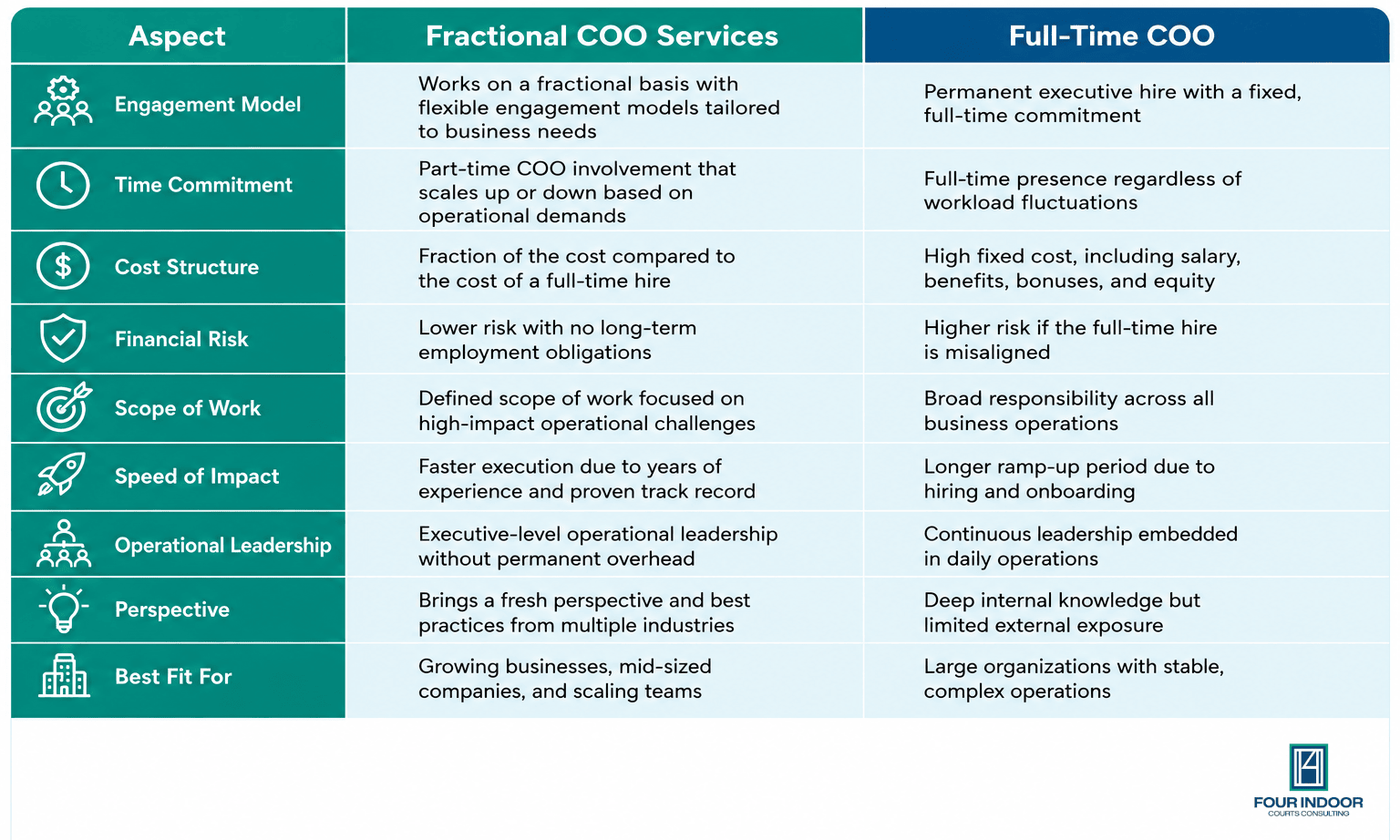
Here is the number that stops most owners cold. The cost of a full-time COO runs well past $250,000 once you add base salary, bonus, benefits, and equity. According to compensation data compiled by the U.S. Bureau of Labor Statistics, top executive pay sits among the highest of any occupation. That is before the equity stakes founders often give away to attract senior talent.
Fractional COO services typically cost $5,000 to $20,000 per month depending on scope and hours. Compare that to the fully loaded cost of a full-time chief operating officer and the math is straightforward. You get COO-level expertise for a fraction of the commitment. No severance risk, no equity dilution, no long recruiting cycle. If you’re comparing options, it’s worth reviewing how fractional support compares to traditional consulting before committing budget in either direction.
The reason this matters is timing. Many small business owners assume they must choose between doing operations themselves or making a six-figure permanent hire. In reality, there is a middle path. Cost-effective leadership on a fractional basis lets you access senior strategy exactly when scaling challenges appear. You avoid betting the budget on a role the business may not need for two years. If you’re unsure whether now is the right time, a free 30-minute Readiness Audit with Leah Norris can help you gauge where the business actually stands.

What a fractional COO actually does (core responsibilities)
The job is execution, not opinions. A fractional COO owns the operating side of the business so the founder can focus on vision, sales, and product.
Core responsibilities usually include:
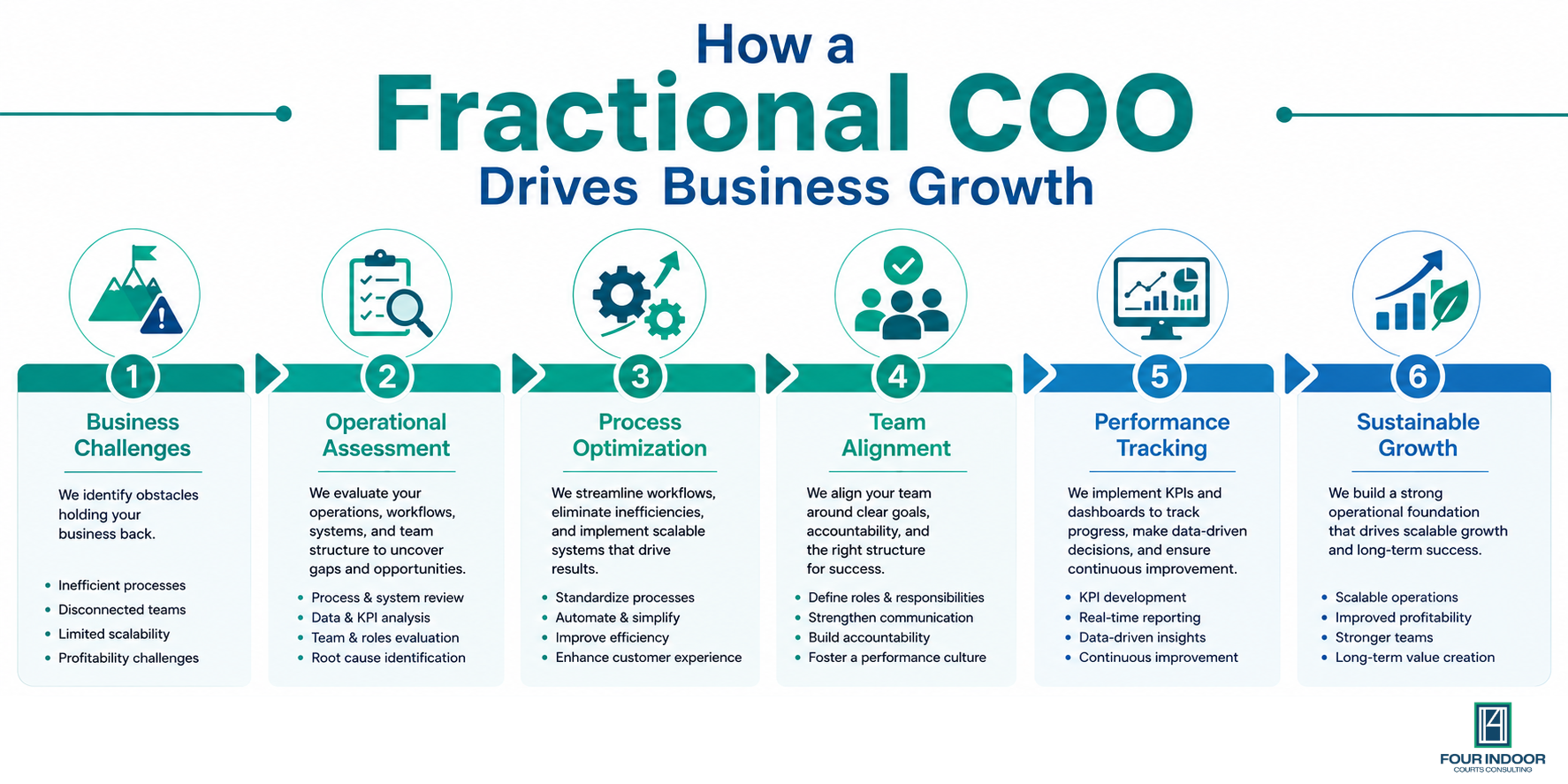
- Building business systems so work doesn’t live in the founder’s head. This covers standard operating procedures, workflow design, and process improvement across departments.
- Operations management and day-to-day operations oversight, keeping projects moving and holding teams accountable.
- KPI tracking and operational visibility, so leadership can see performance instead of guessing.
- Resource allocation and capacity planning, matching people and budget to priorities.
- Change management, guiding teams through new processes without stalling the business.
- Project execution, turning strategic planning into shipped outcomes.
A good operations consultant doesn’t hand you a binder and leave. Firms that provide process improvement and systems design, like Four Indoor Courts, build the structure alongside your team and stay to make sure it sticks. You can see the full range of our fractional COO and operational consulting services and how each piece fits together. The point of an outsourced COO is measurable results in how the business runs, not a strategy deck that gathers dust.
Benefits of hiring a fractional COO
The most immediate benefit is founder relief. When day-to-day operations stop routing through one person, the founder bottleneck loosens and decisions speed up. Founder overwhelm is rarely a discipline problem. It is a structure problem.
Beyond relief, a seasoned operations consultant brings cross-industry experience. Because these operators work with multiple companies, they have seen the same bottlenecks in a dozen contexts and know which fixes hold. That pattern recognition is hard to buy in one full-time hire.
Other benefits show up quickly:
- Operational efficiency from standardized processes and clearer accountability.
- Better decision-making through real data visibility instead of gut feel.
- Sustainable growth, because systems scale where heroics don’t.
- Flexible engagement, so support expands or contracts with the business.
The honest caveat: results vary based on leadership execution, market conditions, and how fully the team adopts the changes. A fractional COO improves operational structure and supports business growth. No one can guarantee revenue outcomes, and any advisor who promises to double your revenue is selling something.

When you need a fractional COO (signs and triggers)
You don’t need to guess. The triggers are specific.
The clearest sign is founder dependency: the business cannot function for a week without the owner answering questions. When you’re the router for every decision, that founder bottleneck slows everything down.
Watch for these signals:
- Revenue is at or approaching $1M, but operational systems haven’t kept pace.
- You’re stuck in day-to-day operations instead of strategic leadership.
- Teams rely on inconsistent workflows and produce inconsistent results.
- You lack operational visibility, so you can’t see where work stalls.
- Growth feels like chaos rather than progress.
The root cause is almost always visibility and structure, not effort. Everyone is working hard. The problem is that scaling exposes operational bottlenecks that were invisible at a smaller size. The U.S. Small Business Administration guidance on managing a growing business underscores how compounding obligations quietly increase as a company expands.
One founder-led services firm around $1.4M in revenue kept missing client deadlines. Every approval funneled through the owner, who traveled half the month. The fix was not more hustle. It was a standardized approval workflow and clear ownership, which cleared the backlog inside a quarter. That is the kind of scaling challenge a fractional COO exists to solve, easing founder overwhelm in the process. For a deeper look at a similar rescue, read about the $1M dog daycare founder’s operational turnaround.
Scaling and growth support
Growth without systems creates friction. Revenue can climb while the operational structure underneath it stays exactly where it was at half the size. That gap is where fast-growing businesses break.
A fractional COO builds the operational strategy that lets you scale your business responsibly. That means designing repeatable processes before you add headcount, not after the chaos forces your hand. It means capacity planning so a big new contract doesn’t overwhelm the team. And it means installing business systems that hold up under more volume.
Many owners assume they’ll fix operations once things calm down. In reality, growing companies rarely get a quiet stretch, so the systems have to be built while the business is moving. That is why fractional COO services work as part-time support. You get help to scale your business responsibly without pausing the growth to do it.
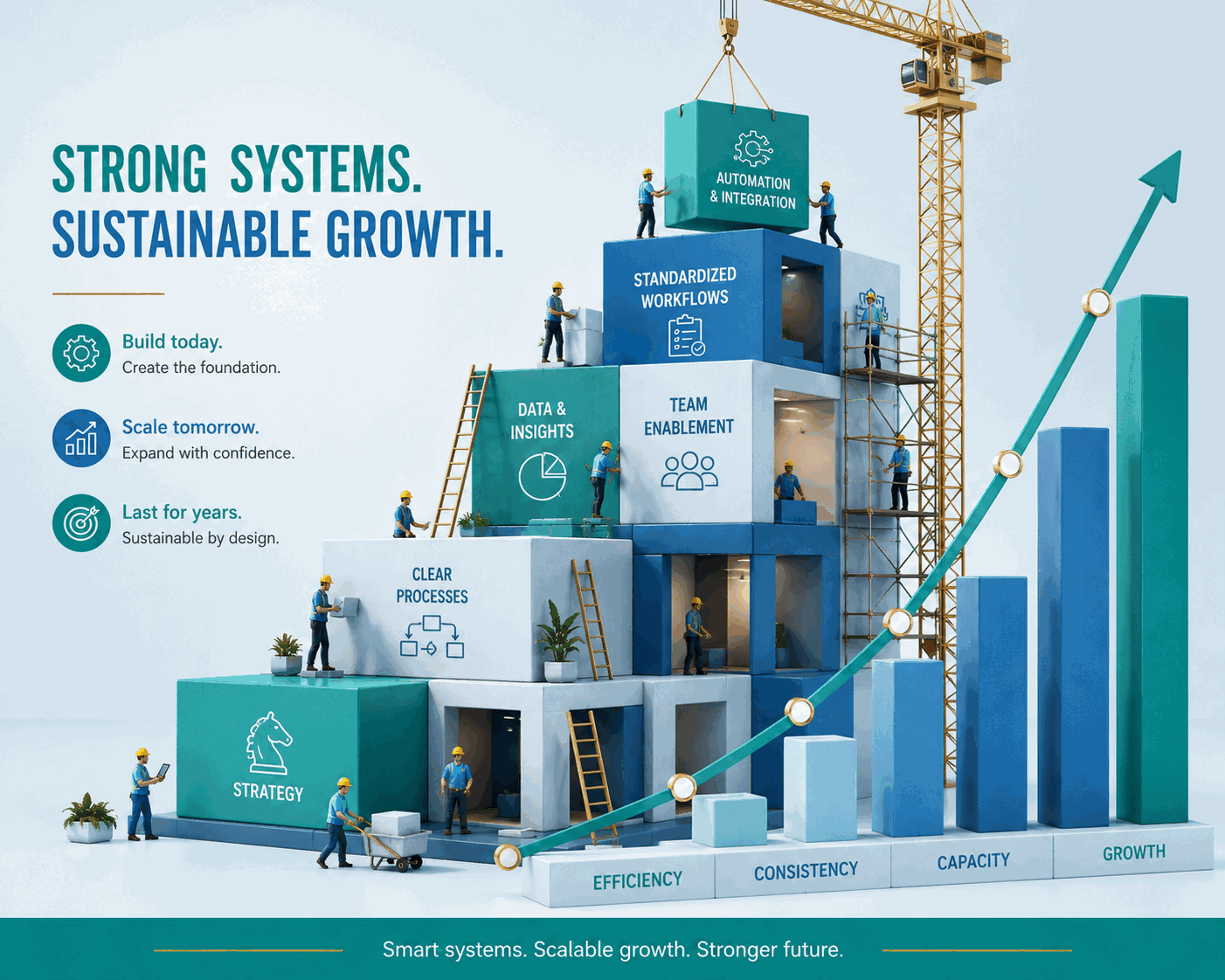
The aim is sustainable growth. Not a spike that burns out the team, but a business operations foundation that supports the next stage and the one after that.
Turning strategy into systems and execution
Strategy is cheap. Most founders already know roughly what they should be doing. The gap between knowing and doing is where businesses stall, and closing it is where a fractional COO earns their keep.
Turning strategy into systems means translating a plan into documented processes, assigned owners, and clear timelines. A goal from strategic planning like “improve client onboarding” becomes a mapped workflow, a checklist, a responsible team member, and a metric to track it. That’s the difference between an idea and an operational reality.
Execution also depends on change management. New systems fail when they’re dropped on a team that had no say in them. Strong project execution brings the team along, adjusts based on what’s actually working, and builds accountability into the routine.
Four Indoor Courts approaches this by aligning operational strategy to execution, then applying process improvement so results stay consistent as the business grows. This deeper, hands-on model is the core of The Architect fractional leadership engagement, which pairs strategy with implementation. The delegation piece matters too. Once systems exist, founders can hand off work confident it will get done the same way every time.
KPI tracking and operational visibility as a fractional COO deliverable
You cannot manage what you cannot see. Many small business owners run on instinct because they lack meaningful reporting, and instinct gets less reliable as the business gets more complex.
A core fractional COO deliverable is identifying the right KPIs and building the reporting to track them. Not a dashboard with fifty vanity metrics, but the handful of numbers that actually predict business health: cash conversion, project throughput, client retention, capacity utilization. KPI tracking turns fuzzy hunches into defensible decisions, delivering measurable results over time.
Operational visibility does something else, too. When leadership can see where work bottlenecks, resource allocation gets sharper, operational efficiency improves, and problems surface before emergencies. Four Indoor Courts provides full-funnel metrics reporting and KPI tracking so founders can decide on data instead of feel.
The mechanism is simple. Visibility exposes bottlenecks early; early detection means cheaper fixes, and cheaper fixes protect margin and steady business growth as you scale. Reporting isn’t paperwork. It’s the control panel for the whole business.

If your business is growing faster than your systems can support, the fastest way to find the friction is to look at it directly. Four Indoor Courts, led by Leah Norris, offers fractional COO services for founders approaching or scaling past $1M who need to build the operational structure their growth requires. You can book a clarity call to map your operational bottlenecks and see where structure is slowing you down.
FAQs
Q1. What does a fractional COO actually do?
A1.
A fractional COO provides part-time operational leadership, typically building the systems a growing business lacks: project management frameworks, standard operating procedures, workflow design, capacity planning, and KPI tracking. The goal is to translate a founder’s vision into repeatable operations that don’t depend on the founder to run day-to-day.
Q2. What size company actually needs a fractional COO?
A2.
Fractional COO support fits early-stage and small-to-mid-market companies that need senior operational leadership but can’t justify a full-time executive salary. For founder-led businesses, that inflection point usually arrives at or approaching $1M in annual revenue, when growth starts outpacing existing systems.
Q3. When should I consider bringing in a fractional COO?
A3.
The clearest signals are a founder buried in daily operations instead of strategy, rapid growth straining existing processes, and a lack of standardized procedures causing inconsistent results. In short, when the business feels harder to manage than it should, the issue is usually visibility and structure, not effort.
Q4. What if I hire a fractional COO and my team doesn't actually adopt the new systems?
A4.
Adoption failure usually comes from systems built in isolation, so a strong engagement starts by defining scope with the founder, then implements changes alongside the team with clear accountability. The right fractional COO measures against KPIs and adjusts, rather than handing over a binder of processes no one uses.
Q5. How is a fractional COO different from a full-time COO?
A5.
A full-time COO is a permanent executive with full-time cost and equity, best for larger or highly complex operations. A fractional COO delivers the same caliber of expertise at 10 to 20 hours per week, offering flexibility and broad cross-industry experience for businesses that need leadership without the full-time commitment.
Q6. How does a fractional COO engagement typically get started?
A6.
Most engagements begin with an assessment of your operational challenges and growth goals, followed by scope definition with the owner around processes, systems, or team management. From there, the fractional COO works part-time to implement and refine. Four Indoor Courts opens this with a free 30-minute Readiness Audit.

Founder of Four Indoor Courts Consulting, Leah Norris helps founders and growing businesses create operational clarity through fractional COO leadership, KPI-driven analytics, and scalable operational strategy. With a background spanning operations, finance, analytics, marketing, and technology, Leah specializes in helping businesses improve visibility, streamline processes, strengthen accountability, and build the operational structure needed for sustainable growth.