

A founder we spoke with hit $1.4M in revenue and still approved every refund, every hire, and every vendor contract herself. Sales were up. She was exhausted, and two department leads had quit because they couldn’t make a move without her sign-off. That bottleneck is exactly what an organizational plan is built to prevent. This article walks through what an organizational plan is, how it differs from broader strategy work, the four planning phases, and the practical steps to build one your team actually uses.

What is an organizational plan (definition and core purpose)
An organizational plan is the internal blueprint that shows how your company is structured to reach its goals and objectives: who does what, who reports to whom, and how work moves through the business. It covers your organizational structure, roles and responsibilities, resource needs, and the systems that keep operations running. The core purpose is simple. It removes the founder as the single point of decision-making, so the business can run on its own logic instead of on one person’s availability.
What many founders don’t realize is that this is a management discipline, not paperwork. The U.S. Small Business Administration walks through the same foundational structure work in its guide to writing a business plan, where organizational and management details sit right beside strategy and finance. A good organizational plan turns informal habits into visible business systems, which is the heart of building an operational excellence strategy that lasts. When roles are documented and reporting lines are clear, decisions stop stacking up on the founder’s desk. The team gains a real understanding of how the work actually gets done.
Organizational planning vs. strategic planning (how they differ)
These two get blurred constantly, and the confusion causes real problems. Strategic planning answers *where* the company is going: the three-to-five-year direction, the markets you’ll enter, the mission and vision that guide big bets. Organizational planning answers *how the company is built to get there*: the structure, the roles, the reporting lines, the resources. Strategy sets the destination. Organizational planning designs the vehicle.
Here’s the mechanism that trips people up. A strong strategic plan with no organizational plan behind it produces ambitious goals that no one is actually structured to deliver. Harvard Business Review has long argued that most strategy failures are failures of execution, not ideas, and execution is exactly what organizational planning governs. In reality, the strategic plan feeds the organizational planning process. You decide the direction first, then build the structure that carries it. Skip the second step, and your strategy stays a slide deck. The two are sequential, not interchangeable, and treating them as one is a common reason growing businesses stall.
Why an organizational plan matters for business success
Growth without systems creates friction. A business can add revenue faster than it adds structure, and that gap is where operational chaos lives: missed handoffs, unclear ownership, and a founder answering questions the team should handle. The issue usually isn’t effort. It’s visibility. When nobody can see who owns a decision, everything routes back to the top.
The root cause is founder-dependency. In the early days, one person holding every process in their head is efficient. Past a certain size, it becomes the ceiling on business growth. Understanding how to grow a small business beyond $1M revenue almost always starts with breaking that dependency. An organizational plan breaks that ceiling by distributing roles into a structure that doesn’t collapse when the founder is out for a week. It also supports sustainable growth by making the business legible to new hires, partners, and buyers. A company with clear structure and documented operations is easier to scale and easier to manage. It’s also far less prone to the founder overwhelm that quietly stalls otherwise healthy businesses.

The four types of organizational planning (strategic, tactical, operational, contingency)
The types of organizational planning stack in layers, and each one hands off to the next. Strategic planning sets the long-range direction, usually three to five years out, anchored in mission and vision. Tactical planning breaks that strategy into department-level moves for the next year: what marketing, sales, and operations each need to accomplish. A tactical plan is where the big strategy becomes assignable.
Operational planning is the ground level: the workflows and standard operating procedures that run day-to-day operations week to week. This is the layer most founder-led businesses skip, and it’s why execution feels chaotic even when the vision is clear. Contingency planning is the backup layer: what you do when a key supplier fails, a system goes down, or demand spikes past capacity. Many assume contingency planning is only for large corporations. In reality, small businesses feel disruptions harder because they have less cushion. A single lost client or unavailable operator can freeze a lean team, which is exactly why the contingency layer belongs in the plan.
Key areas and components of an organizational plan
An effective organizational plan pulls several pieces into one document. Start with mission and vision, because they set the reasoning behind every structural choice that follows. Then define your organizational structure: the departments, the reporting lines, and how authority flows. This is where you decide whether a decision needs the founder or belongs to a team lead.
Next come roles and responsibilities, written clearly enough that anyone can see who owns what. Ambiguity here is the source of most accountability gaps. The plan should also map resource needs, the people, tools, and capacity required to run each function, along with an operational budget that ties spending to work. Standard operating procedures document how recurring tasks get done, so they don’t depend on memory. Finally, the plan names its goals and objectives and the measurable targets that show whether the structure works. Miss any component and the plan describes an intention rather than a working system your team can execute against.
The organizational planning process step by step
The organizational planning process moves in a logical order, and skipping steps is where plans fall apart. First, clarify your mission and vision so every later choice has a reference point. Second, assess your current state honestly: a simple SWOT analysis surfaces where your structure is strong and where it’s leaking. A candid SWOT analysis often reveals that the constraint isn’t the market, it’s the internal structure.
Third, set your strategic goals, then translate them into a tactical plan for each department. Fourth, design the organizational structure and assign roles and responsibilities to match those goals and objectives. Fifth, allocate resources and set the operational budget. Sixth, document the operational planning details: the workflows and standard operating procedures that turn plans into daily action. If you want a more granular walkthrough, we’ve mapped a step-by-step business process optimization strategy that pairs well with this sequence. These planning process steps build on each other. The seventh step is the one businesses forget: define how you’ll monitor and adjust. Without that final loop, the whole process produces a static document instead of a living system.
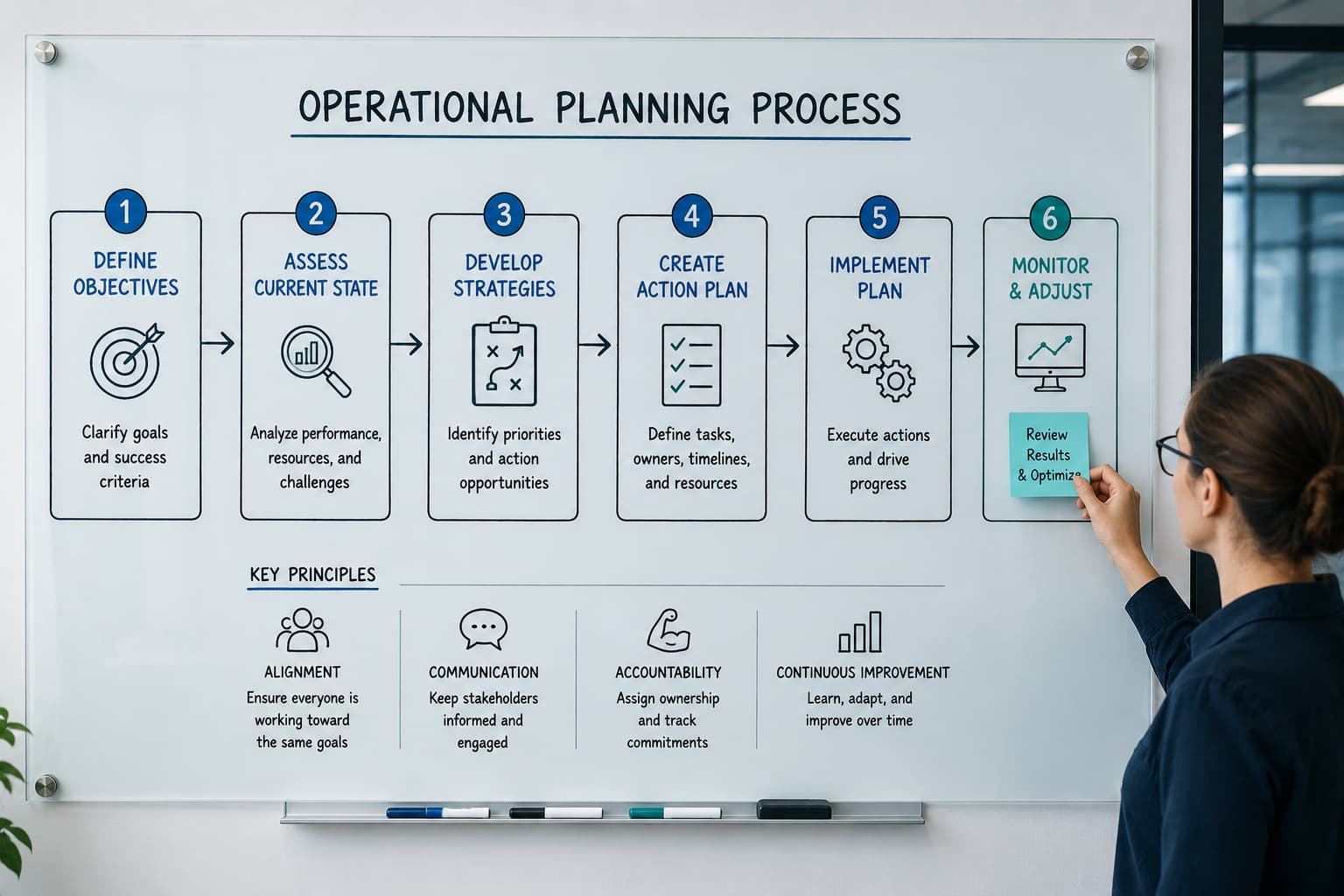
Aligning organizational structure, roles, and resources to goals
A structure that doesn’t map to your goals quietly works against you. If your strategic goal is faster order fulfillment but no single role owns fulfillment end to end, the goal has no home and nothing improves. Alignment means every business goal traces to a specific function, a specific owner, and the resources that owner actually controls.
Here’s why this matters: misalignment shows up as delay and blame, not as an obvious error. Clear ownership isn’t just an efficiency win either. When two people half-own a process, decision-making stalls and each assumes the other has it. So the practical work is drawing clean lines between roles and responsibilities, then checking that each role has the budget, tools, and authority its goals demand. This is systems and process work, and it’s where many growing businesses need outside help. Firms like Four Indoor Courts design the operational structure and standardize processes, so roles line up with business goals and systems stop depending on the founder to hold everything together.
Setting measurable goals and KPIs within the plan
A goal without a number is a wish. “Grow the business” tells no one what to do; “reduce average order-to-ship time from four days to two by Q3” does. Measurable targets convert intent into something a team can actually chase, and they let you know whether the structure you built is producing results.
KPIs are the signals you watch between goals. Pick a small set that maps directly to your business goals: revenue per employee, gross margin, customer retention, cycle time, whatever reflects the health of the functions you just organized. Our guide to identifying the right KPIs for your business breaks down how to choose signals that actually drive decisions. The mistake is tracking everything and acting on nothing. With too many KPIs, the important signals get buried in noise, and the team stops trusting the dashboard. Tie each KPI to an owner from your roles and responsibilities work, so a moving number always has someone accountable for it. Four Indoor Courts helps founders identify the right KPIs and build full-funnel metrics reporting, so leadership gets clear data instead of a spreadsheet no one reads.
Implementing, monitoring, and adapting the plan
Writing the plan is the easy part. Most plans die at implementation because the rollout has no owner and no timeline. To roll out the plan, sequence the changes, assign each one a responsible person, and set dates. Communicate the new structure clearly so people know what changed and why, then let the team operate inside it long enough to see whether it holds.
Then monitor and adjust. Review your KPIs on a regular cadence, weekly for operational metrics, quarterly for strategic goals, and treat gaps as information, not failure. Scaling exposes operational weaknesses, so expect the plan to need revision as you grow. The businesses that struggle are the ones that build a plan, file it, and never look at it again. The ones that compound are the ones that monitor and adjust in a steady loop: measure, learn, restructure, repeat. That loop, not the original document, is what actually drives improvement over time.

Organizational planning examples and templates
Organizational planning examples make the abstract concrete. A ten-person e-commerce brand might use a functional structure: separate owners for marketing, fulfillment, and customer support, each with their own KPIs and a weekly operational plan. A services firm scaling past $1M might shift from a flat structure, where the founder touches everything, to a layer of team leads who own decisions inside their function. Same principle, different structure, both driven by where founder-dependency caps business growth.
A useful organizational plan template usually contains the same sections: mission and vision, an org chart, a roles and responsibilities matrix, resource and budget allocation, standard operating procedures, and a KPI scorecard. You can adapt one from the SBA’s planning resources or build your own, but the format matters less than filling it with real ownership and real numbers. A blank template downloaded and left generic helps no one. The value comes from tailoring each section to how your business actually runs and updating it as the structure changes.
When a growing SMB needs operational leadership to execute the plan (fractional COO)
Most operational problems start when the plan is sound but no one senior owns the execution. Founders are usually experts in their product, not in operations, and building the structure while running the business at the same time is how good plans stall. This is the gap a fractional COO fills: senior operational leadership that turns the effective organizational plan into working systems, without the cost of a full-time executive hire. If you’re unsure what that role actually involves, here’s a closer look at what a fractional COO does for small businesses.
For small business owners approaching or scaling past $1M, this is often the exact inflection point. Revenue has grown, but the organizational structure hasn’t caught up, and the founder has become the bottleneck. A fractional COO steps in to design the systems, align roles to goals, and set up the KPIs that give leadership a clear operational picture. The point isn’t to hand off the vision. It’s to have an experienced operator make that vision executable, so the founder can lead instead of firefight. That relieves the founder overwhelm that stalls growth.
If your business is growing faster than your systems can support, a short conversation can help pinpoint where operational friction is slowing you down. Four Indoor Courts offers a free 30-minute Readiness Audit with Leah Norris, and you can book your operational clarity call to talk through where structure would relieve the most pressure.
FAQs
Q1. What is an organizational plan?
A1.
An organizational plan is a structured document that maps how a company is set up to hit its strategic goals, detailing roles, responsibilities, and reporting lines. It gives founders operational clarity on who owns what, so decisions and accountability don’t default back to the founder.
Q2. What are the four types of organizational planning?
A2.
The four phases are strategic (long-term direction), tactical (department-level actions), operational (day-to-day workflows), and contingency (backup plans for disruption). Most founder-led businesses have the strategic vision but skip the tactical and operational layers, which is where growth starts breaking systems.
Q3. How do I actually build an organizational plan?
A3.
Start by defining vision, mission, and values, then assess your current state, set strategic goals, develop tactical plans, align your structure, allocate budget, and build in a way to monitor and adapt. The final step matters most: without measurement and KPI tracking, the plan becomes a document nobody revisits.
Q4. What's the difference between an organizational plan and a business plan?
A4.
An organizational plan focuses on internal structure, roles, legal ownership, and how work gets done, while a business plan covers the broader picture including market strategy, financials, and funding. Think of the organizational plan as the operational backbone that makes the business plan executable.
Q5. Which organizational structure works best for a small business?
A5.
Functional structures group people by expertise like sales or operations and suit businesses with clear departments, while flat structures with minimal middle management give startups faster decision-making. The right choice depends on team size and how much the founder needs to step out of daily approvals.
Q6. What if we already have processes but no formal organizational plan?
A6.
Existing processes without a documented plan usually means knowledge lives in people’s heads, which creates fragility when teams grow or someone leaves. Formalizing the structure turns reactive, ad-hoc workflows into visible systems that scale without constant founder oversight.
Q7. How often should an organizational plan be updated?
A7.
Revisit it whenever revenue, headcount, or offerings shift significantly, and review core goals at least quarterly against your KPIs. Scaling exposes operational weaknesses, so a plan that fit at $500K often needs restructuring by the time you cross $1M.

Founder of Four Indoor Courts Consulting, Leah Norris helps founders and growing businesses create operational clarity through fractional COO leadership, KPI-driven analytics, and scalable operational strategy. With a background spanning operations, finance, analytics, marketing, and technology, Leah specializes in helping businesses improve visibility, streamline processes, strengthen accountability, and build the operational structure needed for sustainable growth.