
The corner bakery that closes after 18 months rarely makes the news. But it takes a chunk of the neighborhood’s jobs and tax dollars with it. Multiply that failure across thousands of storefronts, and you see why “why small businesses are important?” isn’t an abstract civics question. It’s a measure of whether local jobs, competition, and community services hold together. Small firms make up almost every business in the country, yet most people underestimate how much of the U.S. economy leans on them. This article breaks down the numbers, how small businesses create jobs and circulate money, and why weak systems quietly cap how far they can grow.
What is considered a small business (SBA definition)
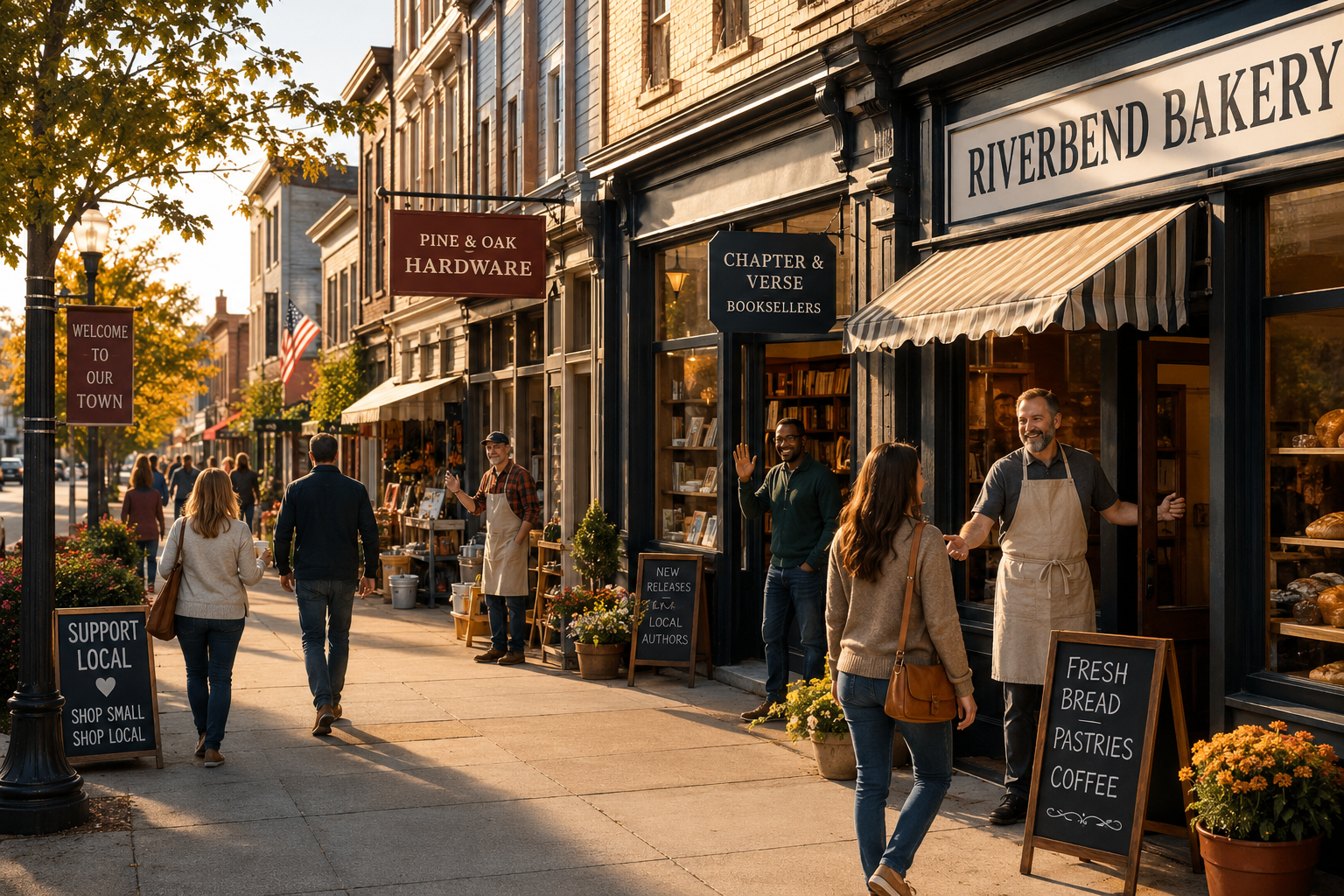
Ask ten people what is considered a small business, and you’ll get ten different answers. The federal standard is more precise than most guesses. The Small Business Administration sets size thresholds that vary by industry. The common shorthand is any independent business with fewer than 500 employees. Some industries measure size by average annual revenue instead of headcount. That’s why a manufacturer and a landscaping company can both qualify under different rules.
The Small Business Administration publishes these size standards so businesses can find out if they qualify for federal contracting and loan programs. You can review the exact thresholds in the SBA’s Table of Size Standards, which lists limits by industry code. For a broader overview of how these classifications shape the data, the SBA Office of Advocacy small business FAQ is a useful reference.
Why does the definition matter? Because it decides who counts in the statistics that shape policy. When reports say small businesses make up 99.9% of all businesses, that figure rests on the SBA definition. Many assume “small” means a solo shop with a handful of staff. In reality, a company with 450 employees and tens of millions in small business revenue still falls inside the category. That range is exactly why the small business economy is so hard to picture and so easy to underestimate.
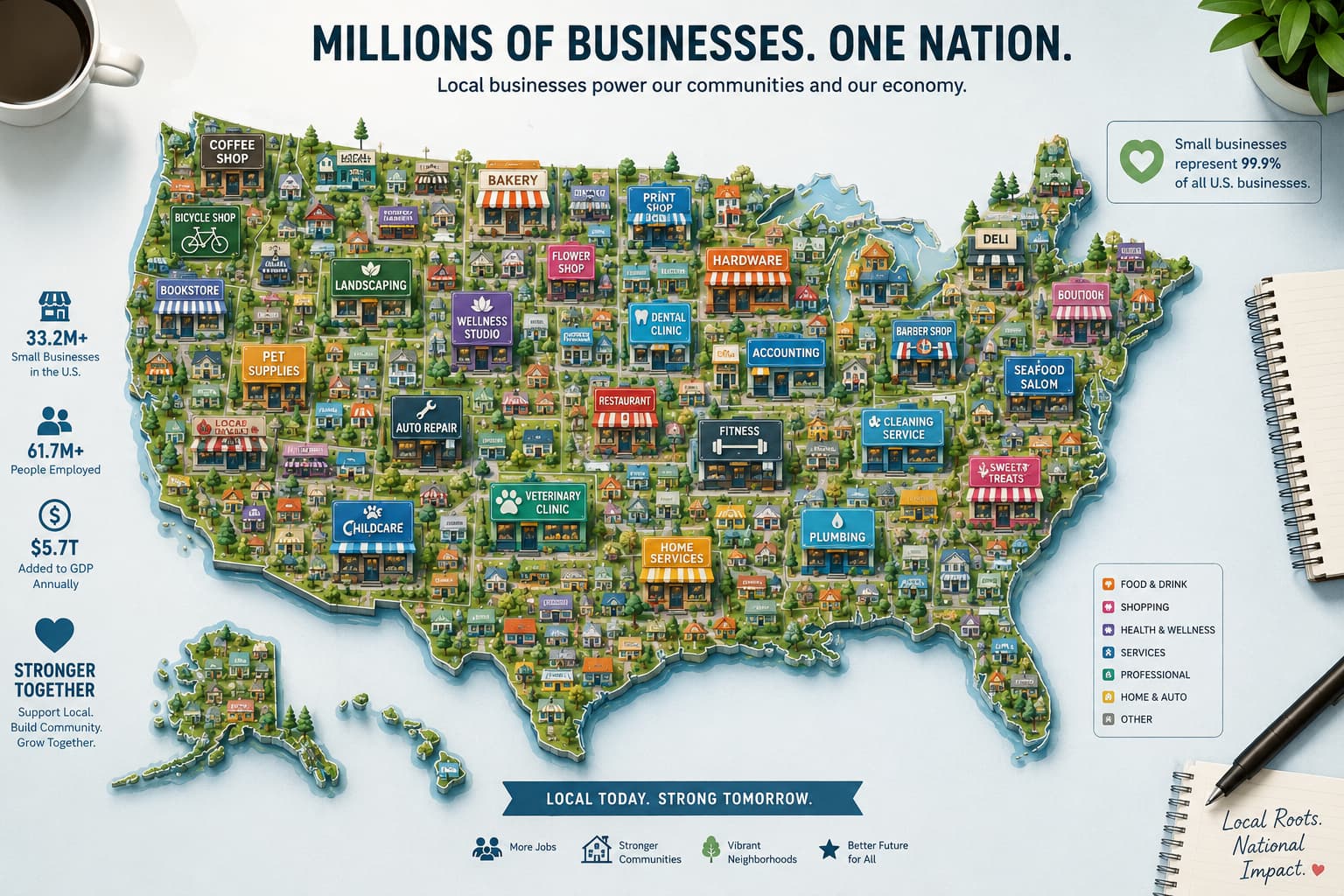
There are roughly 34 million small businesses operating across the country. They account for 99.9% of all businesses. That single statistic explains why the phrase backbone of the economy gets repeated so often. Take away small firms, and you remove nearly every employer in the U.S. economy.
These businesses employ about 62.3 million people, close to 45.9% of the private workforce. According to the U.S. Small Business Administration’s Office of Advocacy, small firms have generated a large majority of net new jobs over recent decades. That job creation is not evenly spread. The bulk of it comes from younger, growing companies rather than long-established ones.
The 99.9% of all businesses figure hides a lot of variety. Most are tiny, with no employees beyond the owner. A smaller slice, those with staff and steady revenue, drive most of the impact. The reason this matters for stability is simple. Because small firms are the backbone of the economy, employment stays spread across millions of independent owners rather than concentrated in a few corporations. A single company’s failure does less damage to the broader small business economy.
How small businesses drive innovation and diversity
Big companies have research budgets. Small ones have hunger and speed. That trade-off is why small businesses produce roughly 16 times more patents per employee than large corporations. When you’re small, you can test a product, kill it, and pivot in weeks. A large firm needs three committees to approve the same decision.
Innovation from small businesses tends to fill gaps the giants ignore. A niche software tool, a regional food product, a specialty service: these rarely start inside a Fortune 500 boardroom. They start with founders who see a problem up close and build something to fix it. That flexibility and adaptability is a structural advantage, not a lucky break.
The root cause of this innovation edge is incentive. A founder’s income, reputation, and often their savings ride on getting it right. So they move faster and take smarter risks than a salaried manager protecting a career. That pressure produces economic growth that pure size cannot replicate.
How small business revenue circulates and strengthens local economies
Where you spend a dollar decides where it lands next. Spend it at a locally owned shop and roughly $68 of every $100 stays in the local economy. Spend it at a national chain and only about $43 sticks around. The rest leaves for corporate headquarters in another state.
That gap is the local multiplier effect. It’s the mechanism behind why supporting small businesses does more than feel good. A local business banks with a local credit union, hires a local accountant, buys from local suppliers, and pays local employees who spend their wages nearby. Each transaction recycles money through the local economy instead of siphoning it out.
The economic impact compounds. When a hardware store thrives, the sign painter, the delivery driver, and the sandwich shop next door all benefit. This is why “shop small” campaigns aren’t just marketing sentiment. They redirect the flow of money back into neighborhoods.
Small businesses also protect community identity. A downtown full of independent restaurants and shops feels different from a strip of identical franchises, and that character draws visitors and residents. The economic and cultural value of local economies is tightly linked. When the small business economy weakens in a town, both the jobs and the sense of place erode together.

Small businesses’ contribution to the tax base and public infrastructure
Roads, schools, fire departments, and parks don’t fund themselves. A large share of the money comes from the local tax base, and small businesses are a major contributor to it. They pay property taxes on their storefronts, collect and remit sales taxes, and generate payroll taxes on every employee they hire.
The link between small business revenue and public services is direct. A town with a healthy cluster of small businesses collects more in local taxes. That funds the infrastructure that residents and other businesses depend on. When storefronts sit empty, the tax base shrinks, and the shortfall shows up as deferred road repairs or cut library hours.
There’s a feedback loop worth naming. Strong public infrastructure, reliable roads, safe streets, and decent schools make an area more attractive to new small business owners and the customers they need. So the tax base small businesses fund also helps create the conditions for the next wave of entrepreneurship.
This is another reason job creation and the tax base move together. Every job a small business creates adds a taxpayer and a wage-earner who spends in the local economy. The private workforce employed by small firms isn’t just working. It’s funding the public systems that keep communities running.
Key industries where small businesses thrive
Small businesses don’t spread evenly across the map of industries. Some sectors are almost entirely their territory. If you look at small business jobs by industry, construction, professional and business services, healthcare, retail, and food service consistently rank at the top for small firm employment.
Construction is a clear example. Most contractors, electricians, and specialty trades operate as small businesses, and they create jobs that can’t be outsourced. Professional services, agencies, consultancies, law and accounting practices are dominated by founder-led firms selling expertise rather than scale.
Healthcare is heavier on small operators than most people assume. Independent dental practices, physical therapy clinics, and home care providers all fall inside the small business economy. Retail and food service remain the most visible face of small business: the restaurants, cafes, and specialty shops that define a neighborhood.
What ties these industries together is proximity to the customer. Small businesses win where personalized service and local knowledge beat corporate scale. A national chain can’t match a neighborhood clinic that knows its patients or a contractor with a decade of local references. That personalized service is the durable edge that keeps small businesses competitive even as larger players expand around them.

Why supporting small businesses matters for long-term prosperity
Supporting small businesses is not charity. It’s an investment in the machinery that produces economic growth, job creation, and competitive markets. This is why supporting small businesses matters beyond any single storefront: when small firms fade, spending concentrates among a handful of large corporations. That concentration reduces the competition that keeps prices honest and quality high.
The long-term payoff runs through job creation. Small businesses have historically produced the majority of net new jobs, and those jobs anchor the middle of the economy. A country that lets its small business base thin out trades broad, distributed opportunity for narrow, concentrated market power. Founders who want to build past that point can start with these 6 steps to grow a small business past $1M, which lay out how sustained expansion actually happens.
There’s a resilience argument too. During downturns, an economy with a wide base of small businesses recovers differently than one dependent on a few giant employers. Distributed ownership spreads risk. That supports the economic growth and stability of the local economy when any single sector stumbles.
Supporting small businesses looks like practical choices: buying local when you can, but also backing policies and programs that help small business owners access capital and reduce the friction of running a business. Sustainable growth for the small business economy depends on founders getting the support to survive their early years. Much of that survival comes down to optimizing small business operations for sustainable growth, since the businesses that make it are the ones that keep creating jobs a decade later.
Why operational systems determine whether small businesses survive and scale
Here’s the part the statistics don’t show. Most small businesses don’t fail because the founder lacked ambition or the product was bad. They stall because growth broke the informal systems that got them there. A founder runs everything from memory and instinct. That works fine at $300K in revenue and breaks down at $1.5M.
Scaling exposes weaknesses. Orders slip, cash flow gets murky, the founder becomes the bottleneck for every decision, and burnout follows. The challenges small businesses face at this stage are rarely about effort. The issue is visibility. Leaders can’t see the metrics or bottlenecks clearly enough to fix them. Putting the right structure in place early matters, which is why the 7 business management systems every small business needs are worth understanding before growth forces the issue.
When Growth Outpaces Your Operations
This is where operational systems separate the businesses that scale from the ones that plateau. Picture a service firm that doubles its client load in a year but keeps tracking projects in a spreadsheet and the owner’s head. The scaling challenges pile up as missed deadlines and refunds start eating the margin the growth was supposed to create. This pattern plays out in real companies, as seen in how soaring sales exposed a failing operations gap for one $1M business.
That kind of gap between growing demand and the systems meant to handle it is exactly the problem Four Indoor Courts helps founders solve, installing fractional COO leadership and the operational systems, KPI tracking, and process improvements that turn the challenges small businesses face into a path toward sustainable growth. To learn more about the team behind Four Indoor Courts, the businesses that clear this hurdle are the ones that keep contributing to the U.S. economy for years, not months.

If your revenue is climbing but the systems underneath feel like they’re straining, that friction usually points to a structural gap, not a personnel one. A clarity call with Four Indoor Courts can help you see where operational bottlenecks are slowing your growth and map a practical path forward. You can also book a free 30-minute Readiness Audit with Leah Norris to pinpoint exactly where to start.
FAQs
Q1. Why are small businesses important to the U.S. economy?
A1.
Small businesses make up 99.9% of all U.S. businesses and generate about 43.5% of national GDP. They employ 62.3 million people, roughly 45.9% of the private-sector workforce.
Q2. How many jobs do small businesses actually create?
A2.
Small businesses create roughly two out of every three new jobs in the U.S. Between March 2023 and March 2024, they accounted for approximately 90% of net new job creation.
Q3. Do small businesses really drive innovation, or do big companies lead there?
A3.
Small businesses produce about 16 times more patents per employee than large firms. They frequently develop niche products and enter markets that larger companies overlook.
Q4. What would happen to the market if small businesses disappeared?
A4.
Their disappearance would concentrate spending among large corporations, accelerating monopolization and reducing competition. Communities would also lose local job creation and the retained dollars that fund nearby services.
Q5. Is supporting a local small business worth it over shopping at a national chain?
A5.
For every $100 spent at a locally owned business, roughly $68 stays in the community, versus about $43 at a large chain. That retained spending circulates back into local jobs, suppliers, and public services.
Q6. Why do small businesses matter more than large corporations for local economies?
A6.
Small businesses account for an estimated 60% to 80% of new jobs annually and reinvest a larger share of revenue locally. They also shape community identity by reflecting local culture and values.
Q7. If small businesses are so vital, why do so many struggle to scale?
A7.
Most founders are experts in their product or service, not operations, so growth breaks the informal systems that got them started. Scaling exposes gaps in visibility, processes, and leadership faster than teams can build structure to support them.

Founder of Four Indoor Courts Consulting, Leah Norris helps founders and growing businesses create operational clarity through fractional COO leadership, KPI-driven analytics, and scalable operational strategy. With a background spanning operations, finance, analytics, marketing, and technology, Leah specializes in helping businesses improve visibility, streamline processes, strengthen accountability, and build the operational structure needed for sustainable growth.