
The first person to leave a growing company is usually the founder’s sanity. Sales climb past $1M, the team doubles, and suddenly one person approves invoices, closes deals, and answers support tickets at 11 p.m. That is the moment small business management stops being a set of habits and becomes a real discipline. This article walks through what the job involves, the skills it demands, and why the systems that carried you to your first million quietly stop working right after you get there.

What small business management actually means (definition)
Small business management is coordinating everything that keeps a company running and growing: planning, money, operations, and people. It is the daily balancing act between what needs to happen today and where the business should be in two years. Most founders learn it by accident, one crisis at a time. That is why it feels chaotic instead of like a repeatable practice.
Think of it as four functions that never stop competing for attention. Strategic planning sets direction. Financial management keeps you solvent. Operations handle the actual work, and people management keeps the team aligned and accountable. Founders who treat these as separate silos tend to over-invest in the one they enjoy and neglect the rest.
The U.S. Small Business Administration’s guide to managing your business breaks these responsibilities into practical categories worth reviewing early. What many founders don’t realize is that management quality, not raw effort, separates a business that scales from one that stalls. Good small business management strategies turn reactive firefighting into predictable business operations. They build the operational efficiency that comes from optimizing small business operations for sustainable growth and keep a company profitable.
What a small business manager or founder-operator does day to day
A small business manager wears more hats before lunch than most corporate executives wear in a quarter. The day-to-day operations usually include reviewing cash position, approving spending, checking in with the team, handling a customer escalation, and making a handful of decisions no one else is authorized to make. That last part is the trap.
In a founder-led company, decision-making is centralized by default. Every pricing question, hiring choice, and vendor dispute funnels back to one desk. That works at ten employees and breaks at thirty. The root cause is that the founder never built the delegation structure to distribute those calls, so leadership becomes the bottleneck.
Strong business operations depend on knowing which tasks demand your judgment and which are simply urgent noise. A capable founder-operator spends less time doing the work and more time designing the business systems that let the work happen without them. That shift is the whole game.
Core skills needed to manage a small business
To manage a small business well, you need a mix of hard skills and human ones, and most founders are strong in exactly half of them. On the technical side: reading a financial statement, building a budget, designing a workflow, and setting up a basic KPI framework. On the human side: delegation, clear communication, and the discipline to hold people accountable without micromanaging.
Time management skills sit beneath it all. If your calendar is a wall of back-to-back reactive meetings, you have no room to think about strategic planning or process improvement. Leadership is not about working the longest hours. It is about deciding where your limited attention creates the most impact, especially when scaling operations stretches every day thinner.
Many assume the answer to operational chaos is hiring smarter people. In reality, sharp people inside broken systems still produce inconsistent results. The skill that matters most as you grow is turning what lives in your head into documented, repeatable business systems that anyone can follow. That single capability creates operational clarity and lets you step back.

Managing finances, forecasting, and cash flow
Cash flow is where most small businesses actually die. Not lack of demand, not weak products: 82% of failed small businesses cite cash flow problems as a cause. You can be profitable on paper and still miss payroll if receivables lag behind payables. That is why learning to manage your finances is the highest-stakes function in small business management.
Start with a daily bookkeeping habit so income, expenses, and cash flow are never a mystery. Then build financial projections that map expected cash in and out over the next 90 days. Those projections do not need to be perfect. They need to be current, because a rough forecast reviewed weekly beats a precise one built once a year. This kind of discipline is part of why Bureau of Labor Statistics data on business survival rates shows how sharply a company’s odds change in its early years.
The reason cash flow discipline matters so much is timing. Growth consumes cash before it returns it. You pay for inventory, hires, and equipment months before the revenue lands. Founders who manage their finances by watching their bank balance alone get blindsided. If cash flow visibility is your weak point, you can book a free 30-minute Readiness Audit to pinpoint where the squeezes are forming before they become emergencies. FICC’s KPI framework development and performance tracking give founders the operational visibility to spot these squeezes early, before they become emergencies.
Hiring, managing employees, and building a team
The moment you hire and manage employees, your job changes from doing to leading. Most founders delay this shift too long, then hire in a panic. That produces exactly the mismatched teams they were trying to avoid. Deliberate team management starts before the first job posting: define the role, the outcomes it owns, and how you will measure performance.
Structured HR practices are not corporate overhead. Setting clear targets, giving regular feedback, and documenting expectations correlate with higher productivity in small companies, not just large ones. According to Gallup’s State of the American Manager report, frontline management quality has an outsized effect on engagement and results. When you hire and manage employees without this structure, accountability quietly evaporates, and the founder absorbs the slack.
Delegation is the skill that decides whether your team scales your capacity or just adds to your management load. Real delegation means handing over the decision, not just the task, and accepting that it may be done differently than you would. Founders who cannot delegate stay trapped in day-to-day operations no matter how many people they hire, which is why learning delegation strategies that free founders from the day-to-day matters so much. That is founder overwhelm in its purest form, and no amount of extra hours fixes a structural problem.
Marketing, sales, and customer relationship management
Marketing and sales are the engine, but growth without systems creates friction here fast. A founder closing every deal personally hits a ceiling the moment their calendar fills. The fix is a repeatable acquisition process: defined channels, a documented sales pipeline, and a customer relationship management system that tracks every lead so nothing slips.
Marketing and sales should feed each other with data, not run on gut feel. If you cannot say which channel produces your best customers, you are spending blind. Track cost per lead, conversion rate, and customer lifetime value so decision-making is grounded in numbers rather than the loudest recent win or loss.
Customer relationship management is not just software. It is the discipline of remembering that retention is cheaper than acquisition. Consider a services firm that pours its budget into new leads while quietly losing existing clients to slow follow-up. The leaky bucket cancels the growth. Building operational clarity into your sales and retention motion turns marketing spend into steadier, more sustainable growth rather than a monthly gamble.

Strategic planning and goal setting
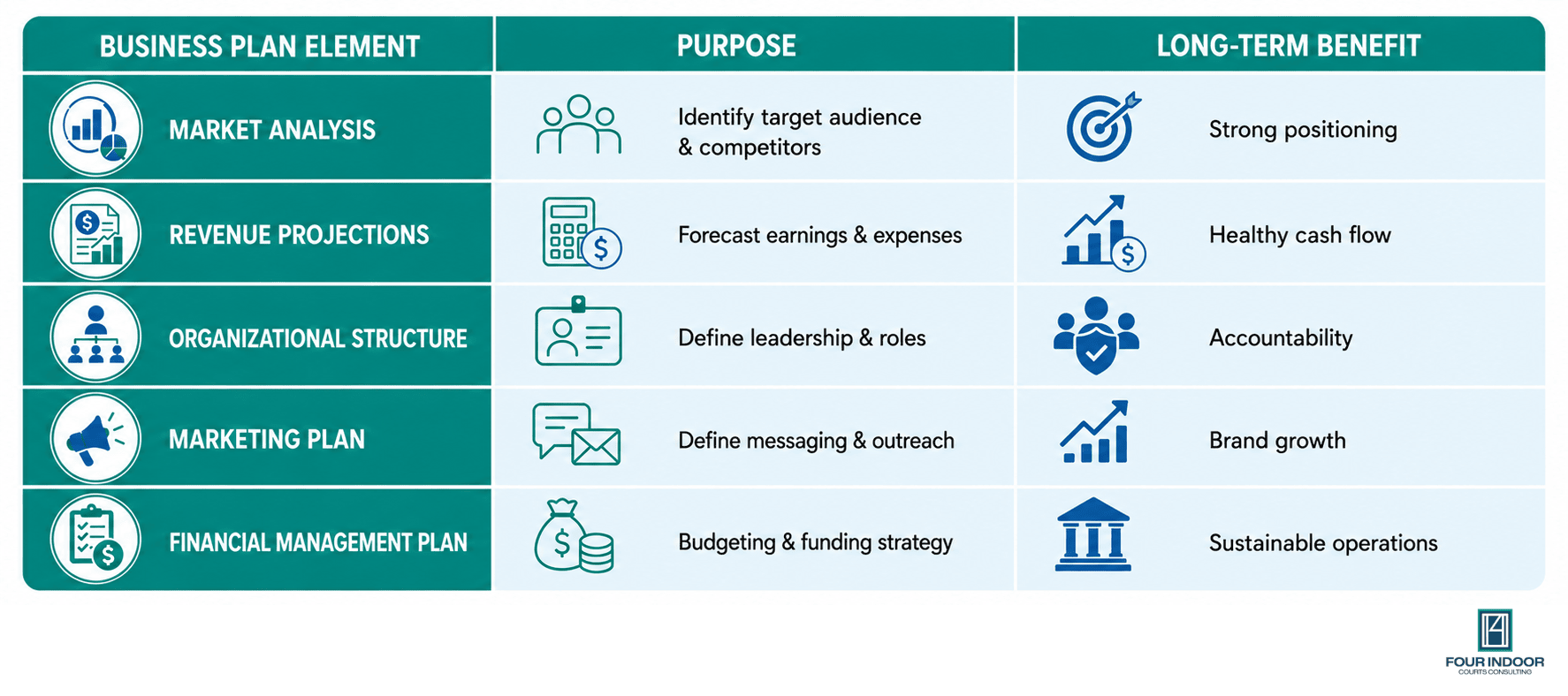
Strategic planning is the difference between a business that reacts and one that decides. Without it, every quarter becomes a scramble to hit numbers no one clearly agreed on. A real plan starts with a business plan that names where you want to be, then works backward into the systems and hires required to get there.
Good goal setting is specific and measurable. “Grow revenue” is a wish. “Add 20 recurring accounts at $2K monthly by Q3 through two new channels” is a business plan you can manage against. Strategic planning also forces trade-offs. Saying yes to one direction means saying no to three others, and founders who avoid those choices spread themselves thin.
Tie your goals to a KPI framework, so progress is visible to the whole team, not locked in your head. This is where communication and transparency matter. The point of strategic planning is the shared alignment it creates, not the document. When everyone knows the priorities, decision-making speeds up because people can act without asking you first. That alignment is what supports profitable growth instead of busy motion.
Staying legally compliant and paying taxes
Compliance is boring right up until it costs you thousands in penalties. To stay legally compliant, you need to know your business structure, your licensing requirements, and your filing deadlines. None of these forgive an honest mistake. As you grow, the obligations multiply: payroll taxes, sales tax across jurisdictions, employment law, and industry-specific rules.
Rules here vary significantly by state and by industry. Confirm your specific obligations with your state’s tax authority and a qualified accountant rather than relying on a generic checklist. Your business structure alone, whether sole proprietorship, LLC, or corporation, changes how you pay taxes and what liability you carry.
The practical move is to build compliance into your operating rhythm instead of treating it as an annual panic. Set calendar reminders for every filing, keep clean records through consistent bookkeeping, and separate business and personal finances from day one. What trips up growing companies is scale. The tax and labor rules that applied at five employees often change once you cross certain headcount or revenue thresholds. Knowing when those thresholds hit is part of responsible small business management.
Using technology and tools to manage the business
Technology utilization is where founders either buy back their time or drown in a dozen disconnected apps. The goal is not more tools. It is fewer tools that talk to each other. A tangle of spreadsheets, chat threads, and standalone apps creates operational bottlenecks because information lives in silos no one can see across.
Start with the systems that touch money and customers: accounting software, a CRM, and a project or task tool that gives the team shared operational visibility. From there, automate the repetitive work: invoicing, follow-up sequences, and standard reporting. Every manual task you automate is one less thing that depends on someone remembering, and each one is a quiet win for operational efficiency.
The reason this matters is compounding. A saved hour per week per person adds up to real capacity as you grow, and automated reporting means you make decisions on live data instead of last month’s guesses. FICC’s operational systems design and data analytics consulting help founders choose and connect the right tools so technology drives process improvement instead of adding to the chaos. Good business systems make the software useful; software alone fixes nothing.

Why management systems break as you scale past $1M
Here is the pattern almost every founder-led company follows. The informal habits that worked at $500K, the mental to-do list, the everything-runs-through-me decision-making, the team that just knows what to do, start cracking somewhere past $1M. Scaling operations exposes weaknesses that were invisible when the business was small enough to hold in one head.
What actually happens is that volume outpaces structure. More customers, more staff, and more transactions multiply decisions, and a centralized model cannot keep up. Operational bottlenecks form around the founder, cash flow becomes harder to predict, and quality wobbles because no documented process enforces consistency. The issue usually isn’t effort. It is visibility.
Picture a distribution company that triples orders in a year but never builds inventory or fulfillment systems. Shipments slip, refunds climb, and a $40K month of returns wipes out the growth. Sustainable growth requires that your business systems, KPI framework, and delegation structure grow alongside revenue. This is exactly where day-to-day operational guidance from a fractional COO can make a difference, marking the transition from founder-operator to actual business leader, which rarely happens by itself. Getting small business management right at this stage is what separates a company that scales from one that stalls.
If your business is growing faster than your systems can support, a clarity call can help pinpoint where operational friction and founder overwhelm are slowing you down. Four Indoor Courts provides fractional COO support that installs repeatable systems, KPI visibility, and senior leadership without the cost of a full-time executive. Book a free readiness audit to see where your operations stand today.
FAQs
Q1. What exactly is small business management?
A1.
It’s the practice of running a small or medium-sized company by balancing daily operations with long-term goals through strategic decisions and resource coordination. In practice, it covers four core areas: planning and strategy, financial management, operations, and people management.
Q2. What are the four main types of business management?
A2.
In a small business context, the four functional areas are planning and strategy, financial management, operations management, and people or team management. Most founders start strong in one or two of these and struggle as growth forces them to handle all four at once.
Q3. How is running a small business different from managing at a corporate level?
A3.
Small businesses are usually owner-managed with few hierarchy layers, centralized decisions, and informal communication, which keeps them flexible. Corporate management runs through multiple levels with defined roles, separated duties, and formal, standardized processes.
Q4. What should my daily management routine actually include?
A4.
Build a daily bookkeeping habit to log income, expenses, and cash flow, then review financial metrics against your budget or forecast to catch problems early. Pair that with a prioritized task list that separates urgent work from high-impact work so operations don’t run you.
Q5. Why does management quality matter so much for survival?
A5.
Formal practices like setting targets, tracking performance, and structured HR correlate with higher productivity and profitability, even in SMEs. Cash flow discipline is often the deciding factor; 82% of small businesses that fail cite cash flow problems as a cause.
Q6. Is investing in better management systems actually worth it, or is it just overhead?
A6.
Research ties structured management practices directly to measurable gains in productivity and profit, so systems act as a growth driver rather than pure overhead. The friction usually isn’t a lack of effort; it’s a lack of visibility, and systems are what create that visibility.
Q7. What if I can't afford a full-time COO but my operations are breaking down?
A7.
This is common for founders approaching $1M in revenue whose sales outpace their systems. A fractional COO gives you senior operational leadership on a part-time basis, so you get repeatable processes and KPI clarity without a full executive salary.
Q8. What skills do I actually need to manage a small business well?
A8.
You need financial competence (budgeting, cash flow, reading statements), marketing and sales fluency, and operational skills like workflow design and inventory management. These hard skills work alongside leadership abilities like delegation and clear communication.

Founder of Four Indoor Courts Consulting, Leah Norris helps founders and growing businesses create operational clarity through fractional COO leadership, KPI-driven analytics, and scalable operational strategy. With a background spanning operations, finance, analytics, marketing, and technology, Leah specializes in helping businesses improve visibility, streamline processes, strengthen accountability, and build the operational structure needed for sustainable growth.