
A ransomware attack locks your systems on a Friday afternoon. By Monday, you realize you’re the only person who knows how to process payroll, reset the accounting software, and reach your top three suppliers. That’s the gap business continuity planning closes. This guide walks through what a plan actually contains, what it costs, how to build one step by step, and why the founder who keeps it all in their head is the biggest risk to their own company.

What a business continuity plan is and why founder-led businesses need one
A business continuity plan, often shortened to BCP, is a documented set of decisions about how your company keeps running when something goes wrong. It’s not a policy manual. It’s a practical playbook: who does what, which critical operations must stay live, and how fast each one has to come back. SBA’s guidance on preparing for business emergencies frames it well: disruptions from natural disasters to cyberattacks hit small firms hardest because they have the least slack to absorb the hit.
For founder-led businesses, the stakes are sharper. Growth usually outpaces documentation, so the systems that got you to $1M live in one person’s memory. That makes the founder the point of failure. If they’re unreachable, unwell, or simply on a plane with no signal, decision-making stalls. This dynamic is at the core of business risk management for founder-dependent companies, where the biggest exposure often isn’t external at all; it’s internal reliance on one person.
A BCP forces that knowledge out of your head and into operational systems. It names critical business functions, assigns roles and responsibilities, and gives your team permission to act without you. That shift, from founder-dependent business to genuinely resilient organization, is the real point.
The real cost of having no plan: downtime, lost revenue, and founder dependency
Downtime has a price, and it’s higher than most owners guess. A day offline isn’t just lost sales. It’s payroll running while nothing gets produced, customers quietly moving to competitors, and vendors you can’t pay on time. FEMA’s Ready campaign for business has long noted that a large share of small businesses hit by a major disaster never reopen. The ones that do usually had a plan.
This matters because of cash flow. A small business rarely has enough reserves to cover weeks of disruption. Each hour compounds: a supply chain failure delays fulfillment, delayed fulfillment triggers refunds, and refunds strain the reserves you’d need to recover from the disruption in the first place. Reviewing federal continuity planning guidance makes clear just how much of this compounding effect comes down to preparation done well before the disruption hits.
Then there’s the hidden cost: founder dependency. A founder-dependent business carries an invisible liability. The whole operation can be one illness or one power outage away from freezing. Picture a distribution company doing $2M in revenue where only the founder can authorize large orders. A three-day hospital stay could mean significant stalled shipments, not because the team is incapable, but because no one else had the authority or the recovery procedures written down.
How to build a business continuity plan step by step
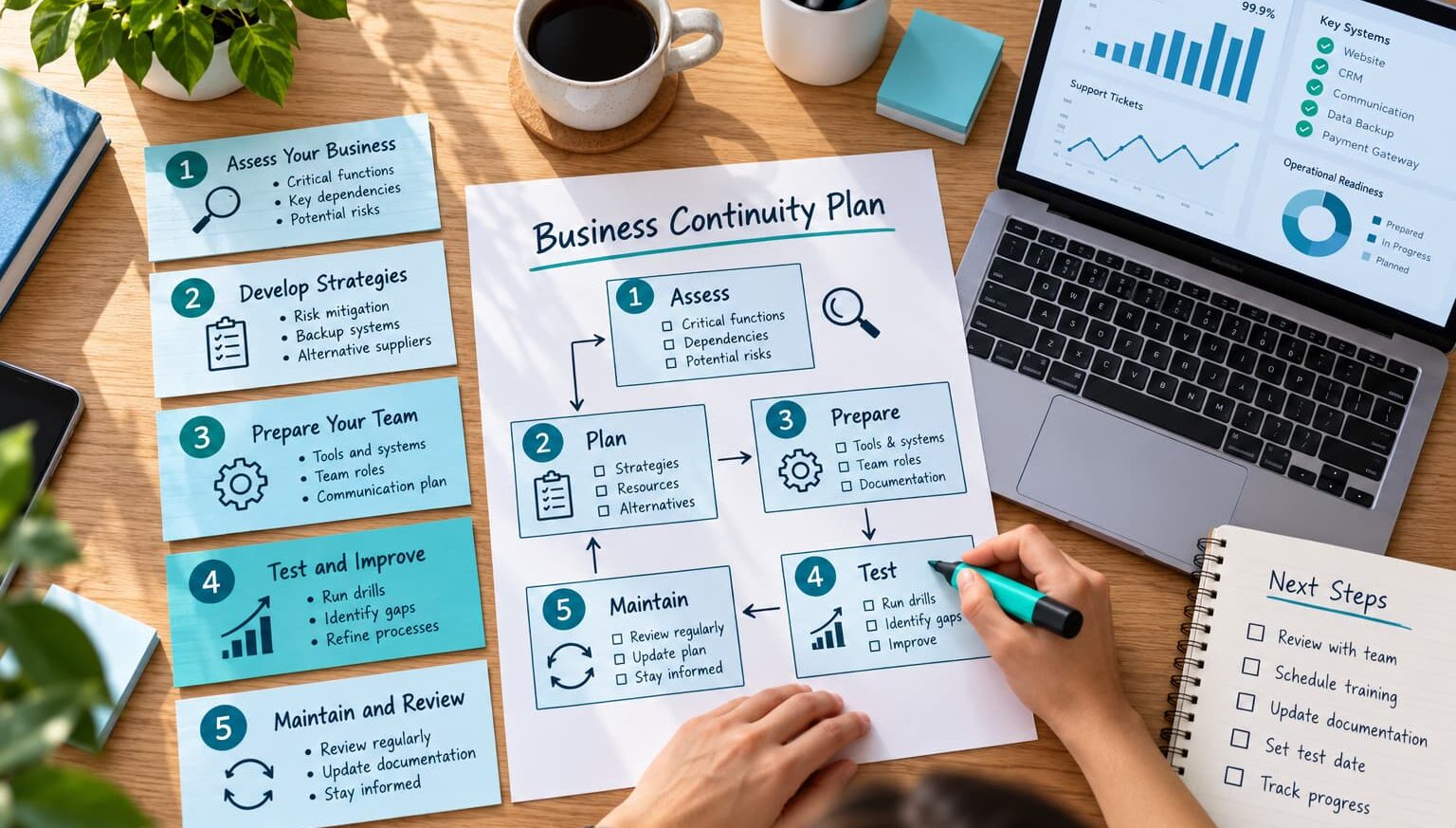
Start narrow. The instinct is to document everything, which is exactly why most plans die half-finished. Build in a sequence instead.
First, identify your critical business functions, the handful of things that, if stopped, stop the business. Second, run a business impact analysis to attach real numbers to downtime for each one. Third, complete a risk assessment covering the threats most likely to hit you: cyberattacks, supply chain failures, natural disasters, key-person loss.
Fourth, write continuity strategies for each priority function, including backup and recovery arrangements. Fifth, define communication procedures and assign a continuity team with clear roles and responsibilities. Sixth, test the plan with a live drill. Seventh, schedule reviews so the document keeps pace with the business.
You don’t need enterprise software to begin. A solid business continuity template and a shared document beat a perfect system you never finish. The reason the sequence matters is that each step feeds the next: you can’t price downtime for a function you haven’t identified, and you can’t build a strategy for a risk you haven’t scored. The goal at this stage is seeing your dependencies clearly, not producing a polished binder.
Identifying critical business functions and their dependencies
Not every task deserves a place in your plan. If it stopped for a week and nothing bad happened, it isn’t critical. The functions that matter are tied directly to revenue, cash, legal obligations, or customer trust: fulfilling orders, invoicing, paying staff, keeping your core service live.
The harder work is mapping dependencies. Every critical function leans on something else: a specific vendor, a piece of software, a login only one person holds, a single warehouse. These hidden dependencies tend to surface during business disruption, at the worst possible moment. Your invoicing depends on an accounting tool, which depends on an integration, which depends on a subscription tied to the founder’s personal card. Left unmapped, these are exactly the kind of operational bottlenecks that put a business at risk when pressure hits.
Walk each critical operation backward and list what it needs to run: people, systems, data, suppliers, physical premises. Many founders assume their bottleneck is a lack of staff. In reality, it’s usually a lack of documented dependencies. That mapping is where a fractional COO can add fast value, and Four Indoor Courts helps founders build the operational systems and process documentation that turn tribal knowledge into something the whole team can run. Clear dependency mapping is what makes every later step in the plan realistic.
Running a business impact analysis (BIA) and risk assessment
A business impact analysis answers one question: what does it actually cost when each critical function goes down, and for how long? You assign every function two numbers: recovery time, how long you can survive without it, and recovery point, how much data or work you can afford to lose. A payment system might tolerate two hours; payroll might tolerate two days.
The business impact analysis tells you where to spend first. Functions with short tolerance and high cost get the most protection. This is how you avoid over-investing in backups for things that barely matter while leaving a genuine single point of failure exposed.
The risk assessment runs alongside it. List credible threats, then apply simple risk scoring: likelihood times impact. Power outages might be moderately likely and low impact if you’re cloud-based; a cyberattack might be less likely but severe. Working through impact scenarios keeps the exercise honest and grounded in your reality, not a generic checklist. Together, the analysis and assessment point you toward where continuity strategies and spending should go.
Developing continuity strategies, backups, and response procedures
Now you decide how each critical function survives disruption. A continuity strategy is a concrete alternative. If the office is inaccessible, staff work remotely from documented cloud systems. If a key supplier fails, a pre-vetted second vendor steps in. If a key person is out, a named backup holds the login and the authority.
Backup and recovery is the foundation. Data needs automated, tested backups stored separately from your live systems, and ideally offsite. A backup you’ve never restored from is a guess, not a safeguard. Test a restore before you need one.
Response procedures spell out the first hour: who gets notified, who makes the call to activate the plan, and what the immediate steps are for each impact scenario. These recovery procedures should be simple enough that a stressed team can follow them without the founder in the room.
The root cause of most failed responses isn’t a bad strategy. It’s ambiguity in the moment: under stress, people default to waiting for permission rather than acting, so unwritten steps simply don’t happen. Written recovery procedures remove the freeze. Good backup and recovery, plus clear response steps, is what separates a bad week from a closed business.

Establishing communication procedures, roles, and responsibilities
When something breaks, silence can turn a problem into a crisis. Communication procedures decide who says what, to whom, and how, before adrenaline is running. Your plan should list contact methods that work even if email or the office phone system is down: a group text, a messaging app, printed contact cards.
Split communication into internal and external. Internally, the continuity team needs to know the plan is active and what their part is. Externally, customers, key vendors, and, for regulated firms, regulators need timely, accurate updates. Vague reassurance erodes trust faster than honest bad news.
Roles and responsibilities are where plans quietly fail. A named owner for each response task turns intention into action. Assign a plan activator, a communications lead, an IT recovery lead, and a decision-maker who can act when the founder is unavailable. Rotate a backup for each role, because the day you need the BCP is often the day someone is on vacation. This structure distributes decision-making so critical operations don’t stall waiting for one person to reappear.
Business continuity vs. disaster recovery: what’s the difference
People use these terms interchangeably, and it causes real gaps. Disaster recovery is a subset of business continuity, not a synonym.
Disaster recovery is the technical, reactive piece: restoring IT systems, servers, and data after an incident. It answers “how do we get our systems back?” It’s essential, but narrow.
Business continuity is the wider, proactive discipline. It covers people, premises, processes, and providers, keeping the whole business functioning during a disruption, not just the servers. A company can restore its IT perfectly and still fail because no one knows who can authorize refunds, or because the only person who understands the fulfillment process is unreachable.
Many teams invest heavily in backup and recovery software, then assume they’re covered. In reality, that’s disaster recovery alone, and it leaves the human and operational side exposed. A resilient organization needs both: disaster recovery to restore the technology, and business continuity to keep decisions, communication, and critical operations moving through the disruption. Treat disaster recovery as one chapter of your continuity plan, not the whole book.
Testing, training, and maintaining your plan so it actually works
A plan you’ve never tested is a hypothesis. The most common failure in business continuity planning isn’t a missing document. It’s a document no one has ever run against reality. Testing turns paper into readiness.
Start with a tabletop exercise: gather the continuity team, present an impact scenario, and walk through the response step by step. You’ll find gaps fast: an outdated phone number, a login no one has, a recovery time that was pure optimism. Then test the plan with something closer to live, like an actual data restore or a simulated key-person absence.
Training matters just as much. People execute plans they’ve practiced, not plans they’ve merely read. Everyone with a role should know it before an incident, not during one.
Then maintain it. Vendors change, staff leaves, systems get replaced. A BCP that’s twelve months stale can be worse than none, because it creates false confidence: the plan gets trusted precisely when its details no longer match reality. Set a recurring review, test the plan at least annually, and update it whenever a critical dependency shifts. Requirements vary by industry and jurisdiction, so verify your obligations with the relevant regulator or a qualified advisor.
Why founders build the plan into operational systems instead of a binder on a shelf
A binder feels like progress. It rarely is. A printed plan locked in a drawer ages instantly and gets ignored when things go sideways. The plans that survive are wired into how the business already runs.
That means continuity lives inside your operational systems: documented processes in the tools your team uses daily, backups running automatically, roles reflected in your actual org structure, contact lists that update themselves. When the plan is part of daily operations, it stays current because using the business keeps it current.
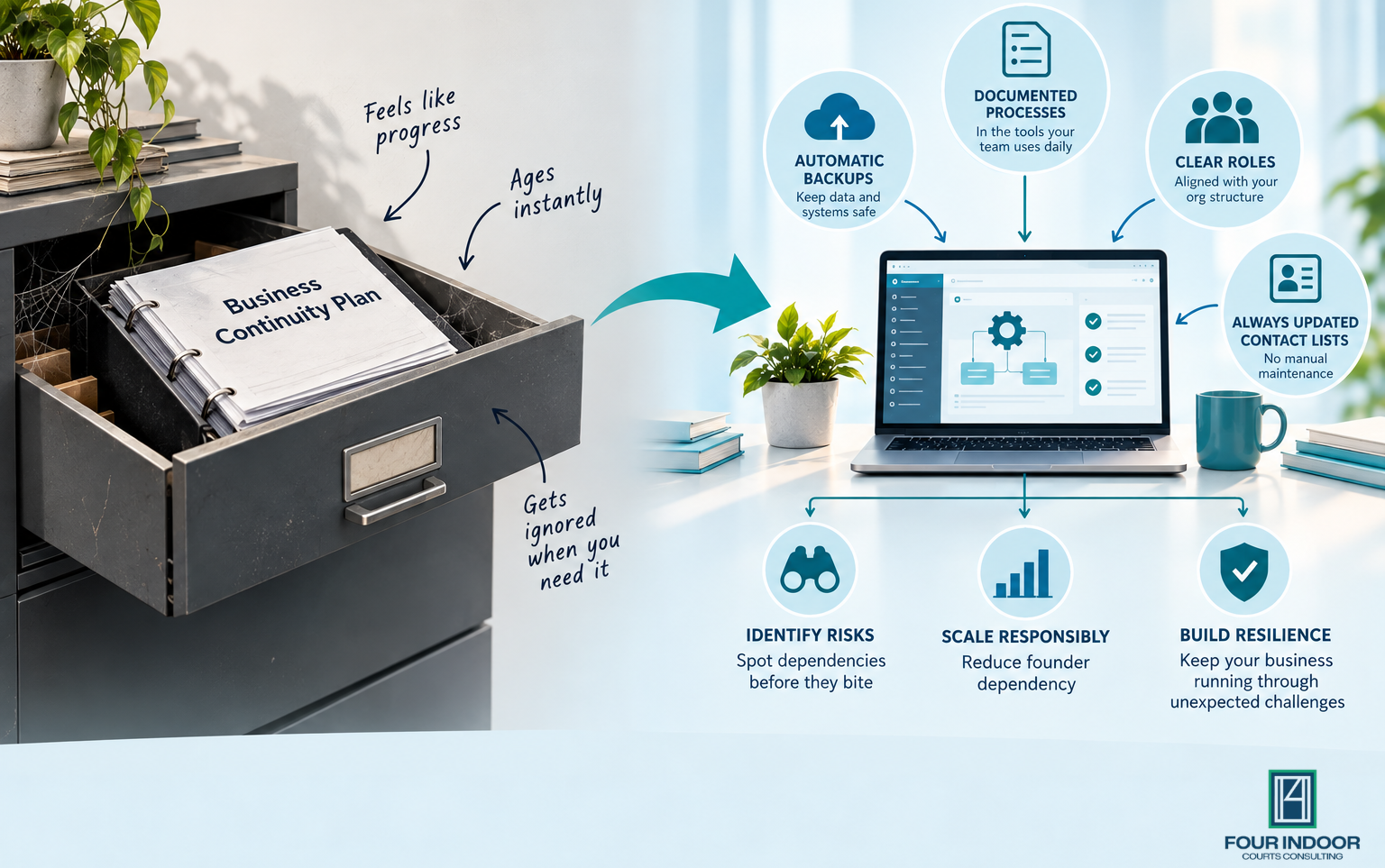
This is also how founders move away from the founder-dependent business trap. Building business continuity planning into operational systems creates visibility into dependencies before they bite, and it can help you scale more responsibly without carrying the whole company in your head. A readiness audit is a fast way to spot where a founder-dependent business is most exposed, and Four Indoor Courts runs exactly that kind of readiness audit to map critical operations and turn scattered knowledge into working systems. Fractional COO support to build resilient operations engagement can take this even further, since the goal isn’t a perfect document; it’s genuine operational resilience.
If your business would stall without you for a week, that dependency is a continuity risk worth addressing before it becomes a crisis. Four Indoor Courts offers a free 30-minute Readiness Audit with Leah Norris to pinpoint where operational fragility is hiding in a founder-led business. You can book your readiness audit here and leave with a clear view of what to fix first.
FAQs
Q1. What actually needs to go in a business continuity plan?
A1.
A working plan documents critical business functions, a business impact analysis, recovery time objectives, communication protocols, and named roles for who acts during a disruption. Most founder-led businesses miss the last part; a plan with no owner rarely gets executed when it matters.
Q2. What are the 'four Ps' people mention in business continuity planning?
A2.
They refer to People, Premises, Processes, and Providers, the four categories a plan needs to account for so operations can continue if any one of them is disrupted. For founder-dependent businesses, ‘People’ is usually the weakest link since too much operational knowledge sits with one person.
Q3. Does a small business really need a formal business continuity plan, or is that overkill?
A3.
If the business would stall without the founder for even a week, the answer is yes; that dependency is itself a continuity risk, not just a growing pain. It doesn’t need to be a 40-page document; a documented set of critical processes and decision-makers is often enough at the $1M-plus revenue stage.
Q4. What's the actual difference between business continuity planning and disaster recovery?
A4.
Business continuity planning is the broader, proactive strategy covering people, processes, vendors, and communications so the business keeps functioning during a disruption. Disaster recovery is narrower and reactive, typically focused on restoring IT systems and data after an incident has already occurred.
Q5. What if we build a business continuity plan and never actually use it?
A5.
That’s the common outcome when a plan is written once and never tested; most failures happen because the document exists but no one ran a drill against it. Plans need periodic testing and updates as the team, vendors, or systems change, not a one-time exercise.
Q6. Do FINRA-regulated firms have specific business continuity requirements?
A6.
Yes, FINRA Rule 4370 requires member firms to maintain a written business continuity plan addressing data backup, mission-critical systems, financial and operational assessments, and alternate communications with customers and regulators. This is a compliance floor, not a template most non-regulated small businesses should copy directly.

Founder of Four Indoor Courts Consulting, Leah Norris helps founders and growing businesses create operational clarity through fractional COO leadership, KPI-driven analytics, and scalable operational strategy. With a background spanning operations, finance, analytics, marketing, and technology, Leah specializes in helping businesses improve visibility, streamline processes, strengthen accountability, and build the operational structure needed for sustainable growth.