
A founder approves a new hire because the team “feels stretched.” Six months later, revenue hasn’t moved, but payroll has climbed 15%. That’s the hidden cost of running a growing company on instinct: the decisions that worked at $300K start quietly draining you at $1.2M. Data-driven decision-making is what fills that gap. It gives leadership a way to see what’s actually happening before the numbers force the issue. This article walks through what the practice means, how it differs from gut-based choices, why it matters for business growth, and how founders can start small without buying a reporting stack they don’t need yet.

What is data-driven decision making (definition and core concept)
What is data-driven decision making? At its simplest, it’s the practice of using tracked metrics and evidence, rather than gut feelings, to guide business choices tied to clear business goals. Rather than deciding whether to raise prices because it “seems right,” you look at conversion rates, margin by product line, and customer acquisition costs. Then you decide based on what those numbers show.
The core concept rests on three moving parts: data collection, data analysis, and data interpretation. You gather relevant data from your sales, operations, and finance functions. You analyze it for patterns, then interpret what those patterns mean for a specific decision. This is sometimes called evidence-based decision-making or fact-based decision-making, and the labels overlap.
Many assume this requires a data science team. In reality, it starts with picking a few performance metrics and tracking them consistently. The U.S. Small Business Administration’s guidance on market research and competitive analysis shows how even early-stage owners can use real figures to size up demand and pricing before committing resources.
Data-driven vs. intuition/gut-based decision-making
Intuition-based decision-making isn’t worthless. A founder’s instinct is pattern recognition built from years of watching the business, and early on, that instinct is often fast and useful. The problem is scale. Gut feelings work when one person can see every order, every client, every missed deadline. Past a certain size, they can’t.
What actually happens is this: as the company grows, the founder’s field of view shrinks relative to the operation. Decisions still rest on intuition-based decision-making, but that instinct now covers only a fraction of what’s happening. That’s where errors compound.
Data-driven decisions don’t replace judgment; they inform it. Harvard Business Review has covered how analytics changes the way leaders make decisions, noting that the shift is less about technology and more about leadership habits, and that companies that embrace data-driven decision-making tend to perform well on measures like productivity and profitability. The practical difference: intuition answers “what do I think is happening,” while data answers “what is actually happening.” You need both, but the second gets harder to fake as you grow.
Why data-driven decision-making matters for business growth
Growth without systems creates friction, and nowhere is that clearer than in decision-making. When a founder-led business crosses $1M in revenue, the number of decisions multiplies while the founder’s capacity to make them well stays flat. Data-driven decision-making helps keep decision quality from degrading as volume rises, even as business objectives grow more complex.
This matters for business growth because every decision made without evidence carries risk, and risk compounds. A pricing error at $500K costs you a few thousand dollars. The same error at $3M, applied across a larger customer base, can cost you a department’s worth of profit. Data-driven decisions can shrink that risk by catching problems in the numbers before they hit the bank account.
It also supports sustainable growth. Founders who rely on data for business decisions tend to catch bottlenecks earlier, scaling structure alongside revenue instead of letting one outrun the other. That’s the mark of a data-driven company, and the difference between growth that feels controlled and growth that feels like chaos.

Key benefits of data-driven decision making
The benefits of data-driven decision-making go beyond “better choices.” The most immediate is operational visibility: when leadership can see performance metrics in one place, problems stop hiding in individual departments. That visibility, the kind measuring performance consistently, is often what founders are missing when the business starts to feel harder to run than it should.
A second benefit is speed with accountability. Data-backed decisions can be delegated because the metrics make it clear what “good” looks like. That can loosen the leadership bottleneck where every call routes back to the founder, since a shared metric reduces the need for the founder to personally verify each judgment call before it moves forward.
Other benefits of data-driven decision-making show up in specific functions. Marketing spend gets tied to customer acquisition cost instead of guesswork. Hiring decisions get anchored to capacity data rather than a vague sense of being busy. Profitability becomes something you measure per client or per product, not a year-end surprise.
The underlying theme is that data turns opinions into shared facts. When a leadership team works from the same key performance indicators, meetings get shorter, and decisions get made faster. The issue usually isn’t effort; it’s visibility, and data provides it.
The core components and process of data-driven decision making
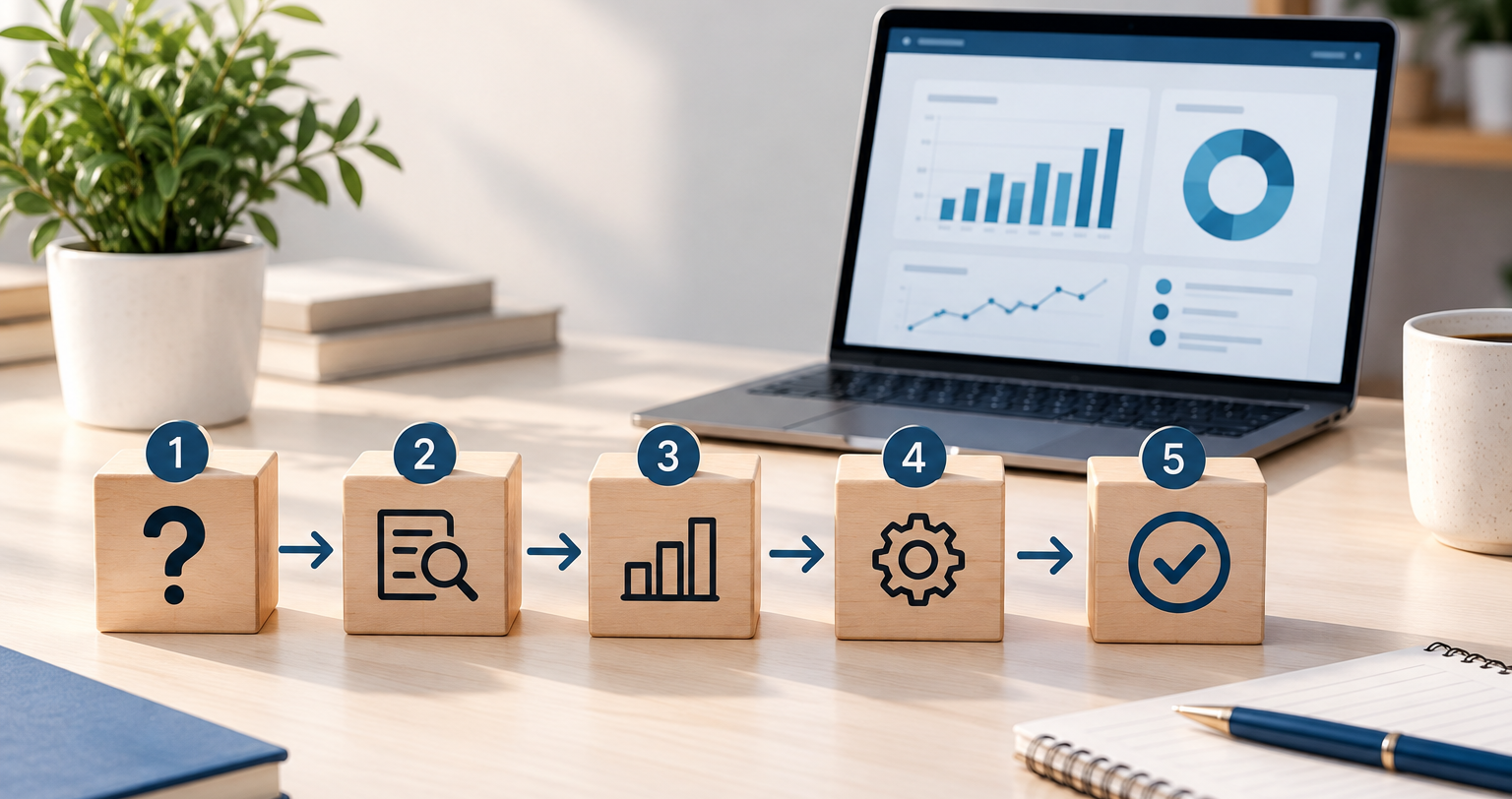
A workable decision-making process has five core steps, and you don’t need software to run them. First, define the decision clearly: what are you actually choosing between, and by when. Second, gather relevant data from the data sources that touch that decision: sales records, operational logs, financials.
Third is data analysis. Look for patterns, not single data points. One bad week isn’t a trend. Fourth, interpret and act: data interpretation is where you weigh what the numbers suggest against context the numbers can’t capture, then make the call. Fifth, measure the outcome and feed it back.
That last step is where Lean and Six Sigma practitioners add discipline. In the DMAIC framework, the “Control” phase exists specifically to keep a decision accurate after it’s made, by monitoring whether the expected result actually held. A common reason “data-driven” efforts fall short is skipping this loop. The decision gets made, nobody checks it against reality, and the business learns little.
Treat decisions as revisable, not final. That’s what separates a data-driven business, and a genuinely data-driven company, from one that just collects reports.
How to implement data-driven decision-making step by step
Implementing data-driven decision-making works best when you start narrow. Pick one recurring decision that costs you real money- pricing, staffing, or marketing spend- and build the habit there before expanding.
Step one: name the three to five key performance indicators that drive that decision. It helps here to understand metrics that aren’t real KPIs and what to track instead, since many founders track numbers that feel important but don’t actually drive decisions. Step two: establish data collection you can actually sustain, even if it’s a shared spreadsheet updated weekly. Consistency beats sophistication early on. Step three: set a fixed cadence to review the numbers, a standing weekly or monthly slot where the leadership team looks at the same data together.
Step four: assign ownership. Each metric needs an owner, or the data quietly rots. Step five: close the loop by comparing predicted outcomes to actual ones.
Building a data-driven culture is the harder, slower part of implementing data-driven decision-making. It’s also one of the clearest ways to confront the challenges of data-driven decision-making head-on. People default to gut feelings under pressure. A clear KPI dashboard and a routine around it can help keep the habit alive. For founders juggling this alongside everything else, Four Indoor Courts builds KPI dashboards and performance-metrics frameworks so leadership has one view to act from, instead of scattered reports.
Tools and technologies that enable data-driven decisions
The tools matter less than founders expect. Plenty of data-driven companies run on a spreadsheet and discipline before they ever buy a platform. That said, the right analytics tools and other software can remove manual work and reduce errors as you scale.
At the entry level, a well-structured spreadsheet plus your existing accounting software covers most early needs. The next tier is a KPI dashboard tool thatautomatically pulls from multiple data sources, so nobody spends Monday morning copying numbers between tabs. Above that sit business intelligence platforms that handle larger volumes and more complex data analysis. If you’re still working out which numbers belong in that dashboard, it’s worth reading about building a KPI dashboard to centralize your business data before choosing a tool.
A common misconception: more powerful tools automatically produce better decisions. They don’t. A business intelligence platform fed by inconsistent data collection just produces polished mistakes faster, because the platform can only surface patterns in the data it’s given; it can’t correct for what was never tracked or was tracked incorrectly. The tool’s job is to make relevant data visible and current, not to make the decision for you.
Choose based on your data acumen and your team’s. If nobody can interpret a complex report, a simple dashboard that everyone understands will likely drive more useful decisions than an expensive system nobody opens. Match the tool to the decision-making process you can actually maintain.
Key business areas and functions where data informs decisions
Almost every function in a growing business benefits from data, but a few show the clearest payoff. In sales and marketing, data ties spend to customer acquisition and reveals which channels actually convert, so budget stops flowing to whatever felt effective last quarter.
In operations, data exposes bottlenecks: which process stage slows down, where rework happens, which jobs run late. This is where measuring performance directly helps protect profitability, because an unseen bottleneck quietly caps your capacity.
In finance, data interpretation turns cash flow and margin into forward-looking decisions instead of rear-view reporting. Here are a few examples of data-driven decisions across functions: adjusting pricing based on margin-by-product analysis, reallocating marketing budget toward the channel with the lowest acquisition cost, or restructuring a team after capacity data shows a role is consistently overloaded.
Hiring is one of the highest-stakes areas. Consider a service firm that hires a second account manager on the founder’s instinct that the team is “slammed,” only to find the real constraint was an onboarding process, not headcount. Data on actual capacity would have pointed that spend toward process improvement instead.
How founders can start with simple KPI visibility instead of complex analytics
Small business founders don’t need a data platform to get started. They need visibility into a handful of numbers that actually move the business. Start with the metrics tied directly to your business objectives: revenue per client, churn or retention, lead response time, and gross margin. Four numbers, tracked weekly, will tell you more than a sprawling report nobody reads.
The point of simple KPI visibility is to build the habit before the infrastructure. A weekly scorecard encourages a routine of looking at real data instead of operating on gut feelings between fires. Once that routine sticks, you expand.
Many founders don’t realize that complex analytics often slow decisions at this stage. More dashboards mean more to interpret, and more places for the signal to get buried, which is itself one of the challenges of data-driven decision-making worth watching for. Keep it lean until the volume of decisions genuinely outpaces what a simple scorecard can support.
Tie each metric to a business goal, assign an owner, and review it on a fixed cadence. That’s data-driven decision-making at a founder’s scale: practical, low-cost, and sustainable, built to serve business goals rather than vanity metrics.

When data-driven decisions expose operational bottlenecks in founder-led businesses
Here’s what tends to happen the moment founders start tracking data seriously: the numbers surface problems that were always there but invisible. A retention metric reveals clients are churning after month three. A capacity report shows one department carrying twice the load of another. Data doesn’t create bottlenecks; it just stops hiding them.
For founder-led businesses, this is often uncomfortable. Many owners assume their issue is “we need better employees.” In reality, the data usually points to a broken process or an unclear structure, not a personnel problem. Scaling exposes operational weaknesses that smaller volume used to mask. Picture a founder who discovers, after finally tracking lead response time, that half of all inbound leads sit untouched for three days because no one owns follow-up; the “sales problem” the founder assumed existed was actually a structure problem the data had been masking all along.
This is also where data-driven decisions reveal the limits of the founder’s own capacity. When every bottleneck traces back to decisions routing through one person, the fix is structural, not another spreadsheet. The Architect fractional COO engagement exists for exactly this gap, translating what the data exposes into systems the team can run without the founder.
If your business is growing faster than your systems can keep up, a short conversation can help pinpoint where the friction actually sits. Book a free readiness audit with Four Indoor Courts to get a clear read on which bottlenecks your data is pointing to, and what to fix first. Many founders start by claiming a free 30-minute Readiness Audit to walk through exactly where their numbers are hiding problems. Results vary based on leadership execution, market conditions, and operational implementation.
FAQs
Q1. What does data-driven decision-making actually mean for a small business?
A1.
It means a founder bases choices, pricing, hiring, and marketing spend on tracked metrics like CAC, LTV, and conversion rates, not gut instinct alone. For founder-led businesses past $1M, this usually requires a dashboard that pulls data from sales, operations, and finance into one view.
Q2. What are the steps in a data-driven decision-making process?
A2.
Most frameworks compress to five core steps: define the decision, gather relevant data, analyze it for patterns, choose and act, then measure the outcome. Lean and Six Sigma practitioners often add a feedback loop (similar to DMAIC’s ‘Control’ phase) so the decision gets revisited as new data comes in.
Q3. Is data-driven decision-making worth it for a business under $1M in revenue?
A3.
At that stage, the return is more about avoiding costly mistakes than optimizing at scale; one bad hire or pricing error can set a small business back months. Even a simple weekly scorecard of 3-5 KPIs gives an owner-operator more leverage than relying on instinct alone.
Q4. What if my business doesn't have clean or complete data?
A4.
Most founders start this way, and the fix isn’t a perfect system, it’s picking 2-3 metrics that are already trackable (revenue per client, churn, lead response time) and building consistency from there. Waiting for ‘perfect data’ before deciding is itself a decision, and usually the wrong one.
Q5. Why is data important for business decision-making specifically at the $1M-plus stage?
A5.
Past $1M, founders typically can’t personally monitor every function, so decisions made without data tend to repeat the same bottlenecks instead of fixing them. Data visibility replaces the founder’s intuition-based oversight with metrics the whole leadership team can act on.
Q6. Does data-driven decision-making mean removing human judgment from the process?
A6.
No, data narrows the options and reveals patterns, but a founder or leadership team still has to interpret context data can’t capture, like team morale or market timing. The goal is informed judgment, not automated decisions.
Q7. What's the difference between data-driven and data-informed decision-making?
A7.
Data-driven treats metrics as the primary basis for a decision, while data-informed uses data as one input alongside experience and qualitative context. Most founder-led businesses operate closer to data-informed, since they lack the data volume larger companies use for purely data-driven models.
Q8. What happens if a founder keeps making decisions without data as the company grows?
A8.
Problems that were manageable at $500K in revenue- inconsistent pricing, unclear team priorities- tend to compound once the business crosses $1M and the founder can no longer see everything firsthand. This is typically when operational bottlenecks surface across multiple departments at once, not just one.

Founder of Four Indoor Courts Consulting, Leah Norris helps founders and growing businesses create operational clarity through fractional COO leadership, KPI-driven analytics, and scalable operational strategy. With a background spanning operations, finance, analytics, marketing, and technology, Leah specializes in helping businesses improve visibility, streamline processes, strengthen accountability, and build the operational structure needed for sustainable growth.