
A founder sells the business as a “turnkey operation,” then spends the first month of the earn-out period on daily calls because nobody wrote down how fulfillment actually works. That gap has a price, and it shows up at the worst possible moment. Business process documentation is the unglamorous work of getting what lives in a founder’s head onto paper so the team can run without them. This article covers what it is, why founder-led companies keep putting it off, how to actually do it, and which processes to tackle first.

What is business process documentation (plain-language definition)
What is process documentation, in plain terms? It’s the written record of how a task gets done, step by step, including who does it, what tools they use, and why each step exists. Think of it as the instruction manual for a repeated activity in your business, whether that’s issuing an invoice, closing a deal, or shipping an order.
Process documentation sits alongside related ideas like standard operating procedures and a knowledge base. The core purpose is simple: make a process repeatable by anyone with the right training, not just its inventor. If you’re starting from scratch, it helps to understand how to create operational processes and procedures before you try to document anything at all.
Good documentation captures the process as it actually happens, not the idealized version nobody follows. The American Society for Quality offers a useful primer on process management fundamentals that shows how mapping tools turn messy reality into clear steps. At its core, documenting business processes answers one question for the next person: how do I do this correctly without asking anyone?
One caveat worth naming early: certain processes carry documentation obligations that aren’t optional. Payroll, tax handling, employee records, and data privacy steps are governed by rules that vary by state and industry, so check requirements with your accountant, an employment attorney, or the relevant agency rather than relying on a general template. The U.S. Small Business Administration and your state’s labor and revenue departments are the right starting points for what you must record and retain.
Why business process documentation matters for founder-led businesses
Most operational problems start when a business grows faster than the systems holding it together. In a founder-led company, the founder often is the system. That works at ten customers. It breaks at a hundred.
The root cause is simple: undocumented knowledge can’t be delegated. If the only copy of your fulfillment process lives in one person’s memory, every handoff becomes a conversation, every new hire becomes a shadowing exercise, and every vacation becomes a risk. Business process documentation is what makes delegation possible without quality dropping off a cliff. In fact, undocumented processes often create hidden bottlenecks that founders don’t notice until growth exposes them.
There’s a real cost here too. A piece from Harvard Business Review on why companies fail to get value from their data points to a recurring theme: value stalls when the underlying work isn’t codified so others can act on it. The U.S. Small Business Administration’s guidance on managing business operations echoes the same theme, and SCORE’s research on standard operating procedures for small businesses makes a similar case for why written procedures protect small companies specifically. For founders, the payoff is operational visibility and a path to scale without being the bottleneck for every decision.
Core benefits: preserving knowledge, consistency, and scalability
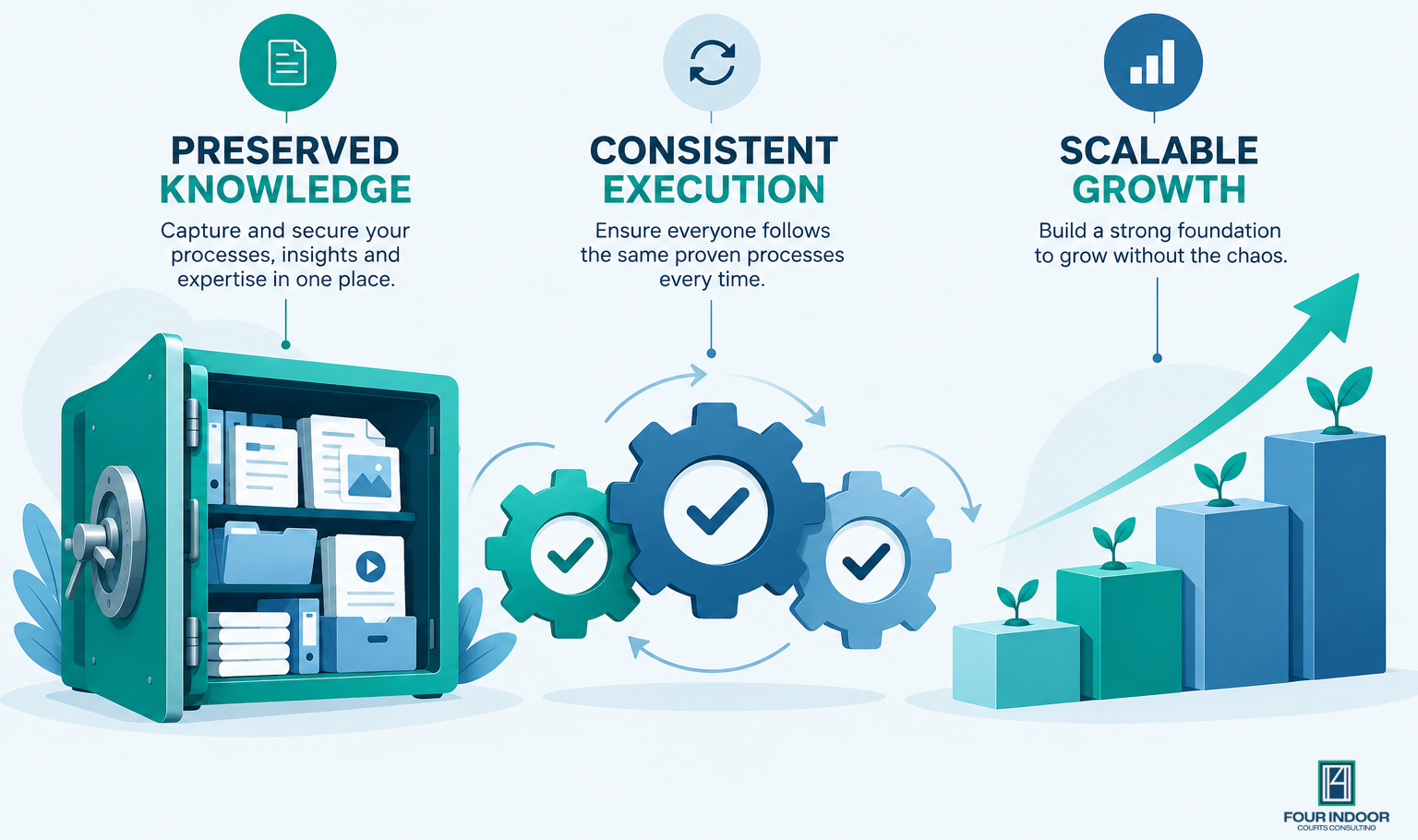
The process documentation benefits that matter most to a growing company come down to three things.
First, preserving institutional knowledge. When a key employee leaves, their replacement inherits a written record instead of a mystery. The knowledge stays even when the person doesn’t. This matters because departures are rarely planned around your readiness, and steps that existed only in one person’s head leave with them the day they do.
Second, consistency. A documented workflow, often built on standard operating procedures, means the fifth customer gets a similar experience to the five hundredth. That consistency builds a reputation you can scale, not a lucky streak. Organizations looking for a rigorous model for this kind of consistency often reference the NIST Baldrige framework for performance excellence, which ties documented processes directly to measurable quality outcomes.
Third, scalability. Repeatable processes are a foundation for more sustainable growth, because you can train, hire, and expand against a known standard rather than reinventing the work each time. This is where operational efficiency can compound: every documented process reduces the friction of adding the next person.
There’s a quieter benefit too: accountability. When you write down steps and ownership, it’s clear who’s responsible when something slips. That clarity is often the first thing founders notice after documenting business processes.
Why founders keep avoiding process documentation (the real reasons)
Nobody avoids documentation because they think it’s useless. They avoid it because it feels like it can wait.
The honest reasons are predictable. It’s slow work with no immediate payoff. The founder already knows how to do the task, so writing it down feels obvious. During fast growth, a fire always feels more urgent than a flowchart.
Here’s the misconception worth killing: many founders assume documentation is overhead that belongs at big companies. In reality, the smaller and more founder-dependent the business, the more expensive it is to keep everything in one head. Founder overwhelm isn’t usually a time problem; it’s a visibility problem. You can’t hand off the work because nobody else can see how it’s done.
What actually happens is the founder becomes the operational bottleneck by default. Every question routes back to them, decisions stall when they’re out, and the business stays stuck at a ceiling set by one person’s available hours. Avoiding documentation feels efficient in the moment. It quietly caps how far the business can grow.
Common challenges and pitfalls of process documentation
Documenting a process is easy to do badly. The process documentation challenges that trip up most teams are predictable, which means they’re also avoidable.
The first pitfall is over-documenting. A forty-page manual for a three-step task never gets read. The second is under-documenting, where a vague bullet list assumes knowledge the reader doesn’t have. Finding the right level of documentation is a judgment call, and most teams miss on one side or the other.
A bigger trap: writing documentation that only makes sense to the author. If you built the process, you unconsciously fill in gaps, which is why an untested document almost always has holes. The reason is straightforward: the author’s memory silently supplies the missing steps, so the gaps stay invisible until a fresh reader hits them.
The last common pitfall is treating it as a one-time project. A process changes. If the document doesn’t change with it, it rots. Within a few months, people stop trusting it, and you’re back to asking the founder. Stale documentation is sometimes worse than none, because people follow outdated steps with confidence.
The step-by-step process of documenting a business process
Process documentation follows a reliable sequence, and skipping any step tends to produce a document nobody uses.
Start by identifying the process and defining its boundaries, where it begins and where it ends. Then map the current steps exactly as they happen now, not the cleaned-up version. A simple process flowchart works well here for anything with branches or handoffs.
Next, assign an owner, document the tools and decision points, and capture the why behind steps that aren’t obvious. This is the heart of capturing the process: the context that keeps people from skipping or misapplying a step.
Then comes the step most teams skip: testing. Hand the document to someone who didn’t build it and watch where they get stuck. Every stumble is a gap. Revise based on what you find.
Finally, treat the result as a living document with a review schedule. If you’re pursuing structured process improvement, the DMAIC methodology (define, measure, analyze, improve, control) pairs naturally with documentation. It gives you a framework for continuous improvement, not a one-off cleanup.

Deciding the right level of detail for your documentation
More detail is not better. The right level of documentation is the minimum needed for a trained person to execute the task correctly without asking for help.
A useful test: match the detail to the risk and the audience. A high-stakes task done by a new hire, like processing a refund or closing month-end books, needs step-by-step precision with screenshots. A routine task handled by an experienced specialist needs a short checklist, not a tutorial.
The reason this matters is practical. Over-documented processes don’t get maintained, and they don’t get read. Under-documented ones generate exactly the questions you were trying to eliminate. Both failures push work back toward the founder.
A simple rule: write for the person with the least context who will realistically do this job. If that’s a brand-new team member, be explicit. If it’s a seasoned operator, trust them and keep it tight. Revisit the level of detail during reviews, because a process now handled by juniors may need more explanation than when it was yours alone.
Who should be involved and who should be assigned roles and responsibilities?
The person who does the work should write the first draft. They know the real steps, the workarounds, and the exceptions that a manager watching from a distance would miss. Documentation written by someone who’s never done the task reliably misses the messy parts.
But a draft isn’t a system. Someone needs to own the structure, choosing the tools and templates for standard operating procedures the whole team will use, making sure formatting stays consistent and reviews actually happen. In founder-led businesses, this ownership role is exactly where a fractional COO fits, bringing operational leadership to help turn scattered notes into a coherent set of business systems. Four Indoor Courts works with founders on this kind of systems design, installing the structure so documentation becomes an asset instead of a pile of abandoned files, often guided by The Advisor’s day-to-day operational guidance to keep the work on track between formal reviews.
Clear roles and responsibilities prevent the common failure where everyone assumes someone else is keeping documents current. Name a writer, name a reviewer, and name an owner. That accountability is what keeps the whole effort alive past the first burst of enthusiasm.
Which processes to document first when scaling past $1M
You can’t document everything at once, and you shouldn’t try. Prioritize the processes that touch revenue, customer experience, and founder time most directly.
For most companies crossing $1M, that’s five areas: sales, customer onboarding, fulfillment or service delivery, finance and invoicing, and hiring. These are where mistakes cost the most and where founder dependency usually runs deepest. Document these first and you address some of the biggest sources of operational bottlenecks. These come first because they combine high frequency with high stakes, so a single undocumented gap gets repeated dozens of times before anyone catches it.
Picture a services company at $1.5M where only the founder knows how to scope and price a project. One good month of inbound leads, and the founder becomes the constraint on every proposal, delaying deals by days. Documenting that single process frees the team to quote without waiting, and the impact can show up quickly.
Process improvement should be targeted, not total. Start where founder time leaks and where inconsistency hurts customers. For teams that want help prioritizing, Four Indoor Courts runs a free 30-minute Readiness Audit, using proven tools and templates to pinpoint which processes are creating the most operational friction before you invest the effort.

How documentation reduces founder dependency and operational bottlenecks
Here’s the mechanism in plain terms. Every undocumented process is a question that eventually routes to the founder. Documentation cuts that routing. The answer lives in the document, not in a text message to the owner at 9pm.
That shift does two things. It restores operational visibility, because written processes make it easier to see where work stalls and who’s accountable for each step. It also breaks the pattern where leadership bottlenecks slow everything down, since decisions tied to a documented standard can often be made by the team without escalation.
The result is real delegation, not delegation in name only. When you capture the steps, tools, and the why, a team member can own a task outright. That’s how founder overwhelm starts to ease and how team efficiency can improve without anyone working longer hours.
None of this guarantees smooth scaling, and results vary based on leadership execution, market conditions, and how consistently the documentation is maintained. But the direction is a sound one: repeatable processes move the business toward operational efficiency and give founders room to work on the business instead of in it. Business process documentation, maintained with a clear owner, is one of the operational investments that keeps paying off as the team grows.
If your business is growing faster than your systems can support, friction usually starts with documentation. Four Indoor Courts helps founders scaling past $1M build the business systems and operational structure that reduce dependency and help restore control. You can book a clarity call with Leah Norris to identify where operational bottlenecks are slowing your growth.
FAQs
Q1. What does business process documentation actually look like in practice?
A1.
It typically includes standard operating procedures (SOPs), workflow diagrams, checklists, and role-based process maps that show who does what, in what order, and with which tools. For example, a customer onboarding process might be documented as a step-by-step checklist paired with a flowchart showing handoffs between sales and operations.
Q2. What are the 5 W's used in documenting a process?
A2.
The 5 W’s, who, what, when, where, and why, ensure a process is documented with enough context for someone unfamiliar with it to execute it correctly. Missing even one, like ‘why’ a step exists, often leads to employees skipping steps they don’t understand the purpose of.
Q3. What are the 5 core business processes most companies document first?
A3.
Most founders start with sales, customer onboarding, fulfillment or service delivery, finance/invoicing, and HR/hiring, since these touch revenue and customer experience directly. Documenting these five first reduces the most common sources of founder dependency and team error.
Q4. What are the 7 steps for documenting a business process?
A4.
The general sequence is: identify the process, define its scope and boundaries, map the current steps, assign ownership, document tools and decision points, test it with a team member who didn’t build it, and revise based on gaps found. Skipping the testing step is the most common reason documentation fails to get used.
Q5. What if the business changes faster than the documentation can keep up?
A5.
This is common in founder-led businesses scaling quickly, and it usually means the documentation was written too rigidly or wasn’t assigned an owner responsible for updates. Treat documentation as a living asset, reviewed quarterly or after major process changes, to keep it from going stale.
Q6. Does documenting processes slow down a fast-moving team?
A6.
Initially, yes, mapping a process takes time away from execution, which is why many founders avoid it. But teams that skip this step tend to lose more time later to inconsistent output, retraining, and the founder re-explaining the same task repeatedly.
Q7. Who should own business process documentation inside a company?
A7.
Ideally, the person closest to executing the process writes the first draft, while a operational leader, often a fractional COO in founder-led companies, owns the overall structure and ensures consistency across departments. Without a single owner, documentation often exists in scattered, outdated versions across different tools.

Founder of Four Indoor Courts Consulting, Leah Norris helps founders and growing businesses create operational clarity through fractional COO leadership, KPI-driven analytics, and scalable operational strategy. With a background spanning operations, finance, analytics, marketing, and technology, Leah specializes in helping businesses improve visibility, streamline processes, strengthen accountability, and build the operational structure needed for sustainable growth.