
The first $1M in revenue is usually built on the founder’s back: long hours, personal relationships, and the ability to make every decision fast. Then the same effort that got you here starts working against you. Learning how to scale a business is less about doing more and more about building the systems, team structure, and visibility that let it run without you touching every part of it. This playbook walks through what changes past $1M, how to tell if you’re ready, and the steps small business owners need to scale a business responsibly. If you’re navigating growth past the $1M mark, the challenges ahead are predictable, and preparing for them separates founders who break through from those who stall.

Why growth stalls after $1M: the systems that got you here won’t get you there
Most operational problems start when volume outgrows the informal habits a founder used to run everything by memory. Below $1M, you can hold the whole business in your head. Past it, that same instinct becomes the ceiling. Growth without systems creates friction: orders slip, quality wobbles, and the founder becomes the bottleneck for every decision.
The root cause is simple. Early success rewards heroics, and heroics don’t scale. Scaling a business hits a point where operational bottlenecks and inefficiencies pile up faster than revenue can absorb them, exposing the scaling challenges that stayed hidden while volume was low. The reason is mechanical: informal habits carry no capacity buffer, so the first surge in volume consumes all the slack the founder used to rely on. The U.S. Small Business Administration’s growth stage guidance points to the same pattern: growing companies need repeatable processes and clear roles before they can sustain expansion.
Past this point, you rely on systems, not instinct- a shift many small business owners resist at first. That shift is uncomfortable because it asks founders to trade control for capacity. But every founder who breaks through the $1M ceiling makes it: the business has to work without them in the room. U.S. Census Bureau data on small business survival and growth shows that businesses that persist past early-stage revenue milestones tend to formalize their operations rather than lean harder on the founder. Knowing how to scale a business, then, starts with accepting that operational clarity must replace personal effort as the engine of growth.
Signs your business is ready to scale (and signs it isn’t yet)
Ready to scale looks like this: predictable demand, stable profit margins, documented repeatable processes, and a team that can execute without the founder approving every step. If revenue is climbing but you’re personally busier than ever, that’s founder overwhelm, not readiness, a common symptom for founders trying to scale a business without the underlying structure.
Not-yet signs are just as clear. Cash gets tight during busy periods. Quality drops whenever you’re out for a week. Nobody besides you has real operational visibility into performance, so decision-making stays with one person. If any of that sounds familiar, the foundation isn’t there yet. Scaling exposes weak spots, so scaling before you fix them amplifies them. The mechanism behind this is straightforward: more volume flows through the same weak points, so a small crack under low load becomes a break under high load.
A useful gut check: track your working capital. Harvard Business Review’s work on the challenges of growth shows that overtrading, growing sales faster than cash can support, sinks many otherwise healthy businesses. Many assume readiness is about ambition or market opportunity. In reality, it’s about whether your business systems can absorb more volume without breaking. If they can’t yet, that’s a fixable gap, not a verdict, and it’s exactly what a free 30-minute Readiness Audit is designed to uncover before you commit to a growth push.

Step-by-step playbook: how to scale a business past $1M
Scaling a business is a sequence, not a leap. Work through these steps in order:
- Build a rolling 90-day cash flow forecast and keep business and personal finances fully separated so funding gaps surface early.
- Identify your single biggest bottleneck, whether it’s sales capacity, delivery, or cash, and fix that one first.
- Document your core processes for continuous process improvement so they no longer live only in your head.
- Define the KPIs every business should track for your model, and set up simple reporting for real visibility.
- Delegate the first layer of decisions with clear accountability, not just tasks.
- Productize your service into a scalable business model with predictable delivery.
- Monitor and adjust monthly, tightening the processes that break as volume rises.
Do these in sequence, since each step builds on the next rather than standing alone. The order matters because each step depends on the one before it: you can’t delegate decisions cleanly until you document processes, and you can’t productize until you know which parts of delivery repeat. Founders who try all seven at once usually stall on step one, because cash pressure forces them back into firefighting.
Build systems, not heroics: reducing founder dependency
Founder dependency is the single biggest thing blocking most companies from scaling past $1M. Here’s why it matters: a business where every decision routes through one person can only grow as fast as that person’s bandwidth, and bandwidth doesn’t scale.
Picture a service company doing $1.4M with a founder who still approves every proposal and handles every escalation. Growth slows the moment the founder takes a two-week vacation, and one missed renewal window can cost a five-figure contract. The fix isn’t a better founder. It’s business systems that let the work happen without them. This is precisely the scenario explored in how one $1M business stabilized operations to keep scaling, where sales growth had outpaced the operational foundation needed to support it.
Building those systems means writing down how things get done, so quality doesn’t depend on who’s in the room. This is where a fractional COO fits: it installs senior leadership without the cost of a full-time executive hire, giving a founder-led business the structure larger competitors already have, which is the real value of operations support for a company at this growth stage business owners recognize as a turning point. Four Indoor Courts embeds fractional COO leadership into growing businesses to build the systems and KPI frameworks that reduce founder dependency and help restore the founder’s calendar.
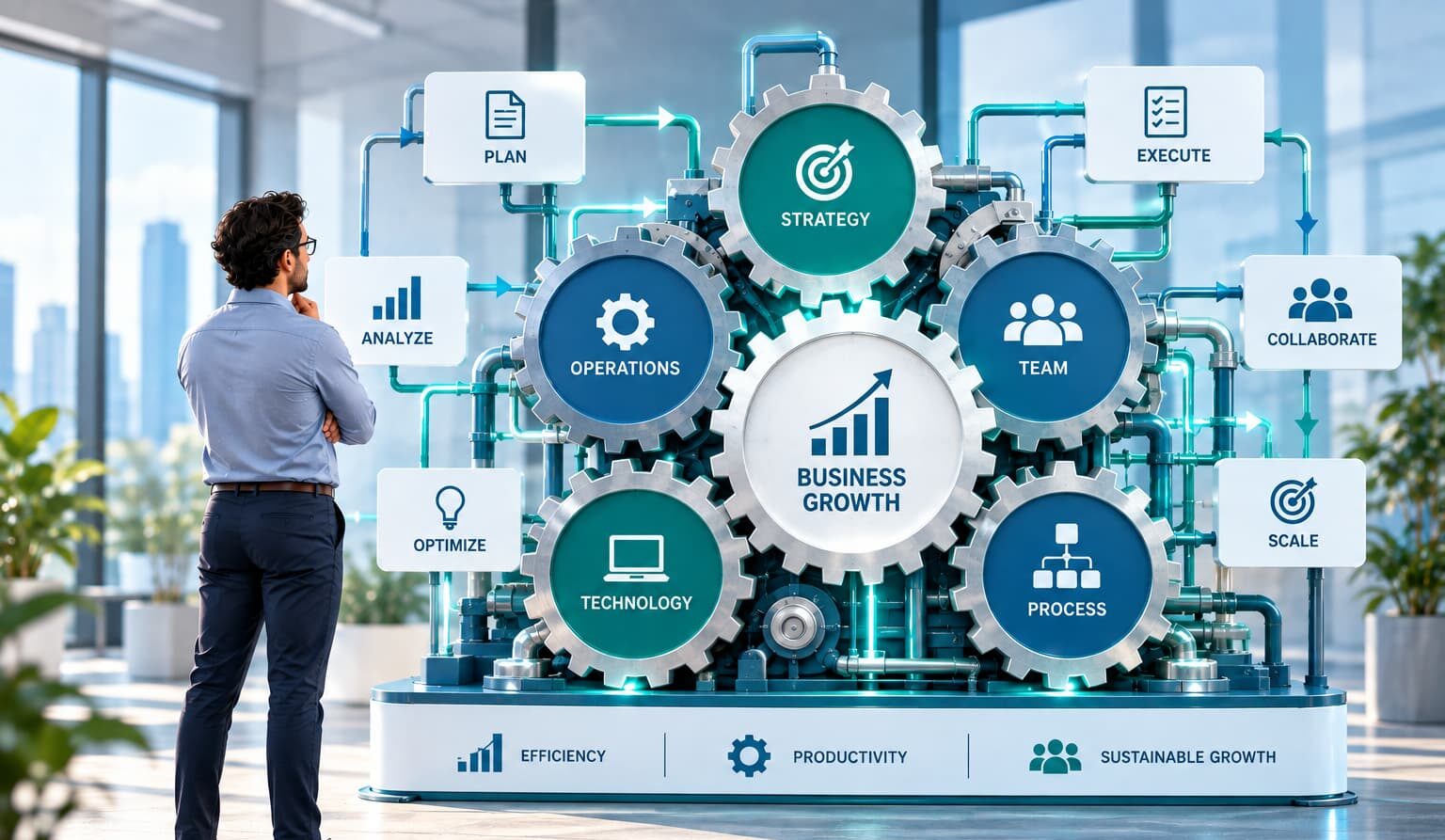
Delegation, team structure, and accountability as you scale
You can’t scale your business if delegation means dumping tasks and hoping. To delegate effectively, hand over outcomes plus the authority to make decisions about them, then hold people accountable to clear metrics. Most founders skip the authority part, which is why delegated work keeps bouncing back to their desk. The reason is causal: without decision authority, a team member has to escalate every judgment call, so the founder stays in the loop by design.
Team structure matters more than headcount at this stage. At this stage, a business needs defined roles with owners for each function, not a flat group all reporting to the founder. Accountability is what makes team structure real: every important number should have one name attached to it.
Many small business owners assume they just need better employees, but scaling a service business rarely comes down to talent alone. In reality, most personnel-looking problems are structure and accountability gaps, one of the most common scaling challenges founders face. A capable person inside a broken system still misses targets.
Practical accountability frameworks are exactly what senior operational support helps put in place, so decision-making under pressure stops landing on the founder alone. That’s the difference between a team that executes and one that waits for instructions. For founders scaling beyond this stage, The Integrator package is designed to build that layer of accountable leadership underneath the founder.
The metrics and KPIs that tell you scaling is working (ROI, margins)
The issue usually isn’t effort; it’s visibility. If you can’t see your numbers weekly, you can’t tell whether scaling is working or quietly draining cash. Operational efficiency starts with the same tracking that gives you real visibility into performance.
Start with the KPIs every business should track: gross and net profit margins, cash runway, customer acquisition cost, and average order value. For a service business, add utilization and delivery cycle time. Rising revenue with shrinking profit margins is a warning, not a win, and tracking these metrics early usually reveals you’re buying growth instead of scaling it, because rising costs eat the extra revenue faster than it comes in.
ROI is where the case for structured support shows up. A published survey of 87 companies reported that nearly all respondents felt coaching returns exceeded the investment, and one Microsoft case study cited a 670% ROI from executive coaching. Figures like that reflect the effect of installing durable business systems, not motivation, though results vary widely by company.
Data and analytics support helps founders build reporting that surfaces problems before they hurt margins. Consider a founder who only reviews financials quarterly: a slow margin slide can run for months before anyone notices, and by then the fix is far more expensive than a weekly check would have made it. When you can see the numbers, you can monitor and adjust with intent instead of guessing. Results vary based on execution and market conditions, but visibility is the constant that separates steady, sustainable growth from a spurt that stalls.

Productizing and standardizing your service offering to scale profitably
Custom work is where service businesses go to plateau. Every bespoke project resets the process, so nothing compounds. To productize your service, package your offering into defined tiers with fixed scope, standard deliverables, and known costs, moving toward a scalable business model rather than one-off engagements.
Standardizing doesn’t mean rigid. It means repeatable processes for the 80% that’s the same every time, so your team’s judgment can focus on the 20% that’s genuinely custom. This kind of process improvement directly supports profit margins, because predictable delivery means predictable costs.
Quality standards have to exist before volume rises, not after customers notice a problem. Many companies that scale well use frameworks like Lean or Six Sigma to catch quality drift early. The mechanism is simple: a documented standard makes deviation visible, so you fix it before it reaches the customer.
Productizing also makes delegation easier, because a standardized offering is far simpler to hand to a team than a custom one. That’s how owners scale a service business without personally scoping every engagement.
Your next step: the 30-minute Readiness Audit and how to start
Getting started doesn’t mean overhauling everything at once. It means getting clear on where the friction actually is. A short readiness audit maps your current systems, KPIs, and founder dependency against what it takes to scale past $1M, so you know which of the seven steps to tackle first.
Here’s how to start. Block 30 minutes. Write down every decision that only you can make, every process that lives in your head, and the three numbers you check most. That list is your bottleneck map. Most founders are surprised by how much sits on their own shoulders.
From there, a structured readiness audit with an experienced operator turns that map into a prioritized plan. This is the practical entry point to operations support: it’s diagnostic, not a sales pitch, and it tells you whether you’re genuinely ready to scale your business or need to shore up systems first. Ultimately, scaling a business past $1M comes down to replacing founder-driven heroics with operational clarity, and real visibility beats reacting to whatever breaks next.

If your business is growing faster than your systems can support, the smartest first move is clarity, not more effort. Four Indoor Courts works directly with founders to pinpoint what’s slowing progress and how to scale responsibly. You can book a clarity call to map your scaling bottlenecks and leave with a clear next step.
FAQs
Q1. What does it actually mean to scale a business, versus just growing it?
A1.
Scaling means increasing revenue without a proportional increase in costs, usually through systems, automation, or delegation that let output grow faster than headcount. Growth, by contrast, adds resources, more staff, more spend, roughly in lockstep with revenue, so margins stay flat instead of expanding.
Q2. How do you scale a business without running out of cash?
A2.
Build a rolling 90-day cash flow forecast so funding gaps show up before they become emergencies, and keep business and personal finances fully separated. Founders who scale successfully also track working capital tightly, since overtrading – growing sales faster than cash can support – is one of the most common reasons scaling attempts stall.
Q3. What are the biggest bottlenecks that stop a business from scaling?
A3.
The most common constraints are founder dependency, unclear KPIs, and inconsistent processes that work only because one person holds them together. Identifying the single biggest constraint, whether it’s sales capacity, delivery, or cash, and fixing that first, rather than everything at once, tends to unlock the next stage of growth.
Q4. Is hiring a fractional COO or business coach actually worth it when scaling?
A4.
It depends on fit, but the data leans positive: a survey of 87 companies found nearly all respondents felt coaching returns exceeded the investment, and one Microsoft case study cited a 670% ROI from executive coaching. For founder-led businesses, the value often comes from installing operational systems and accountability structures the founder hasn’t had time to build alone.
Q5. Can a business scale operations without sacrificing quality or customer experience?
A5.
Yes, but it requires defining measurable quality standards up front and documenting repeatable processes before volume increases. Companies that scale well often adopt process frameworks like Lean or Six Sigma to catch quality drift early, rather than discovering problems after customers complain.
Q6. What if scaling just breaks things faster instead of fixing them?
A6.
That’s a real risk if systems, KPIs, and delegation aren’t in place before growth accelerates; scaling amplifies whatever is already broken in your operations. This is why founders often see operational chaos worsen right after a growth spurt, not before it.
Q7. Do you need expensive tools or software to scale a small business?
A7.
Not necessarily; automation and reporting tools help, but only about 11% of North American and European companies piloting generative AI have scaled its use across operations, according to recent McKinsey research. Most founders get more immediate value from clarifying processes and KPIs first, then layering in tools once there’s something worth automating.
Q8. What stages does a business typically move through as it scales?
A8.
Businesses generally progress through recognizable stages, from founder-led startup to early team growth, until operational systems are built or growth stalls under the founder’s bandwidth. Most founders get stuck in the transition from doing everything themselves to delegating with real accountability.

Founder of Four Indoor Courts Consulting, Leah Norris helps founders and growing businesses create operational clarity through fractional COO leadership, KPI-driven analytics, and scalable operational strategy. With a background spanning operations, finance, analytics, marketing, and technology, Leah specializes in helping businesses improve visibility, streamline processes, strengthen accountability, and build the operational structure needed for sustainable growth.