
Most founders don’t realize their business is breaking until they’re already behind. Revenue grows. Teams expand. Customers multiply. But somewhere between the early wins and sustainable scale, the systems that got you here stop working. Growth without business management in small businesses creates friction, which shows up as founder overwhelm, missed deadlines, and operational chaos.
This guide walks through the seven core business systems every growing business needs to scale responsibly. These aren’t theoretical frameworks. They’re the operational structures that prevent bottlenecks, improve visibility, and help leadership teams make better decisions faster.

What business management for small businesses actually means and why it matters
Business management for small businesses is the practice of organizing people, processes, and resources so the company can grow without constant founder intervention. It’s not about adding bureaucracy. It’s about creating the operational visibility and business structure needed to scale sustainably.
Most small businesses start with informal systems. Founders handle everything. Communication happens in real time. That approach works until it doesn’t. Scaling exposes operational weaknesses because what worked for five people breaks at fifteen: the founder becomes the bottleneck, teams wait for approvals, and costs rise faster than revenue.
According to the U.S. Small Business Administration, roughly 50% of small businesses fail within the first five years. Many failures aren’t due to bad products or weak demand. They fail because operational chaos outpaces the founder’s ability to manage it.
Effective small business management solves this by building operational processes and procedures that create clarity, improve accountability, and distribute decision-making across the team.
Time management and founder bandwidth optimization
The issue usually isn’t effort. Most founders work long hours. The problem is that their time gets consumed by tasks that don’t require their expertise.
Founder bandwidth is the scarcest resource in any growing business. When founders spend their days answering operational questions, approving small purchases, or fixing recurring problems, they’re not doing the strategic work only they can do. That creates a leadership bottleneck that slows business growth.
Time management for founders means identifying which decisions actually need founder involvement and delegating everything else. It requires clear processes, documented workflows, and accountability structures that let teams manage day-to-day operations without constant oversight.
Practical steps include auditing where founder time actually goes each week, identifying recurring decisions that can be delegated or automated, creating decision-making frameworks so teams know when to escalate, and building operational visibility so founders can monitor progress without micromanaging.
When founders protect their bandwidth, they create space for strategic planning, business development, and the high-impact work that drives growth. Implementing effective delegation strategies is essential for this transition.
Data visibility and performance tracking for small business management
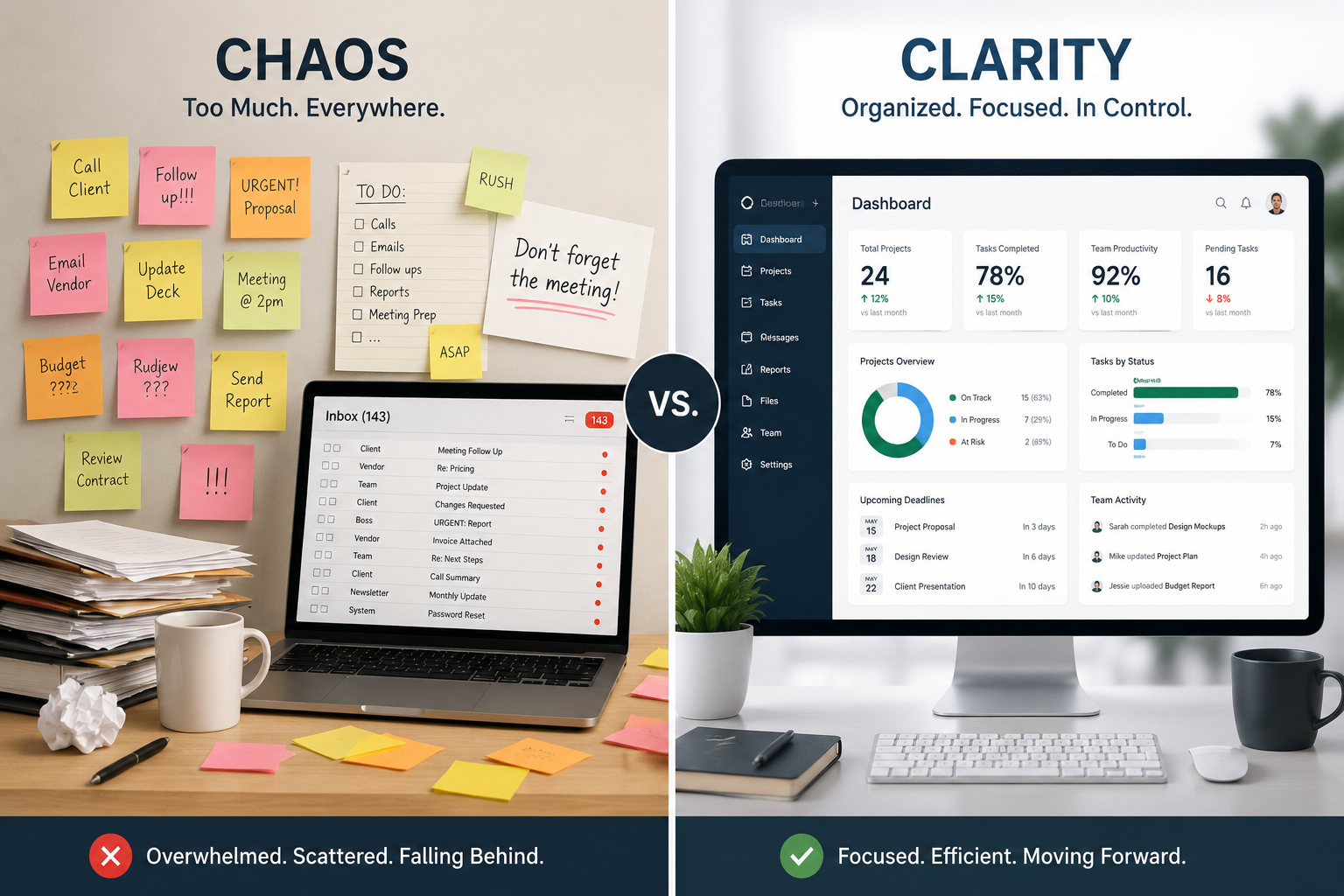
You can’t manage what you can’t see. Most small businesses collect data but don’t organize it in ways that support decision-making. Spreadsheets pile up. Metrics live in different tools. Leadership teams make decisions based on intuition instead of information.
Operational visibility means having real-time access to the metrics that matter. It’s not about tracking everything. It’s about identifying the key performance metrics that indicate whether the business is on track and building business systems to monitor them consistently.
For most growing businesses, that includes revenue and profit trends, cash flow position and runway, customer acquisition cost and lifetime value, team capacity and utilization, project or delivery timelines, and customer satisfaction and retention rates.
Without this visibility, leadership teams operate reactively. They discover problems after they’ve already caused damage. Clients churn before anyone notices the pattern. Cash flow tightens before leadership realizes spending has outpaced revenue.
Data visibility changes that. It gives leadership teams the information needed to spot trends early, adjust strategy quickly, and make decisions based on evidence instead of assumptions. Choosing the right KPIs for your business ensures you’re tracking what truly matters.
Accountability structures and execution alignment
Growth creates complexity. As teams grow, communication breaks down. Priorities get misaligned. Projects stall because no one knows who owns the next step.
Accountability structures solve this by making ownership clear. Every goal, project, and deliverable should have a single person responsible for its outcome. That doesn’t mean they do all the work. It means they own the result.
Most businesses struggle with accountability because they confuse activity with progress. Teams stay busy, but nothing moves forward. The issue usually isn’t effort. It’s visibility and follow-through.
Effective accountability requires clear ownership for every initiative, defined success metrics so progress is measurable, regular check-ins to review status and remove blockers, and consequences when commitments aren’t met.
Accountability creates clarity. Teams perform better when they know what’s expected, who owns what, and how success is measured. According to research from Harvard Business Review, organizations with strong accountability structures see significantly higher execution rates.
Execution alignment means the entire team is working toward the same priorities. That requires strategic planning at the leadership level and clear communication across the organization. When alignment breaks, teams work hard on the wrong things.

Financial management and cash flow discipline for small business owners
Revenue is not profit. Profit is not cash. Many small business owners learn this the hard way when they land a big contract but can’t afford to deliver it because cash is tied up in receivables or inventory.
Financial management for small businesses means understanding the difference between accounting and cash flow, and building business systems to monitor both. It includes bookkeeping, budgeting, forecasting, tax obligations, and managing the timing of cash inflows and outflows.
Cash flow is the operational lifeblood. A business can be profitable on paper and still fail if it runs out of cash. A U.S. Bank study found that 82% of business failures are due to poor cash flow management.
Practical financial management includes monthly cash flow forecasting to anticipate shortfalls, clear payment terms and collections processes to reduce receivables aging, expense discipline to avoid unnecessary spending during growth, financial projections tied to strategic planning, and regular review of profit margins by product, service, or client.
Founders don’t need to become accountants, but they do need to understand their numbers well enough to make informed decisions.
Strategic planning and operational execution for business growth
Strategic planning is how leadership decides where the business is going. Operational execution is how the team gets there. Most businesses are better at one than the other.
Some founders are visionary but struggle with execution. They set ambitious goals but don’t build the operational structure needed to achieve them. Other founders are strong operators but lack strategic clarity. They execute well on the wrong things.
Sustainable growth requires both. Strategic planning defines the business model, target market, competitive positioning, and growth priorities. Operational planning translates that strategy into projects, timelines, budgets, and accountability.
Effective strategic planning includes clear goals with measurable outcomes, resource allocation tied to priorities, quarterly or annual planning cycles that allow for adjustment, and alignment between leadership vision and team execution.
Operational execution includes project management disciplines to track progress, regular team check-ins to identify blockers, process improvement to boost operational efficiency, and performance metrics to measure whether execution is working.
The gap between strategy and execution is where most businesses lose momentum. Closing that gap requires both strategic planning and operational discipline, which is why developing a detailed roadmap for operational excellence is critical to sustainable growth.
When to seek fractional leadership vs. building management systems yourself
Not every business needs a full-time COO. But every growing business needs operational leadership. The question is whether that comes from the founder, an internal hire, or fractional support.
Fractional leadership provides experienced operational expertise on a part-time or project basis. It’s a flexible model that gives businesses access to senior-level skills without the cost or commitment of a full-time executive.
Founders should consider fractional leadership when the business is growing faster than internal systems can support, operational bottlenecks are slowing revenue or delivery, the founder is overwhelmed and needs strategic support, the business lacks internal expertise in operations, finance, or strategic planning, or hiring a full-time executive isn’t financially viable yet.
Building management systems yourself works when the founder has operational experience and bandwidth, the business has strong internal managers who can own execution, or growth is steady and manageable without external support.
Most founders are experts in their product or service, not business operations. They know their market but haven’t built reporting systems, accountability structures, or strategic planning processes before. Fractional COO support to align strategy with execution helps businesses build the operational clarity and structure needed to scale without the founder becoming the bottleneck.
If your business is growing faster than your systems can support, schedule a call to explore your options.
FAQs
Q1. What does business management for small businesses actually involve?
A1.
It involves organizing people, processes, and resources so the business can grow without constant founder intervention. It includes financial management, strategic planning, operational visibility, accountability, and execution discipline.
Q2. Why does effective management matter more as a small business grows?
A2.
Scaling challenges expose operational weaknesses. What worked for a small team breaks as the business grows, and without systems, the founder becomes the bottleneck.
Q3. What management skills do small business owners need most?
A3.
Leadership skills, decision-making clarity, financial literacy, and the ability to delegate effectively are essential. Founders also need to build accountability structures and operational visibility.
Q4. Is hiring fractional leadership actually worth the investment for a small business?
A4.
Yes, when the business is growing faster than internal systems can support. Four Indoor Courts provides fractional COO support that delivers senior-level operational expertise without the cost of a full-time hire.
Q5. What if my business isn't big enough yet to need formal management systems?
A5.
If you’re spending most of your time answering operational questions or fixing recurring problems, you’re already big enough. Systems prevent chaos; they don’t create it.

Founder of Four Indoor Courts Consulting, Leah Norris helps founders and growing businesses create operational clarity through fractional COO leadership, KPI-driven analytics, and scalable operational strategy. With a background spanning operations, finance, analytics, marketing, and technology, Leah specializes in helping businesses improve visibility, streamline processes, strengthen accountability, and build the operational structure needed for sustainable growth.