
Most small business owners hit a predictable wall around $1 million in revenue. The business is growing, but the founder is drowning. What worked at $500K no longer works. Systems break. Teams wait for decisions. The business starts running you instead of the other way around.
This isn’t a motivation problem. Growth without systems creates friction. The issue usually isn’t effort; it’s visibility. You can’t see where bottlenecks are forming until they’ve already slowed everything down.
This guide walks through how to grow a small business past that $1M mark without burning out. You’ll learn how to build operational structure, create visibility, and scale responsibly when the day-to-day is already overwhelming.
Founder Overwhelm and Being Trapped in Day-to-Day Operations
Founder overwhelm doesn’t mean you’re failing. It means your business has outgrown the informal systems that got you here.
When you started, you could manage everything yourself. You knew every customer, every project, every deadline. But as revenue climbs, that model collapses. You become the bottleneck. Every decision waits for you. Your team can’t move without approval.
The path forward isn’t working more hours. It’s creating operational clarity so your team can execute without constant oversight. Success requires aligning strategy with day-to-day execution so that growth becomes sustainable rather than chaotic.

Understanding the Stages of Small Business Growth
Small business growth follows predictable stages. Most operational problems start when founders try to run a $2M business with $500K systems.
Stage 1: Startup ($0 to $500K)
The founder does everything. There’s no formal structure. Decisions happen fast because there’s only one person making them.
Stage 2: Growth ($500K to $1M)
You hire your first employees. Some tasks are delegated, but most processes remain informal. Things work because everyone asks you when they’re stuck.
Stage 3: Scaling ($1M to $5M)
This is where most businesses break. You have a team, but no clear accountability. Processes exist in people’s heads, not in documentation. Revenue grows, but so does chaos.
Stage 4: Expansion ($5M+)
You need executive leadership, formal systems, and data visibility. The business can’t run on the founder’s instinct anymore.
What many founders don’t realize is that each stage requires different management styles. Entrepreneurial management works in Stage 1. By Stage 3, you need organizational structure and delegation, or growth stalls. According to U.S. Census Bureau data on small-business growth, understanding these transitions is critical to long-term survival.
Building Business Systems and Processes to Support How to Grow a Small Business
Business systems are what let you scale without losing control. They turn repetitive decisions into repeatable processes.
Start with the areas causing the most friction. If customer onboarding is inconsistent, document it. If project handoffs fail, create a checklist. If reporting takes hours, build a template. The practice of documenting processes and procedures transforms institutional knowledge into scalable assets.
Here’s what effective business systems include:
- Clear ownership: Every process has one person accountable for outcomes.
- Documentation: Steps are written down, not just explained verbally.
- Consistency: The process works the same way every time, regardless of who executes it.
- Feedback loops: You can see when something breaks and fix it quickly.
Scaling your business without systems means every new hire adds complexity instead of capacity. You end up managing people rather than leading strategy with a proven growth plan.
Operational Visibility and Data-Driven Decisions for Small Business Growth
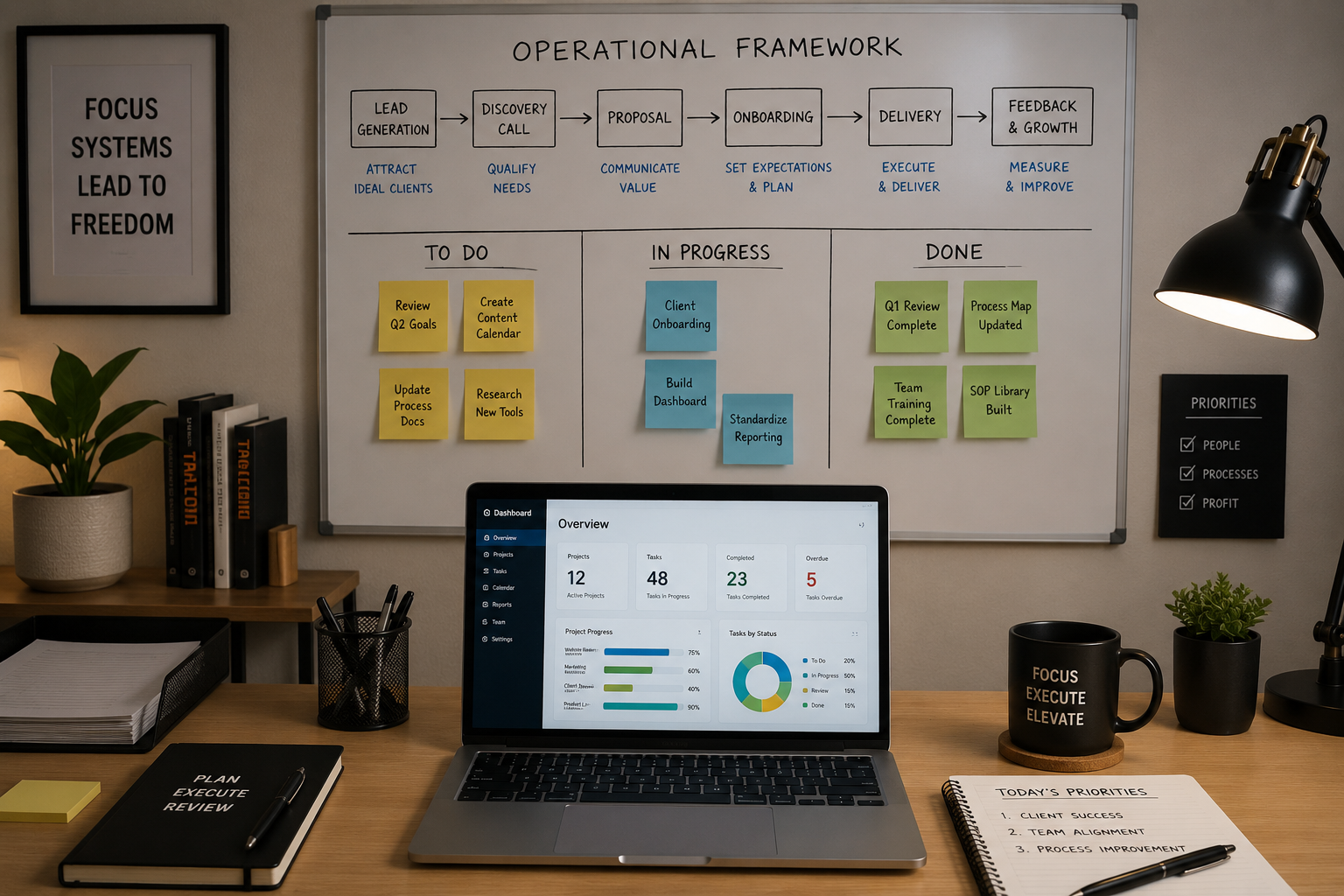
Operational visibility means you can see what’s actually happening in your business without having to ask 10 people for updates.
Most small business owners make decisions based on gut feeling because they lack reliable data. You know revenue is up, but you don’t know which products are profitable. You know the team is busy, but you don’t know where time is going. Research like JPMorgan Chase Institute research on small business cash flow highlights how critical financial visibility is to sustainability.
Start by tracking the metrics that matter:
- Revenue by product or service line: What’s actually making money?
- Customer acquisition cost: How much does it cost to find new customers?
- Project profitability: Which clients or projects are worth your time?
- Team capacity: Where are bottlenecks forming?
You don’t need expensive software. A shared spreadsheet updated weekly is better than nothing. The goal is visibility, not perfection. The discipline of tracking the right performance metrics ensures you’re measuring what actually drives results.
When you can see patterns, you can act before small problems become expensive ones. That’s how operational visibility supports small business growth.
When to Bring in Fractional Executive Leadership to Grow Your Business
Most businesses wait too long to bring in executive leadership. They assume they need to be bigger, more profitable, or less messy first.
In reality, a fractional COO is most valuable when you’re stuck. When growth is happening, but systems aren’t keeping up. When you’re spending more time managing chaos than leading with a clear growth strategy.
Here’s when fractional executive leadership makes sense:
- You’re trapped in the day-to-day and can’t focus on strategic planning.
- Your team lacks accountability or clear ownership.
- You don’t have operational visibility into what’s working and what’s not.
- You’re preparing to scale but know your current structure won’t support it.
A fractional COO brings structure without the cost of a full-time hire. They assess where friction is happening, build systems to support sustainable growth, and help your leadership team execute more effectively. Part of this work involves learning to delegate effectively so that founders can focus on strategic priorities rather than tactical firefighting.
Four Indoor Courts provides fractional COO support for growing businesses that need operational clarity but aren’t ready for a full-time executive. The focus is on practical execution, not theory.
Identifying and Removing Operational Bottlenecks to Expand Your Business
Operational bottlenecks slow everything down. A bottleneck is any point in your business where work piles up waiting for a decision, approval, or resource.
Often, the founder is the bottleneck. Every proposal waits for your review. Every client issue gets escalated to you. Every new hire needs your sign-off. Your team can’t move without you, so nothing moves fast.
Here’s how to identify bottlenecks:
- Track where work stalls. What tasks sit in “waiting” status the longest?
- Ask your team. They know where delays happen. They just haven’t been asked.
- Look at your calendar. If you’re in every meeting, you’re probably the blocker.
Once you spot a bottleneck, you have three options:
- Delegate it. Give someone else the authority to make that decision.
- Automate it. Use a system or tool to handle it without human input.
- Eliminate it. Some approvals don’t need to exist at all.
Removing operational bottlenecks often creates more capacity than hiring new people. It’s process improvement, not headcount.
Moving Forward: From Operational Chaos to Sustainable Growth
You don’t need a perfect plan to start. You need to take the next step.
If you’re overwhelmed, start with one system. Pick the area causing the most pain and document a process. If you don’t have visibility, start tracking one metric. If you’re the bottleneck, delegate one decision. Consider taking a free operational readiness assessment to identify your highest-impact opportunities for improvement.
Learning how to grow a small business doesn’t happen all at once. It happens when you build structure in the places that matter most, then expand from there. The process of building an operational excellence roadmap provides a framework for prioritizing improvements that compound over time.
The businesses that scale past $1M aren’t the ones with the best ideas. They’re the ones that build operational structure before they need it. They create visibility before problems compound. They bring in leadership support before burnout forces the issue.
If your business is growing faster than your systems can support, now is the time to speak with the team about where operational friction is slowing progress. Four Indoor Courts specializes in helping founders build the operational clarity needed to scale responsibly without sacrificing what makes their business work.
Growth is possible. But it requires building a foundation that enables it to happen sustainably.
FAQs
Q1. How do you grow a small business when you're already stretched thin?
A1.
Focus on building systems that reduce your involvement in daily decisions. Delegation and operational visibility let your team execute without waiting for you.
Q2. What's the 3-3-3 rule in sales, and does it actually work for small businesses?
A2.
The 3 3 3 rule suggests contacting three prospects, following up with three leads, and closing three deals daily. It works if you have the operational structure to support consistent execution and a solid marketing plan.
Q3. Can a small business realistically make $10,000 a month in profit?
A3.
Yes, but profit requires more than revenue growth. You need visibility into costs, operational efficiency, and systems that don’t require constant founder involvement to grow your business sustainably.
Q4. What's the 50 100 500 rule and should I follow it?
A4.
The 50 100 500 rule suggests businesses need new management styles at 50, 100, and 500 employees. Most small business owners hit friction much earlier when systems don’t scale with revenue.
Q5. How fast can you actually grow a small business without breaking operations?
A5.

Founder of Four Indoor Courts Consulting, Leah Norris helps founders and growing businesses create operational clarity through fractional COO leadership, KPI-driven analytics, and scalable operational strategy. With a background spanning operations, finance, analytics, marketing, and technology, Leah specializes in helping businesses improve visibility, streamline processes, strengthen accountability, and build the operational structure needed for sustainable growth.