

A founder hits $1.2M in revenue, hires three new people, and somehow everything gets slower. Orders ship late. The team waits for her to approve things that shouldn’t need approval. Nobody can say where the work actually gets stuck. That’s not a people problem. It’s what happens when growth outpaces a business process optimization strategy. The informal systems that worked at $400K quietly buckle under volume. This article walks through a practical, seven-step approach to mapping, fixing, and protecting the workflows that keep operations running as you scale.

What is business process optimization (and how it differs from process improvement and automation)
Business process optimization is the practice of analyzing how work actually flows through your company. You then redesign it to remove waste, delays, and rework. It looks at the entire chain, from the first customer touch to the final handoff, with no steps skipped. If you’re new to the concept, it helps to first understand what process optimization actually means before building a strategy around it.
People mix up three things that are not the same. Process improvement usually means a small fix to one task. Workflow automation means handing a repetitive step to software. Business process optimization is the broader discipline that determines what should be improved, what should be automated, and what should be eliminated entirely.
Many founders assume automation is the answer. In reality, automating a broken process just produces bad output faster. You optimize first, then automate what’s left.
The discipline draws on established methods. The American Society for Quality maintains many of the standards behind these methods. It defines process improvement as the ongoing effort to raise quality and reduce variation. Optimization wraps that effort into a repeatable strategy rather than a one-time project, drawing on established quality and process-improvement methodologies refined over decades.
Why a business process optimization strategy matters for growing businesses
Most operational problems start when revenue grows, but business systems do not. The founder becomes the bottleneck because every decision still routes through them. Cycle times stretch. Quality slips. The team gets busier without getting more done.
What many founders don’t realize is that this isn’t a sign they hired the wrong people. It’s a sign that the workflows were never built to handle the current volume. Scaling exposes weaknesses in small business operations that were invisible when the company was small. Back then, one person could hold the whole picture in their head. Understanding the role of process operations in business growth makes it clear why these gaps surface exactly when momentum picks up.
A business process optimization strategy gives you operational visibility. You can see where work stalls and decide what to fix first. According to McKinsey & Company, companies that build operational discipline into their scaling absorb growth with far less friction than those that react to chaos after it appears.
The payoff is concrete. Optimized business processes reduce founder dependency, support sustainable growth, and allow you to add capacity without introducing proportional confusion. Growth without systems creates friction. Systems turn growth into something you can manage. A real example of this is when a $1M business’s sales outpaced its operations, and process fixes became the wake-up call that saved it.
Benefits of optimizing your business processes (efficiency, cost, quality, customer satisfaction)
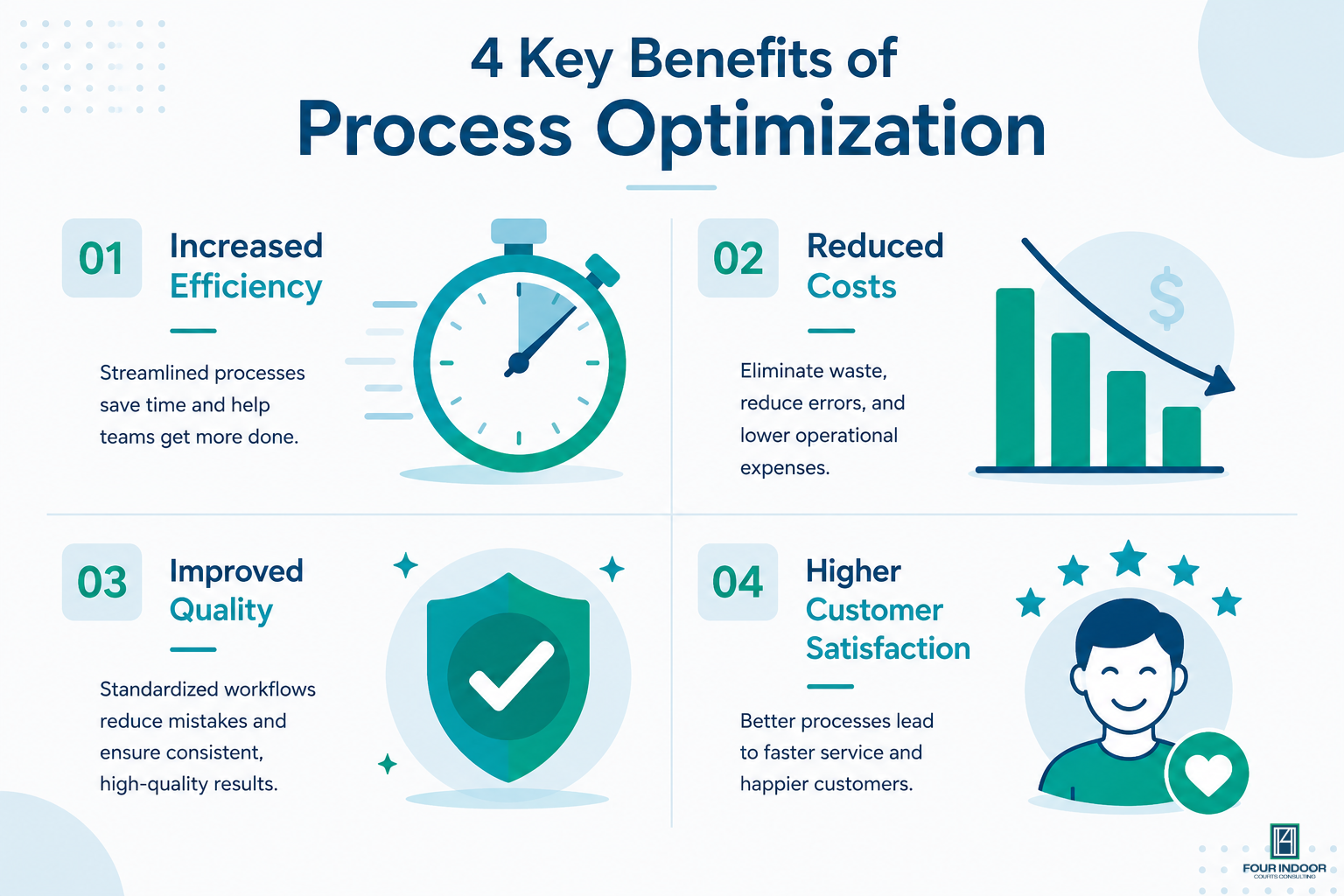
The first benefit is operational efficiency. Removing redundant steps and handoffs shortens cycle times. The same team handles more volume without burning out.
The second is cost reduction. Every unnecessary approval, duplicate entry, or rework loop costs money. Cutting those inefficiencies frees up budget and time you can redirect toward growth instead of firefighting.
Quality improves because consistent processes produce consistent output. When the work follows a documented path, you stop relying on whoever happens to be in the room to remember the right way to do it.
Customer satisfaction follows directly. Faster delivery, fewer errors, and predictable service all come from cleaner operations. Customers feel the difference between a business that runs on systems and one that runs on heroics.
There’s also a leadership benefit that rarely gets mentioned: better decision-making. When your processes generate reliable metrics, you stop guessing. You can see what’s working, allocate resources accordingly, and drive operational efficiency instead of hoping the next hire fixes everything.
Step 1: Identify and prioritize the key processes to optimize
You cannot fix everything at once, and trying to is how optimization projects stall. Start by listing your core business processes: lead intake, sales handoff, fulfillment, onboarding, billing, and support. Then prioritize.
The reason this matters is that not all inefficiencies cost the same. A clumsy internal report wastes a few hours a week. A broken fulfillment process loses customers. Rank each process by three things: revenue impact, cost of the current waste, and risk exposure if it fails.
One distribution business I worked with had a billing process that delayed invoices by an average of nine days. That single bottleneck was tying up roughly $30,000 in cash flow at any given time. It jumped to the top of the list immediately, ahead of a dozen smaller annoyances the team found more irritating.
Focus your first wave of process optimization on the two or three workflows that, if fixed, change the business. The small stuff can wait. Picking the right targets is half the battle in any business process optimization strategy.
Step 2: Map out your current processes for full visibility
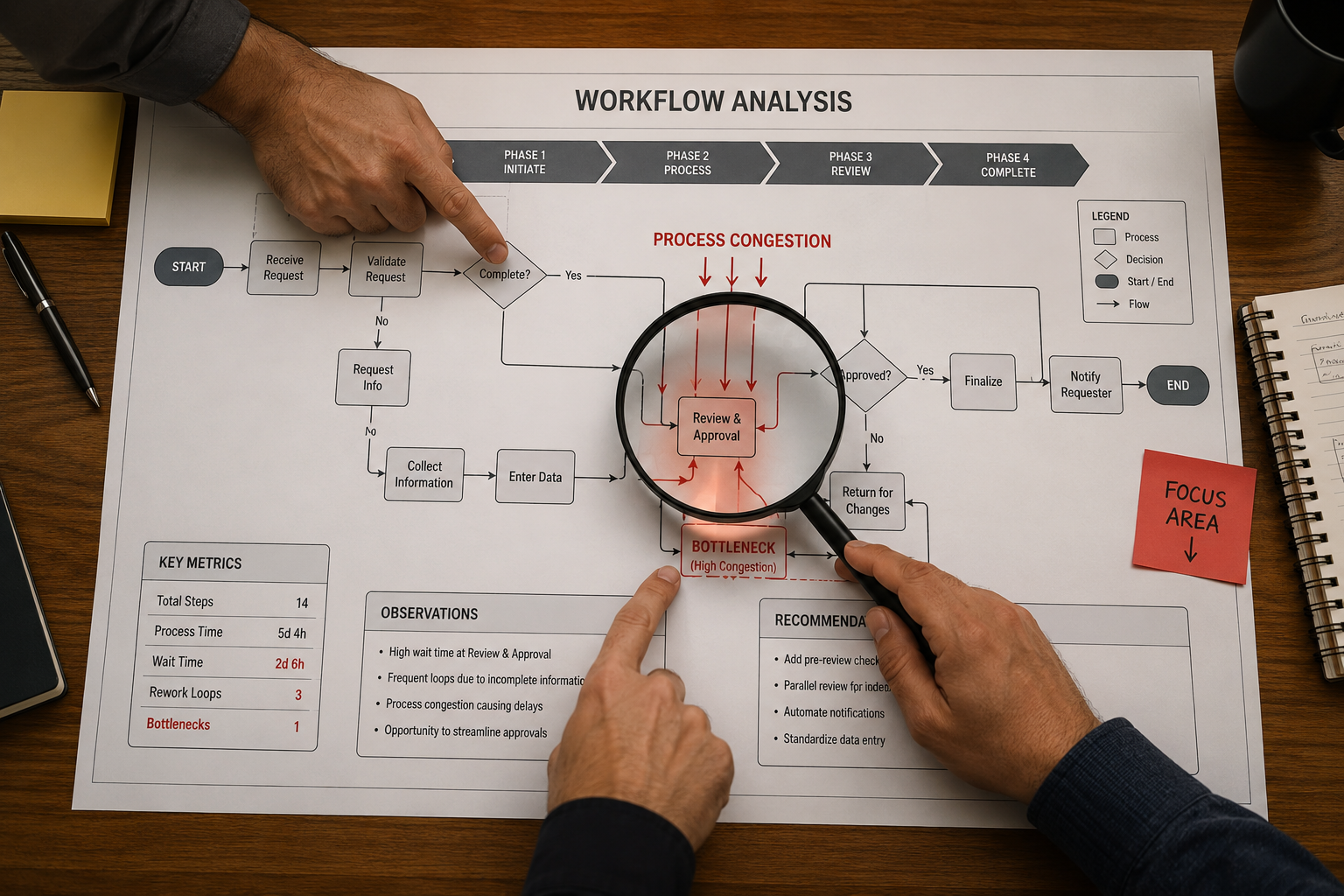
Before you change anything, document how the work actually happens, not how you think it happens. Process mapping means writing down every step, decision point, handoff, and tool involved from start to finish.
Do this with the people who run the process daily, not from the corner office. The map you build in a meeting room is always cleaner than reality. The team will show you the workarounds, the unofficial steps, and the “we just email Sarah” moments that never appear on any official chart.
A simple flowchart is enough. Note who does what, how long each step takes, and where work sits waiting. Those waiting periods are usually where your real inefficiencies hide.
This step delivers something most growing companies lack: real operational visibility. Once the process is on paper, problems that felt vague and overwhelming become specific and fixable. Honest process mapping is the foundation, because you can’t redesign operations you’ve never truly seen.
Step 3: Analyze processes to find bottlenecks and inefficiencies
With the map in front of you, hunt for friction. Look for the steps where work piles up, where it gets handed back for corrections, and where one person becomes a chokepoint for everything downstream.
Bottlenecks usually show up as waiting. If a task takes two hours of actual work but five days to complete, the gap is the problem, not the work itself. Measure cycle times for each step so you’re working from data, not gut feel.
The root cause is often hidden one level down. A slow approval step might really be a manager who lacks the information to decide quickly. Fix the visibility, and the bottleneck disappears without touching the approval at all.
Watch for the usual suspects: duplicate data entry, unnecessary approvals, unclear ownership, and manual steps that workflow automation could absorb. Separate the symptoms from the cause. Many teams treat the slow handoff when the real issue is that nobody owns the process end-to-end. Naming the actual constraint is what makes the next steps work.
Step 4: Set clear objectives and KPIs to measure success
Optimization without targets is just rearranging work. Before you redesign anything, decide what success looks like in numbers. Vague goals like “be more efficient” give you nothing to measure against.
Set specific objectives tied to the bottleneck you found. “Reduce invoice cycle time from nine days to two.” “Cut onboarding from three weeks to one.” Then attach key performance indicators that you’ll track over time: cycle time, error rate, cost per transaction, and completion rate. The work of identifying the right KPIs to track is what separates metrics that drive decisions from numbers that just sit in a report.
Good KPIs do two things. They tell you whether the change worked, and they catch the process when it starts to slide back into old habits. Without a KPI, improvements quietly erode within a few months, and nobody notices until the bottleneck returns.
Keep the metrics few and meaningful. Three key performance indicators your team actually watches beat fifteen that live in a spreadsheet nobody opens. These KPIs become the backbone of your operational visibility and the basis for honest decisions about what to fix next.
Step 5, Redesign and select methodologies (Lean, Six Sigma, DMAIC, Kaizen)
Now you rebuild the process to hit those targets. Two proven frameworks guide most process optimization methods. Choosing between them comes down to the kind of problem you have.
Use lean process optimization when the issue is waste: too many steps, too much waiting, work that adds no value to the customer. Lean strips the process down to what matters. Use Six Sigma when the issue is inconsistency: the same process produces different results depending on who runs it or on the day.
Six Sigma works through the DMAIC cycle (Define, Measure, Analyze, Improve, Control), a structured loop for reducing variation and locking in the fix. It’s rigorous and data-driven, which suits high-stakes processes where errors are expensive.
For smaller, faster wins, the kaizen method favors small continuous improvements made by the team itself rather than large redesigns. Many SMBs blend these process optimization methods: lean process optimization to cut waste, a light touch of Six Sigma where consistency matters. The framework is a tool, not a religion. Pick what fits the problem and redesign accordingly.
Step 6: Implement, test, and communicate the new processes
A redesigned process on paper changes nothing. Rolling it out is where most optimization efforts either land or die. Start small. Pilot the new workflow with one team or one segment before you push it company-wide. Following best practices for managing process and change initiatives keeps a rollout from collapsing under its own ambition.
Testing matters because the map never catches everything. The pilot surfaces the edge cases, the “what do we do when” questions, and the spots where the new process collides with an old habit. Fix those before you scale the change.
Communication is the part that teams underestimate. People resist changes they don’t understand. Explain why the process changed, what problem it solves, and how it makes their day easier, not just management’s reporting cleaner. Assign a clear owner to each new process so accountability doesn’t evaporate the week after launch.
Document the new way of working so it survives turnover. A process that lives only in one person’s head isn’t optimized; it’s a future bottleneck waiting for that person to quit. Written documentation is what turns a one-time fix into a durable part of your business systems.

Step 7: Monitor, measure, and continuously improve
Optimization is not a project you finish. It’s a process optimization lifecycle. The KPIs you set in Step 4 serve as your early warning system, alerting you when a workflow drifts back toward its old inefficiencies.
Review your metrics on a regular cadence, monthly for most SMBs. Watch the trend, not just the snapshot. A cycle time that’s slowly creeping up signals a problem forming before it becomes a crisis you have to firefight. This kind of disciplined tracking aligns with patterns seen in U.S. small-business performance data, where companies that monitor consistently tend to weather growth far better.
This is where continuous improvement earns its keep. Each cycle of measuring and refining moves you closer to operational excellence and keeps the gains from quietly slipping away. Markets shift, volume grows, tools change, and processes that were optimal last year develop new bottlenecks.
Build a simple rhythm: measure, spot the drift, fix it, repeat. That loop separates companies that optimize once and regress from those that pursue operational excellence through a culture of continuous improvement. Done consistently, it’s also the foundation of any serious digital transformation, because clean, measured processes are the only ones worth automating or scaling.
When to involve a process optimization consultant or fractional COO
Some teams can run this loop internally. Others can’t, and the honest signal is usually time and distance. If the founder is still the bottleneck, or if everyone close to the work is too buried in it to see it clearly, an outside operator changes the equation.
A process optimization consultant or fractional COO brings two things that internal teams often lack: the perspective to quickly identify your inefficiencies, and the bandwidth to actually drive change while your team keeps the business running. Founders frequently mistake operational problems for personnel problems. A skilled operator can tell the difference between a system gap and a people gap. That saves you from firing your way through a problem that better processes would solve. Knowing what to look for when choosing the right process improvement consultant makes the difference between an engagement that sticks and one that fizzles.
The trigger point is usually scaling challenges. Revenue is climbing, operational structure isn’t keeping up, and founder overwhelm is becoming the norm. That’s when senior operational leadership stops being a luxury and starts being the thing standing between you and sustainable growth. Four Indoor Courts works directly with founders and leadership teams to spot operational friction and build the systems that resolve it.
How to optimize processes without a full-time COO (fractional leadership approach)
Most SMBs near $1M in revenue need executive-level operational leadership but can’t justify a full-time COO salary, which often runs well into six figures. The fractional model solves that math. You get senior operational expertise on a part-time, flexible basis, scaled to the business’s actual needs right now.
In practice, a fractional COO leads the optimization work directly: prioritizing the right business processes, mapping and redesigning them, setting KPIs, and building the reporting that gives leadership real visibility. The difference from a traditional consultant is execution. You’re not buying a slide deck. You’re getting an experienced operator who stays to implement and improve small business operations from the inside.
Four Indoor Courts offers exactly this through fractional COO support, business process documentation, and KPI-driven reporting for founders scaling toward and past $1M. The engagement flexes from day-to-day support to deeper work focused on scale. So you fix scaling challenges and ease founder overwhelm by building systems first and adding headcount only when the structure can support it. That’s how you scale responsibly without overcommitting on payroll.

If your business is growing faster than your systems can support, the fastest way to identify where operational friction is slowing you down is to look at it through the lens of an experienced operator. Four Indoor Courts offers a free 30-minute Readiness Audit with fractional COO Leah Norris. Book a clarity call to pinpoint the bottlenecks holding back your next stage of growth. Results vary based on leadership execution, market conditions, and operational implementation, but clarity on where the friction lives is always the first step.
FAQs
Q1. What is a business process optimization strategy?
A1.
It’s a structured plan to analyze and refine your workflows to cut waste, reduce costs, and align operations with business goals. Most strategies start by mapping current processes, pinpointing bottlenecks, and setting measurable targets for improvement.
Q2. What frameworks should I use to optimize my processes?
A2.
The most established options are Six Sigma, which uses the DMAIC cycle (Define, Measure, Analyze, Improve, Control) to reduce variation, and Lean, which removes non-value-adding work. For SMBs, the right choice usually depends on whether your problem is inconsistency (Six Sigma) or wasted effort and delays (Lean).
Q3. What are the main steps to build and implement the strategy?
A3.
Identify and prioritize high-impact processes, map how they currently work, set clear goals, engage the people who run them daily, then test and roll out changes with KPIs to track results. Prioritizing by revenue, cost, or risk exposure keeps the effort focused on what actually moves the business.
Q4. Why does this matter for a business trying to scale past $1M?
A4.
Growth usually breaks the informal systems that led a founder to early success, creating bottlenecks and founder dependence. Optimized processes free up leadership time, improve visibility into performance, and enable the company to absorb more volume without proportional chaos.
Q5. Do I need to hire a full-time COO to run this?
A5.
No. A fractional COO can lead to optimization on a part-time basis, giving you senior operational expertise without a full-time salary, which is why many SMBs near $1M in revenue use this model to build systems before adding headcount.

Founder of Four Indoor Courts Consulting, Leah Norris helps founders and growing businesses create operational clarity through fractional COO leadership, KPI-driven analytics, and scalable operational strategy. With a background spanning operations, finance, analytics, marketing, and technology, Leah specializes in helping businesses improve visibility, streamline processes, strengthen accountability, and build the operational structure needed for sustainable growth.