

A founder hit $1.4M in revenue last year and still couldn’t take a vacation without three calls a day. Sales were up, and the team had doubled. Yet the business felt harder to run than when it was half the size. That’s the moment most owners start asking whether a process improvement consultant can untangle the mess. It’s usually the right instinct for the wrong reason. The problem isn’t effort or talent. Growth quietly broke the systems that got the business this far.

A business consultant collaborates with a small business owner to review workflow diagrams and optimize operational processes in a modern office environment.
What a process improvement consultant is and what they do
A process improvement consultant is the person founders call when the business feels harder to manage than it should. Their job is narrow and practical. They look at how work moves through your company, find where it stalls, and redesign those workflows so they run faster and more consistently. If you’re still weighing the basics, it helps to understand what a process improvement consultant actually does before deciding whether the role fits your situation.
The work usually breaks into four parts. First comes process assessment, where they map your current business processes and watch where handoffs break or work piles up. Then comes opportunity identification and prioritization, separating the fixes that matter from the ones that don’t. After that, solution design, process documentation and standardization, so the team stops relying on memory and tribal knowledge. Finally, change management to make the new way stick.
In most small businesses, processes grow by accident. Nobody designs them. They accumulate. A process improvement consultant brings the outside visibility to see operational bottlenecks the team has stopped noticing. The discipline of business process improvement, known as business process management, has been documented for decades by organizations such as Gartner. The core principle holds: you can’t improve a process you can’t see. That’s why operational visibility comes before any fix.
Signs your business needs a process improvement consultant
Most operational problems start when revenue grows, but operational structure does not. Here are the signs your business needs help that most often show up.
You’re the bottleneck. Every decision routes through you, and the team waits instead of acting. That’s founder overwhelm, and it caps how fast the business can move. Second, you can’t get a straight answer on performance. If pulling basic performance metrics takes a frantic afternoon of spreadsheets, you have a data visibility problem, not a reporting inconvenience.
Third, the same mistakes keep happening. Reactive decision-making and inconsistent workflows mean every project feels like the first time. Fourth, scaling challenges show up as operational strain. Orders ship late, onboarding drags, and things fall through the cracks that never used to. The pattern is common enough that you can see it play out in how a $1M business stabilized when operations couldn’t keep up with sales.
Many founders assume these are people problems and try to hire their way out. In reality, it’s usually a systems problem. Better employees can’t outrun a broken process. If three or more of these signs your business needs help sound familiar, the missing operational efficiency is a structural issue. A process improvement consultant exists to fix exactly that.

Benefits and value of process improvement consulting
The real benefits of a process improvement consultant rarely come from the final report. They come from what changes after it. The first and biggest is operational visibility. Once your business processes are mapped and measured, you can finally see where money and time leak out. That makes decision-making faster and far less stressful.
Lower costs follow. Removing redundant steps and standardizing workflows reduces the hidden costs of rework and delays. Enterprise reengineering projects often report 20 to 40 percent cost reductions when fully implemented. Small businesses rarely see numbers that dramatic, but the proportional gains are real. The stakes are worth taking seriously when you look at business survival rates from the U.S. Bureau of Labor Statistics, which show how many companies stall before they ever build durable systems.
Then there’s reduced founder dependency. When processes are documented and owned by the team, the business stops running you. That’s the difference between revenue growth and sustainable growth. One creates more chaos. The other creates capacity.
The reason this matters is mechanical. A business that depends on one person’s judgment for every decision has a ceiling, and that ceiling is the founder’s bandwidth. The benefits of a process improvement consultant come from raising that ceiling by distributing decisions into reliable systems. The payoff isn’t just efficiency. It’s the operational excellence that turns into a competitive advantage when your competitors are still firefighting.
Core process improvement services and methods
Good process improvement consulting follows a sequence, not a menu of buzzwords. It starts with process assessment and workflow optimization: mapping how work flows today and where it jams. From there, the work moves into process documentation and standardization, documenting the right way to do things so quality doesn’t depend on who’s working that day. Founders who want to attempt some of this in-house can start by creating operational processes and procedures themselves before bringing in outside help.
The methods come from established frameworks. Lean focuses on stripping waste out of a process, anything that adds time or cost without adding value. Six Sigma reduces variation, so outcomes stay consistent. For broken processes that can’t be patched, process reengineering rebuilds the workflow from scratch rather than tweaking a flawed one. These aren’t academic theories. They’re practical tools for finding and removing operational bottlenecks.
Underneath all of it sits business process automation, offloading repetitive tasks to systems rather than people. This is where many small business operations find quick wins. Picture a service firm where every invoice waits on the founder to approve it by email: the bottleneck isn’t the team, it’s the manual handoff, and automating that approval frees days each month. Four Indoor Courts approaches this through workflow optimization and standardization, alongside data and analytics consulting, so the new processes include reporting to track them. Best practices only work when someone can measure whether they’re being followed. So this kind of business process improvement builds performance metrics in from the start, rather than bolting them on later.
Continuous improvement as an ongoing discipline
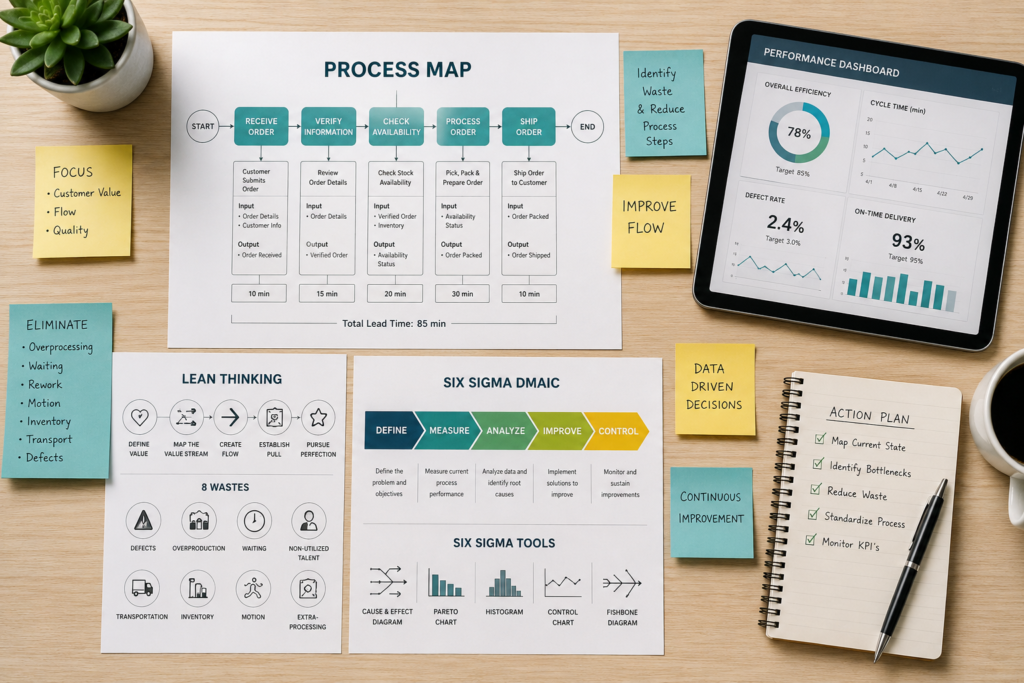
Here’s where most process improvement programs quietly fail. A consultant comes in, fixes the obvious problems, delivers a binder, and leaves. Six months later, the team has drifted back to old habits and the gains evaporate. The fix was an event, not a habit.
Continuous improvement treats process as something you maintain, not something you complete. Markets shift, teams change, and a workflow that was efficient last year becomes a bottleneck this year. The businesses that build lasting efficiency review their business systems on a regular rhythm. They adjust before small problems compound, making continuous improvement a defining habit rather than a project. Conditions can shift quickly under any company’s feet, which is why a standing rhythm beats a one-time cleanup.
The root cause of process decay is simple. Without ownership and accountability, standards slip. Someone has to watch the performance metrics, notice when a number drifts, and act. That’s the difference between a one-time cleanup and genuine operational excellence. A process improvement analyst or manager often fills this role inside larger companies, keeping the discipline alive after the initial project.
For smaller firms that can’t justify that headcount, ongoing operational support fills the gap. The point isn’t constant change for its own sake. It protects the gains you paid for, so business transformation actually holds, and growth stays sustainable. This is also where building an operational excellence strategy turns scattered fixes into a repeatable system.
Process improvement consultant vs. fractional COO
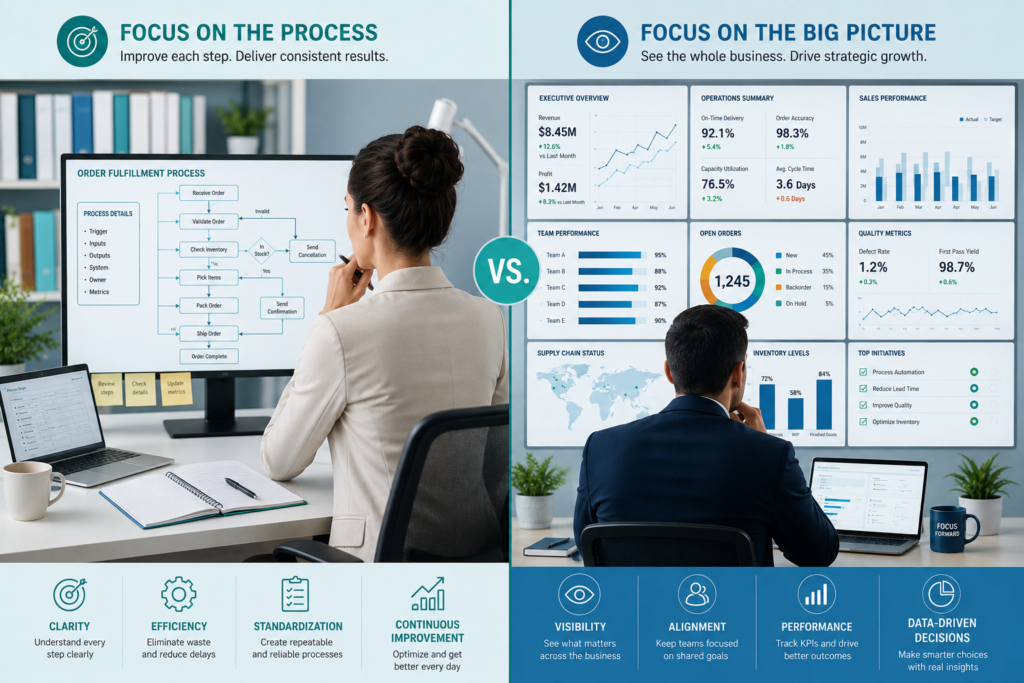
These two roles are often confused, and the difference lies in bandwidth and scope. A process improvement consultant fixes specific workflows. They come in, target operational bottlenecks, redesign the process, and hand it off. The role of a process improvement consultant is deep but narrow: better business processes, measured results, then done.
A fractional COO owns operations as a whole. They don’t just fix one workflow. They run the operational engine: hiring decisions, performance metrics across the company, leadership structure, strategic planning, and yes, the role of a process improvement consultant as one piece of a larger job. Think of it as the difference between a specialist who repairs one system and an operator who keeps every system running together. It’s worth understanding fractional COO services and how they compare before assuming a narrow fix is all you need.
Which one you need depends on the problem. If you have one clearly broken process, a consultant is the efficient choice. If your whole operation lacks leadership and you’re drowning in founder overwhelm, you need ongoing operational leadership. Four Indoor Courts provides fractional COO support for SMBs at this stage, giving founders senior operational guidance without the cost of a full-time executive hire. Many businesses start with focused business process improvement and graduate into broader fractional COO support as their scaling challenges grow.
How to evaluate readiness before engaging a consultant
Bringing in help before you’re ready wastes money. Process improvement only works if someone implements the changes, and a team in the midst of a crisis often can’t. So before you engage anyone, run an honest check.
First, can you name the problem? “Things feel chaotic” isn’t enough. The clearer you are about where work stalls, the faster a consultant delivers value. Second, do you have the bandwidth to implement? A redesigned process that nobody adopts is just an expensive document. Third, is leadership actually willing to change how things are done? Change management fails when the founder asks for new systems but keeps overriding them.
Worth flagging, honestly: the scope and approach to operations work vary by industry and business stage, and in regulated fields, they also vary by jurisdiction. A fix that works for a service firm won’t always translate to a product business, and compliance-heavy sectors carry rules set by their own governing authorities. Check the requirements that apply to your industry and location, and get a real assessment of your specific situation rather than copying someone else’s playbook.
If you’re not sure where you stand, a structured readiness check beats guessing. Four Indoor Courts offers a free 30-minute Readiness Audit with Leah Norris that surfaces where operational friction is actually slowing you down before you commit to anything bigger.
If your business is growing faster than your systems can support, the first step isn’t a sweeping overhaul. It’s clarity on where the real bottlenecks are. To talk through your operational strain and see what a path to sustainable growth would look like, you can explore your options with Four Indoor Courts and decide whether a process improvement consultant or broader support fits your situation.
FAQs
Q1. What exactly does a process improvement consultant do?
A1.
A process improvement consultant analyzes a company’s existing workflows to find bottlenecks, then designs and helps implement more efficient processes. The work typically spans four areas: process analysis, solution design, change management, and ongoing performance monitoring.
Q2. What's the difference between a process improvement consultant and a management consultant?
A2.
A process improvement consultant focuses narrowly on refining specific workflows to cut costs and improve quality, often using Lean or Six Sigma methods. A management consultant takes a broader view of a company’s structure, strategy, and overall performance rather than of individual processes.
Q3. Is hiring a process improvement consultant actually worth it for a small business?
A3.
It can be when growth has outpaced your systems and the business depends too heavily on you to run day-to-day. The value comes from eliminating redundant work, reducing operational costs, and creating visibility, but it’s worth it only if you’re prepared to implement the changes, not just receive a report.
Q4. Why would a company bring in a process improvement consultant instead of fixing things internally?
A4.
Founders are usually experts in their product, not in operations, and internal teams are often too close to the problem to see the bottlenecks clearly. A consultant brings outside visibility, proven methods, and the bandwidth to design and standardize processes that the team can sustain afterward.
Q5. What methodologies do process improvement consultants use?
A5.
Most rely on established frameworks like Lean and Six Sigma to map workflows, eliminate waste, and standardize processes. The goal is consistent quality and measurable performance gains tracked through defined metrics rather than one-off fixes.

Founder of Four Indoor Courts Consulting, Leah Norris helps founders and growing businesses create operational clarity through fractional COO leadership, KPI-driven analytics, and scalable operational strategy. With a background spanning operations, finance, analytics, marketing, and technology, Leah specializes in helping businesses improve visibility, streamline processes, strengthen accountability, and build the operational structure needed for sustainable growth.