
Most founders don’t notice the exact moment their business outgrows its systems. They notice the symptoms: a shipping error that costs a good client, a Monday spent putting out fires that shouldn’t exist, a team that keeps asking questions only the founder can answer. Building an operational excellence strategy is how you stop reacting and start running a business that works without you standing in the middle of it. This guide walks through what operational excellence actually means, its core principles, the methods that make it work, and how to build it step by step. It matters most if you’re a growing founder nearing the point where manual workarounds can no longer hold up.

What operational excellence is (definition and core meaning)
Operational excellence is the practice of running your business processes so consistently that quality and customer value no longer depend on any single person, including you. It isn’t a one-time project. It’s an ongoing discipline of process management, continuous improvement, and clear performance measurement. That discipline keeps the day-to-day predictable while the business grows.
Here’s the part many founders miss. Operational excellence is not about squeezing more effort out of people. In most growing companies, good employees keep hitting the same operational bottlenecks. The workflows around them were never designed. They just accumulated. Fix the design, and the same team produces better results with less friction.
The concept has deep roots in manufacturing and quality management, but it applies to any business. The American Society for Quality describes lean thinking as maximizing customer value while minimizing waste. That idea sits at the center of any real effort. When you strip out steps that don’t add value, you gain operational efficiency and visibility at once. The goal is a business that runs on systems, not heroics.
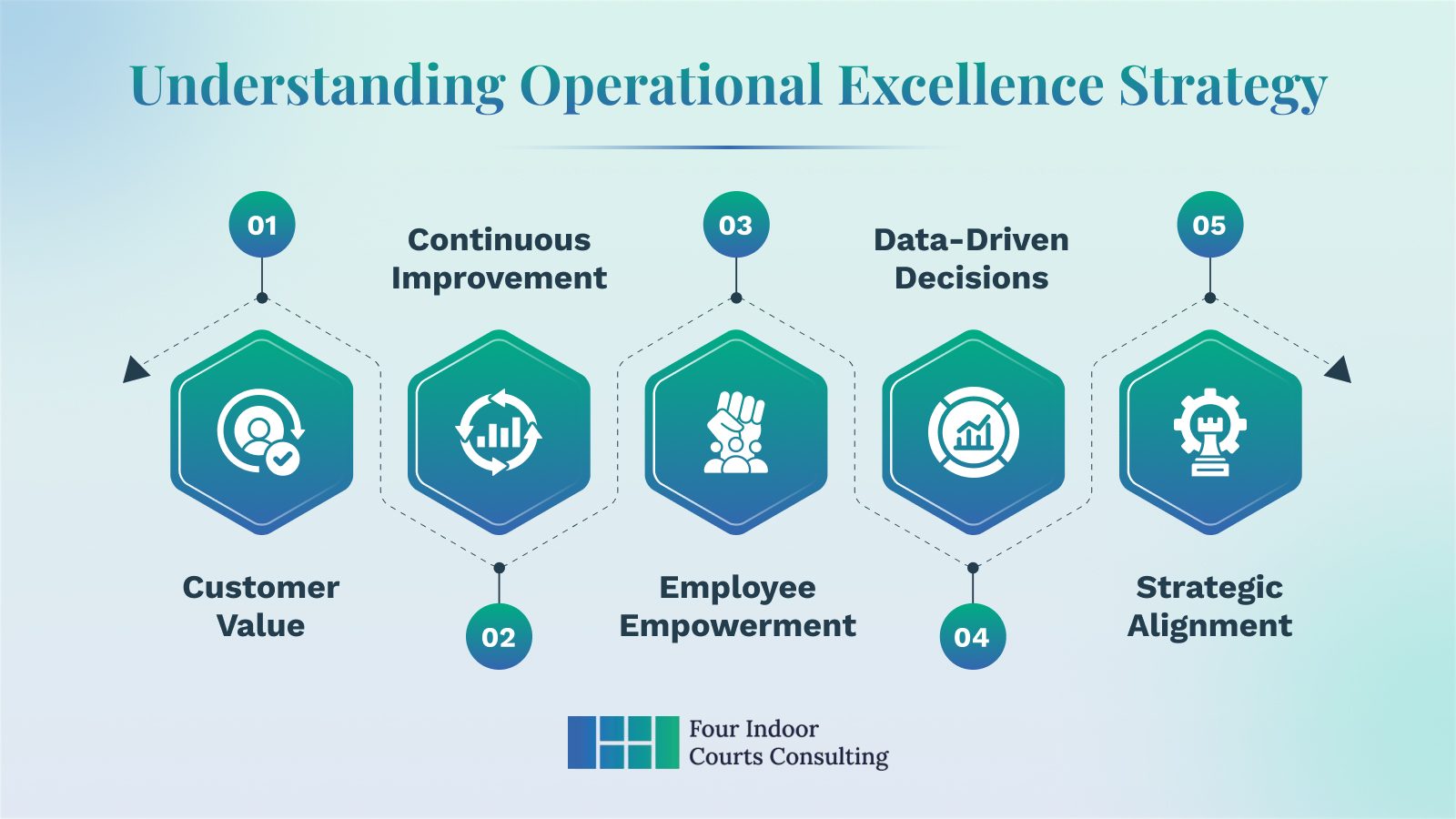
Core principles and pillars of operational excellence
Operational excellence rests on four pillars that must move in tandem: customer satisfaction, employee engagement, commercial impact, and efficient use of resources. The mistake is optimizing one in isolation. Cut costs too aggressively and service quality slips. Chase speed and your team burns out. The core principles only work when you balance all four.
Underneath those pillars sit a few operating rules. Standardization comes first, because you can’t improve a process that runs differently every time. Data-driven decision-making comes next, since gut feel stops scaling once you have a team. Then continuous improvement, customer focus, and respect for the people who do the work. These principles show up across nearly every serious operations framework, because they address the root cause of most chaos: inconsistency. If you want to see them applied end-to-end, a 7-step business process optimization strategy shows how these rules translate into a concrete sequence of moves.
The reason this matters is simple. Growth multiplies whatever system you already have. If your process-improvement habits are strong, scaling makes you better. If your business processes are inconsistent, scale multiplies the mess and warps your culture, too. Deloitte’s writing on operating models, summarized in its operations transformation insights, points to the same pattern. Clarity and standardization are what help companies grow without their quality falling apart.
Strategic leadership, vision, and alignment
Operational excellence fails when it’s treated as a floor-level project instead of a leadership priority. Strategic leadership sets the vision, and vision without alignment is just a poster on the wall. The founder or leadership team has to define what “good” looks like and ensure every team measures against the same goals.
Many founders assume alignment happens naturally because everyone “knows the mission.” In reality, teams drift the moment priorities aren’t written down and tied to daily work. Strategic alignment means each department can explain how its work supports the company’s key objectives. It can also point to the key performance indicators that prove it. Getting this right starts with identifying the right KPIs for your business, so the metrics you track actually reflect the outcomes you care about.
This is also where cross-functional collaboration lives or dies. When sales, operations, and finance each optimize their own corner, you get local wins and shared friction. Strategic leadership breaks that pattern with shared key performance indicators, a shared definition of customer value, and the cross-functional collaboration that keeps teams aligned and turns coordination into a competitive advantage. The leadership job isn’t to make every decision. It’s to build the clarity that lets other people decide well without waiting on you. That’s how you escape the founder bottleneck.

Process management, standardization, and optimization
Process management is where strategy meets reality. Every repeatable outcome in your business, from onboarding a client to fulfilling an order, runs on a process whether you’ve documented it or not. The problem is that undocumented processes live in people’s heads, and heads leave, get busy, or forget. Process management is only one part of a bigger picture; there are the 7 core systems every small business needs to run reliably, and process design connects to all of them.
Standardization is the first fix. Write down how the work should be done, then make that the default. This isn’t bureaucracy for its own sake. Standardization gives you a stable baseline to measure and improve, and it turns a founder-dependent workflow into a system the team can run. Once a process is standardized, workflow optimization becomes possible. You can see where handoffs stall, where rework happens, and where operational bottlenecks quietly eat hours.
The next lever is business automation. Once a process is stable and documented, business automation of repetitive tasks (invoicing, reminders, status updates) removes the manual workload that small teams tend to absorb. This fits the process improvement work four-indoor-courts-2 offers, which maps how work actually flows and rebuilds the steps that create friction. Good process management gives you operational visibility, and that visibility makes every later workflow optimization possible.
Improvement methodologies (Lean, Six Sigma, Kaizen)
You don’t need to master every operational excellence method, but you should know what each one does. Lean focuses on eliminating waste, meaning anything that consumes time or money without adding customer value. Six Sigma focuses on reducing variation and defects, so your output stays consistent. Together, these operational excellence methodologies give you speed and quality management, and Lean Six Sigma has become the default toolkit for serious operations teams because it delivers both.
Kaizen is the mindset that ties them together and shapes company culture around it. Instead of one massive transformation, kaizen builds a habit of small, continuous improvement that the whole team contributes to. A daily fix to one broken step, repeated across a year, beats a heroic overhaul nobody sustains. That’s the practical appeal for smaller businesses: kaizen doesn’t require a big budget, just consistency, and a healthy company culture makes it stick.
The operational excellence tools that support these methods (value stream maps, standard work documents, simple performance dashboards) matter less than the discipline of using them. Many founders assume these operational excellence tools and Lean Six Sigma are only for factories. In reality, the same operational excellence methodologies apply cleanly to service businesses, agencies, and e-commerce, because everyone has processes, waste, and variation to manage.
Implementing and building the strategy step by step
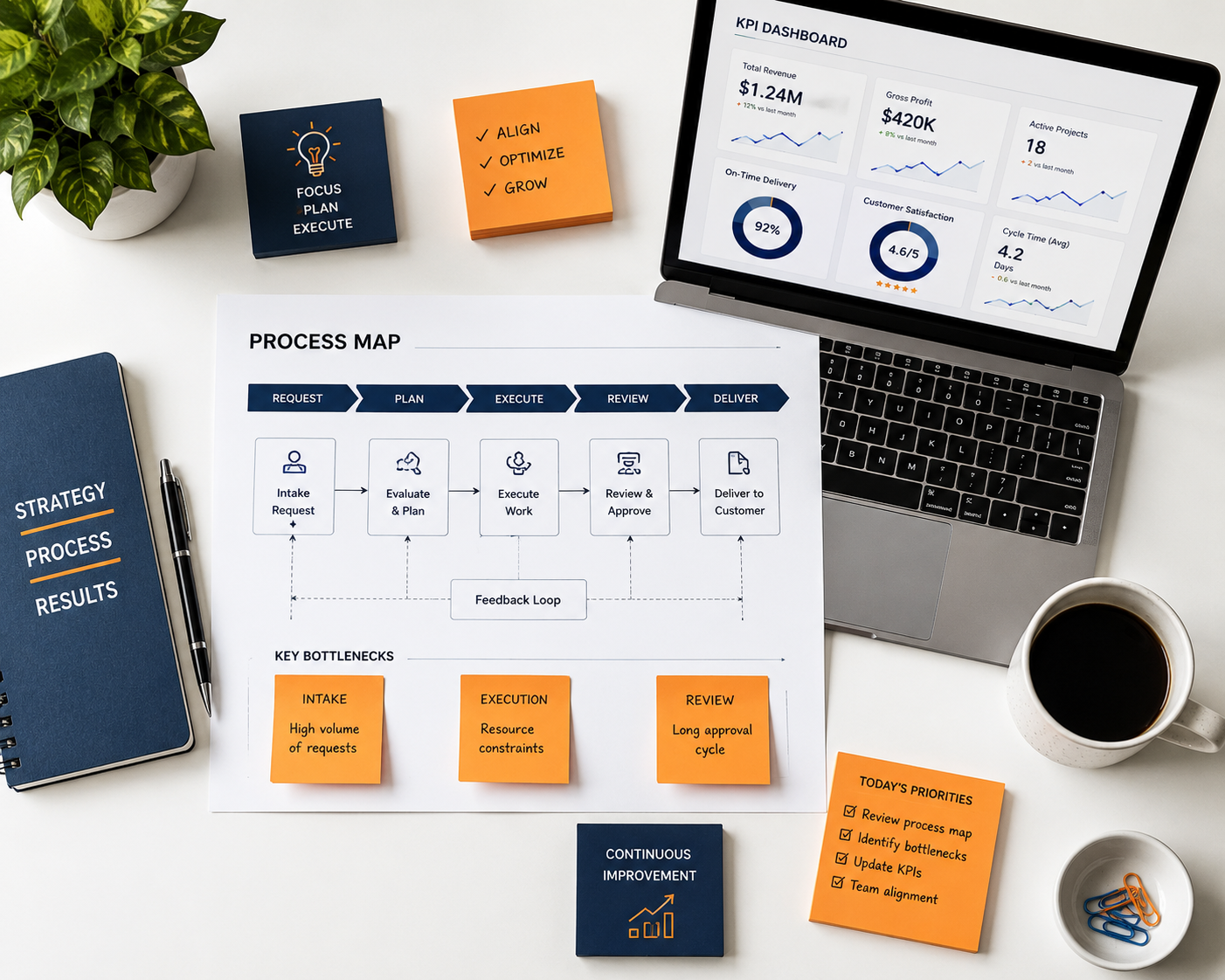
Start with visibility, not action. You can’t fix what you can’t see, so the first step is to map your core business processes and identify the real operational bottlenecks. Most founders are surprised: the bottleneck is rarely where they assumed.
From there, the sequence is straightforward. First, pick two or three high-friction processes that directly touch customer value. Second, standardize them so the work is done consistently every time. Third, define the performance measurement that tells you whether they’re improving. Fourth, layer in data so data-driven decision-making replaces guesswork. Fifth, apply continuous improvement: small changes reviewed on a regular rhythm, rather than a single big push.
The mistake is trying to overhaul everything at once. That’s how initiatives stall, and teams get cynical. Real operational efficiency compounds from focused, repeated process improvement. Assign an owner to each process, review the metrics on a set cadence, and protect the time to make changes. Building an operational excellence strategy is less about a perfect plan and more about a reliable loop: measure, improve, standardize, repeat.
Benefits of operational excellence
The benefits are practical, not abstract. The first is operational efficiency. The same team delivers more without working longer hours, because the friction between tasks disappears. The second is consistency, which sharpens customer focus and satisfaction. Customers experience the same quality every time, instead of depending on who happened to handle their order.
The third benefit is data. When your business systems are standardized, you finally get clean data and analytics. That enables data-driven decision-making instead of guesswork. You can see which products are profitable, where time is lost, and which fixes will move the needle.
There’s also a benefit founders undervalue: freedom. When operations run on systems, the business stops depending on you for every decision, which addresses founder overwhelm at its source. And done responsibly, operational excellence supports sustainable growth, the kind where structure keeps pace with revenue instead of falling behind it.
A word of honesty here. Operational excellence supports better results, but outcomes vary based on leadership execution, market conditions, and the consistency with which changes are implemented. It’s a competitive advantage precisely because most businesses won’t do the unglamorous, repeatable work. The ones that do build sustainable growth on a foundation competitors struggle to copy.
Operational excellence for SMBs approaching the $1M threshold
There’s a predictable point where things break. For many small and medium-sized businesses, it’s around $1M in revenue. The manual workarounds and founder-in-the-loop decisions that got the company here can’t scale, and the scaling challenges show up all at once.
I’ve watched this play out with a founder-led services company doing just under $ 1 M in revenue. Every client detail lived in the founder’s inbox and memory. When she took a two-week vacation, a renewal got missed, and a client walked, roughly $40,000 in annual revenue gone. The team wasn’t bad. There was simply no system holding the process. That’s the cost of operating on heroics past the point where they work. It’s worth studying how a $1M business rescued its operations before it was too late, because the warning signs are almost always visible before revenue loss sets in.
The lesson is that this threshold is exactly when an operational excellence strategy matters most. Below it, you can survive on hustle. Above it, you need structure, standardization, and operational visibility, or growth creates more chaos than profit. Scaling exposes operational weaknesses that were always there, and easing founder overwhelm early keeps those scaling challenges from compounding. The founders who navigate this well build systems before the cracks turn into lost revenue, not after.
Fractional COO leadership as a lever for operational excellence
Here’s the tension. The businesses that most need senior operational leadership usually can’t justify a full-time COO. A permanent C-suite hire at this stage is expensive and often premature. But without that leadership, the founder stays stuck being the operations department by default.
A fractional COO solves this. You get experienced operational leadership, strategy plus execution, without the cost and commitment of a full-time executive. If you’re unsure what that involves day-to-day, it helps to understand what fractional COO services actually include before deciding whether the model fits your stage. This is the core of what four-indoor-courts-2 does: senior leadership delivered through tiered fractional COO packages that align strategy with execution, support scaling and sustainable growth, or simply help founders drowning in day-to-day operations.
Many founders assume a fractional COO only advises. In reality, the value is in implementation. A good fractional operator doesn’t just hand you a strategy deck. They help build business systems, establish process management habits, and create operational clarity that lets your team run without constant founder intervention. This model gives growing companies the strategic leadership and people development that a full-time hire would bring, matched to the size and budget of a business not yet ready for one. It’s how many SMBs get the operational excellence they need at the stage they need it.

The 7-systems framework and readiness assessment for founders
Not every founder knows where to start, and that’s normal. A structured framework helps, because it turns a vague sense of “things are messy” into a clear map of which business systems need attention first. four-indoor-courts-2 uses a 7-systems framework for exactly this. It looks across the key areas of the business, from process management to data and analytics, and identifies where operational bottlenecks and gaps create the most friction.
The point of a framework isn’t complexity. It provides operational clarity and lifts operational efficiency across teams while grounding people development in real work. When you can see all seven systems side by side, priorities become obvious, and you stop trying to fix everything at once. That focus is what separates real process improvement from busywork.
Before committing to any engagement, a readiness assessment tells you where you actually stand. four-indoor-courts-2 offers a free 30-minute Readiness Audit with Leah Norris to surface the biggest operational risks and quick wins. There’s no downside to knowing where your friction lives. The clarity alone often changes what a founder prioritizes next quarter.
If your business is growing faster than your systems can support, a short conversation can help pinpoint where operational friction is slowing you down. Book a clarity call with four-indoor-courts-2 to get an honest read on your operations and a practical next step toward scaling responsibly.
FAQs
Q1. What exactly is an operational excellence strategy?
A1.
An operational excellence strategy is a structured approach to improving how a business runs by eliminating waste, standardizing processes, and increasing efficiency, quality, and customer satisfaction. For founder-led businesses, it usually means turning reactive, founder-dependent workflows into systems the team can run without you.
Q2. What are the four pillars of operational excellence?
A2.
The four pillars are customer satisfaction, employee engagement, commercial impact, and efficient use of resources. The goal isn’t to perfect one in isolation, but to balance all four, so that improvements in efficiency don’t quietly damage service quality or team morale.
Q3. What are the five basic elements of operational excellence?
A3.
The five core elements are vision, structure, people, principles, and tools. Most founders under $1M in revenue have the vision and people but lack the structure and consistent principles, which is where operational bottlenecks tend to start.
Q4. What if we don't have time to overhaul all our processes at once?
A4.
You don’t need a full overhaul to start. Most gains come from fixing a handful of high-friction bottlenecks first, then improving continuously, which is why frameworks like Lean and Kaizen focus on incremental changes rather than one large reset.
Q5. How is operational excellence different from just working harder?
A5.
Working harder addresses effort; operational excellence addresses visibility and design. The issue usually isn’t that your team lacks effort; it’s that inconsistent processes and unclear metrics make good work harder than it should be.
Q6. Do I need a full-time COO to run an operational excellence strategy?
A6.
No. Many SMBs get senior operational leadership through a fractional COO instead of a full-time C-suite hire, which delivers strategy and execution support at a fraction of the cost until the business is large enough to justify a permanent role.

Founder of Four Indoor Courts Consulting, Leah Norris helps founders and growing businesses create operational clarity through fractional COO leadership, KPI-driven analytics, and scalable operational strategy. With a background spanning operations, finance, analytics, marketing, and technology, Leah specializes in helping businesses improve visibility, streamline processes, strengthen accountability, and build the operational structure needed for sustainable growth.