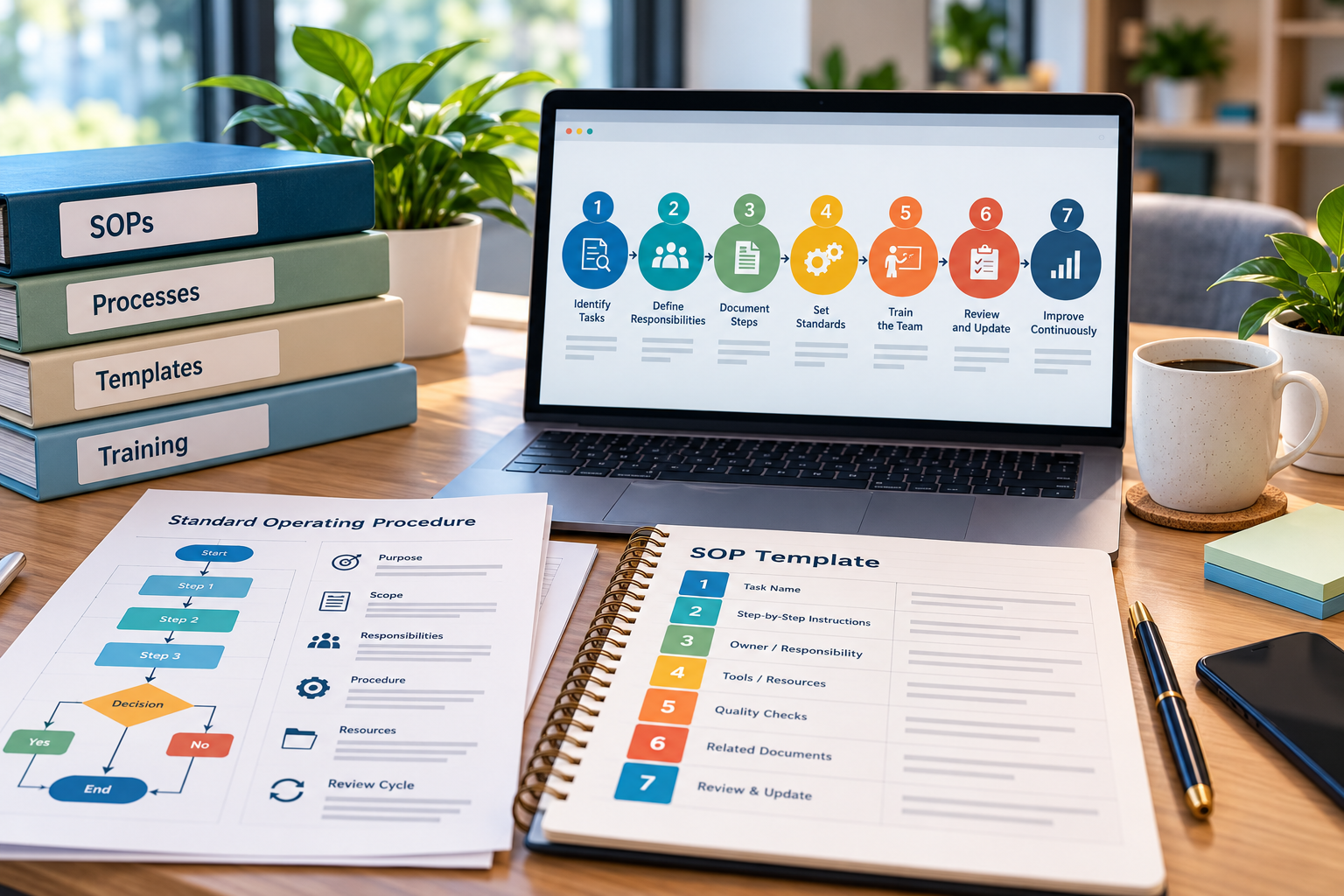
A founder with $1M in revenue takes a two-week vacation. By day three, the phone starts ringing because nobody else knows how she approves vendor payments. That single gap, an undocumented process living only in one person’s head, is exactly why SOPs for business stop being optional once a company grows. This guide covers what an SOP is, the formats that fit different tasks, and how to write an SOP in seven steps, with a template you can copy.

What is an SOP (standard operating procedure) for business?
A standard operating procedure is a documented set of step-by-step instructions for completing a specific, repeatable task the same way every time. A small business SOP answers the question “how do we actually do this here?” so the knowledge doesn’t live only in one person’s memory. If you’re still mapping out the basics, this breakdown of how to create operational processes and procedures for a company is a useful companion to the steps below.
Good business standard operating procedures cover routine work: processing refunds, onboarding clients, and closing the books each month. The goal is consistency across every business process, so each task produces the same result no matter who runs it. That consistency reflects ASQ’s view of process standardization, which treats repeatable, documented work as the foundation of quality output.
SOPs aren’t only a corporate habit. The U.S. Small Business Administration’s guidance on managing your business operations treats documented processes as part of running a stable company. Without sop documentation, every exception becomes a fresh decision, and those pile up on whoever has the most context, usually the founder.
Why SOPs matter for small and founder-led businesses
Most operational problems start when a business grows faster than its systems. Revenue climbs, headcount climbs, and the informal “just ask the owner” model quietly breaks. This happens because informal knowledge doesn’t scale: each new hire adds another person who needs the founder’s time to learn what was never written down.
Here’s a common pattern: a founder-led company hires its fourth employee, but training still happens by watching someone over their shoulder. Results get inconsistent. Mistakes repeat. The founder becomes the bottleneck for every non-obvious question, and delegation stalls because there’s nothing to hand off. SOPs help eliminate these operational bottlenecks by removing the founder as the single point of failure.
SOPs tend to help with faster onboarding, steadier quality control over what “done right” looks like, and clearer visibility into how business processes actually flow. Harvard Business Review’s work on why organizations need standard processes points to a simple truth about scaling: structure reduces the mental load of repeated decisions. For small business SOP efforts, that structure is what lets a founder step back without the business stumbling.
Common types and formats of SOPs (checklists, step-by-step, hierarchical, flowcharts)
Not every task needs the same SOP format. Matching the format to the work is half the battle.
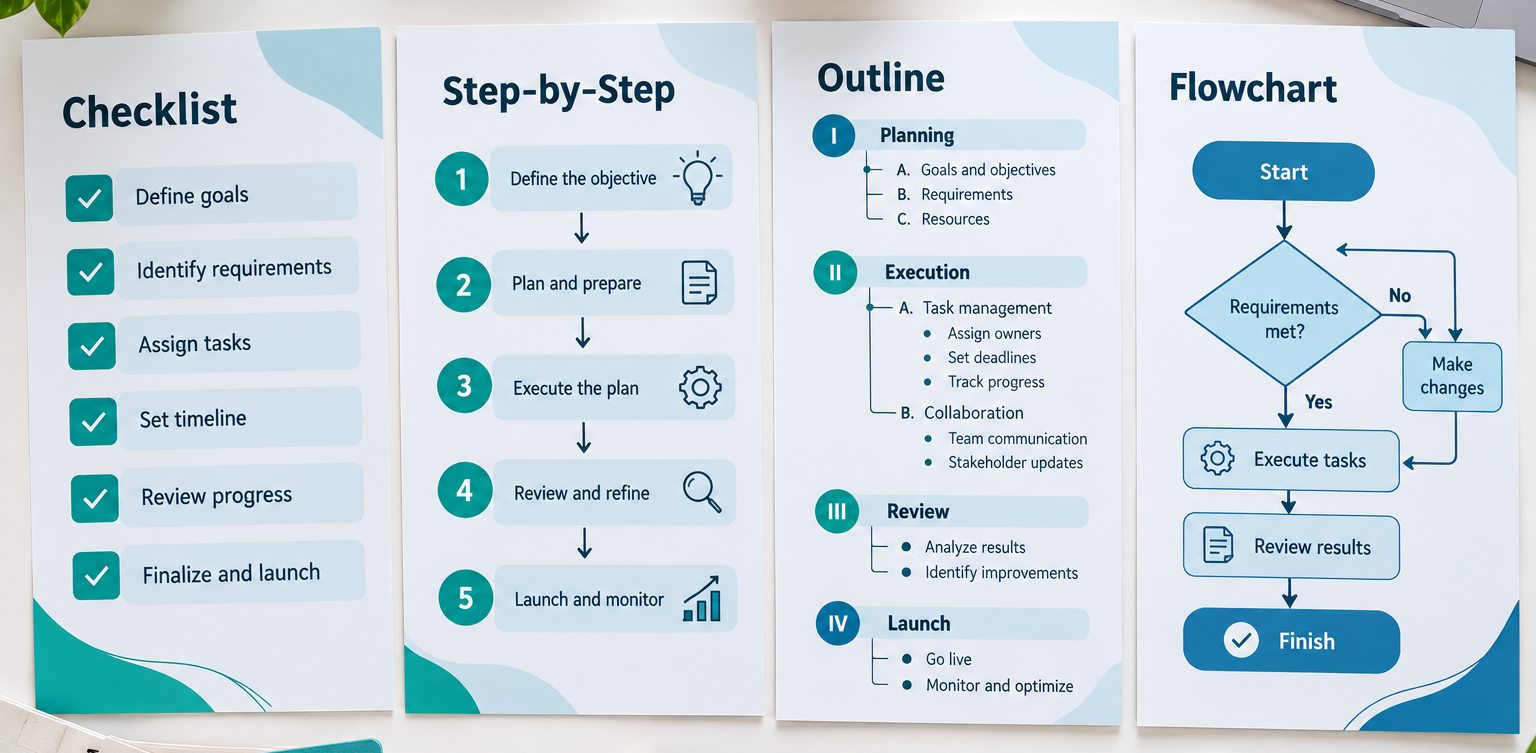
The main types of SOPs worth knowing break down into four groups. Checklists suit simple, order-independent tasks, like a storefront opening routine. Step-by-step instructions work for linear tasks where order matters, such as processing a payroll run. Hierarchical steps fit complex procedures with sub-steps and conditions, where step 3 might branch into 3a and 3b. Flowcharts work best when a process has decision points, like a customer complaint that routes differently based on severity.
Many assume a flowchart is always clearer because it’s visual. In reality, a flowchart for a straightforward linear task just adds clutter. Pick the lightest format that captures the real workflow. A one-page checklist people follow beats a detailed flowchart nobody reads.
Step 1: Identify the process and define scope and goals
Start with the process causing the most repeated confusion, not the one that’s easiest to write. The highest-value SOP documentation almost always targets a routine task only the founder currently knows how to do.
Define the purpose and scope before writing a single step. Purpose answers why the SOP exists; scope sets where it starts and stops.
- Name the specific process (for example, “approve and pay a vendor invoice”).
- Write one sentence on the purpose and the result a correct run produces.
- Define the scope: the clear trigger that starts it and the clear end point.
- Note what’s explicitly out of scope so the SOP stays focused.
- Set a simple success measure, like “paid within 48 hours, zero duplicate payments.”
Tight purpose and scope keep an SOP from sprawling into a vague document that tries to cover everything and guides nobody.
Step 2: Choose the right SOP format for the task
Now map the process you scoped to one of the formats. This is where most SOPs for business either click or fall flat, and it’s a core part of learning how to write an SOP well.
- List the task’s actions in rough order.
- Mark any point where the next action depends on a condition.
- No conditions and order matters? Use step-by-step instructions.
- Several conditions or branches? Use flowcharts or hierarchical steps.
- Order-independent items you just can’t miss? Use a checklist.
Choosing the SOP format up front saves you from rewriting the whole thing later.
Step 3: Gather input from the people who do the work
The fastest way to write an SOP nobody follows is to write it alone, from memory, at your desk. The person running the task daily knows the shortcuts, the exceptions, and the step that always goes wrong.
Sit with them. Watch one real run of the process. The version in a founder’s head is usually the ideal version, while the real workflow has detours the founder forgot or never saw.
- Identify the current process owner and anyone else involved.
- Observe or record one actual run, start to finish.
- Ask where the task commonly breaks or slows down.
- Note the exceptions, the “except when” cases that aren’t in the clean version.
- Confirm roles and responsibilities: who touches the process and when.
This input also catches handoffs between stakeholders that a solo draft would miss, and it’s one of the SOP best practices worth building into every draft to write an SOP that actually holds up.

Step 4: Include the essential SOP components (purpose, roles, procedure, resources)
A reliable standard operating procedure has a predictable skeleton. The core components of an SOP are the same whether you’re documenting a refund or a payroll run, which is what makes a consistent SOP template worth building once.
Include these components in every business standard operating procedures document:
- Title and ID so the SOP is findable and versioned.
- Purpose and scope carried over from Step 1.
- Roles and responsibilities: who does what, who approves, who’s accountable.
- Procedure: the actual step-by-step instructions, numbered and in order.
- Resources: tools, logins, templates, and links needed to run it.
- Owner and review date so the SOP stays alive.
Teams most often skip roles and the review date. This matters because an SOP without a named owner has nobody responsible for catching when it drifts out of date, and without clear roles, two people assume the other handled it, and the task falls through.
Step 5: Write the SOP with clear, right-level-of-detail instructions
Write for the least experienced person who’ll ever run this task. If a new hire can follow it on day one without a follow-up question, you’ve hit the right level of detail.
Use plain language and action verbs. “Click Approve in the billing system” beats “process the approval.” One action per step. Avoid jargon that assumes context the reader doesn’t have yet.
- Write each step as a single, concrete action.
- Start every step with a verb.
- Add a screenshot or example where a step is easy to misread.
- Flag decision points clearly (“if the invoice exceeds $5,000, route to Leah”).
- Read it back as if you’d never done the task before.
The common mistake is over-detailing obvious steps while skipping the tricky ones. Spend your detail budget on the exceptions and decision points, not on explaining how to open email.
Step 6: Review, test, and get approval before rollout
A draft SOP is a guess until someone who didn’t write it runs it. Testing is where the gaps surface.
Hand the SOP to a person who doesn’t normally do the task and have them follow it exactly, no improvising. Every place they get stuck is a place the instructions failed, not where the tester failed. Fix those, then route it for sign-off from the process owner and any stakeholders accountable for the outcome. Companies operating under formal quality systems will recognize this review-and-approval cycle from the ISO 9001 quality management standard, which treats documented, tested procedures as core to consistent output.
- Have a non-expert run the SOP word for word.
- Note every point where they hesitate or ask a question.
- Revise the unclear steps.
- Confirm compliance requirements are met if the process is regulated.
- Get formal approval and record the version and date.
Skipping this step is why so many SOPs sit unused: they were never checked against reality before launch.

Step 7: Implement, train, and keep SOPs updated as you grow
Approval isn’t the finish line. An SOP creates value only once it’s in use and the team has completed training on it.
Roll it out with a short walkthrough, store it where the team actually looks, and fold it into onboarding new employees so it becomes the default way the task gets done. Then schedule the part most companies skip: a review cadence to keep SOPs updated.
- Train the team with a live walkthrough, not just a shared link.
- Store the SOP in one findable, single-source location.
- Add it to your onboarding materials for the relevant role.
- Set a review date, quarterly for fast-changing processes.
- Give the named owner responsibility for process improvement over time.
SOPs written before a growth stage drift out of date quickly. Pairing each one with a review date and an owner is what helps keep your business systems usable as volume, tools, and headcount change, and it’s one of the simplest SOP best practices for staying ahead of that drift.
SOP template and example you can copy
Here’s a simple SOP template you can adapt today, useful shorthand for anyone still working out how to write an SOP from scratch. Copy it into a doc and fill each field:
Title / ID: [Process name + version]
Purpose: [Why this exists and the result]
Scope: [Where it starts, where it ends, what’s excluded]
Roles and responsibilities: [Who runs it, who approves, who’s accountable]
Procedure: [Numbered step-by-step instructions]
Resources: [Tools, logins, templates, links]
Owner / Review date: [Name + next review]
A quick SOP example for a refund: Purpose: issue approved refunds within 24 hours. Scope: starts when a refund request arrives, ends when the customer is notified. Procedure: (1) verify the order, (2) confirm it meets the refund policy window, (3) process in the payment system, (4) email confirmation. That SOP example shows the difference between the SOP (the steps) and the policy (the eligibility window). Compliance rules for refunds vary by state, so check your state’s consumer protection statute where relevant.
How SOPs reduce founder dependency and build operational visibility
The real payoff of SOPs for business isn’t the documents. It’s what they free up. When a routine task runs on documented workflows, the founder stops being the answer key for every exception, and delegation finally becomes real.
The issue usually isn’t effort; it’s visibility. With SOPs in place, leaders can see how business processes actually flow, where they slow down, and which ones need improvement, instead of guessing. That operational visibility and consistency can support more sustainable growth because you can only scale what you can see and measure. If you want an outside read on where your own visibility gaps are, a free 30-minute Readiness Audit is a low-lift way to find out before committing to a bigger documentation project.
Documenting SOPs is also where founder dependency starts to break. Four Indoor Courts helps founder-led companies design these business systems and the KPI frameworks that sit on top of them, turning scattered know-how into structure a team can run without the owner in the room. For founders who want ongoing support rather than a one-time project, The Advisor fractional COO guidance package is built to help keep those systems current as the business scales.

If your business is growing faster than your systems can support, the hardest part isn’t writing SOPs. It’s seeing which processes are quietly creating the most friction. A short conversation with Four Indoor Courts can help you find where operational bottlenecks are slowing your growth and what to document first. No pressure, just a clearer view of your next step.
FAQs
Q1. What are some real examples of SOPs in business?
A1.
Common examples include a client onboarding checklist, an employee offboarding workflow, an invoice approval process, and a customer complaint escalation script. In founder-led businesses, the most valuable first SOPs are usually the repetitive tasks only the founder currently knows how to do, like vendor negotiations or scheduling logic.
Q2. Can ChatGPT actually write SOPs for my business?
A2.
ChatGPT can draft a workable first version of an SOP if you feed it clear step-by-step input, but it can’t observe your actual workflow or catch the exceptions your team handles daily. Treat AI-generated SOPs as a rough draft that still needs a process owner to test and correct against real operations.
Q3. Is building SOPs actually worth the time for a small team?
A3.
For a 3-5 person team doing everything informally, full SOP documentation can feel like overkill and may not pay off yet. The inflection point tends to hit once a founder is the bottleneck for decisions in a $1M+ business, where undocumented processes directly slow hiring and delegation.
Q4. What happens if we write SOPs but nobody follows them?
A4.
This usually signals the SOP was written without input from the person doing the work, or there’s no accountability structure tied to it. SOPs only function as operational tools when paired with ownership, someone responsible for updating and enforcing them- not just a document in a shared drive.
Q5. Is there a set number of standard SOPs every business needs, like 25?
A5.
There’s no universal list of 25; the right number depends on your function count and where your business breaks down operationally. Most founder-led companies get more value from documenting the 5-10 processes causing the most repeated confusion than chasing a generic checklist.
Q6. What exactly counts as a business SOP versus just a policy?
A6.
An SOP is a documented, repeatable sequence of steps for completing a specific task, like how to process a refund, while a policy is a broader rule governing decisions, like a refund eligibility window. Businesses often confuse the two, which can lead to SOPs that are too vague to guide an employee’s actions.
Q7. Do SOPs become outdated fast as a business grows past $1M?
A7.
Yes, SOPs written before a growth stage often stop matching reality within months once new hires, tools, or client volume change the workflow. This is why SOPs tied to a KPI or review cadence stay usable longer than ones treated as a one-time documentation project.
Q8. Can SOPs alone fix operational chaos without other systems?
A8.
SOPs document what should happen, but they don’t fix the underlying structure if there’s no clear owner, no reporting line, or no way to measure whether the process is working. Founders who document SOPs without addressing organizational structure or accountability often see the same bottlenecks resurface within a few months.

Founder of Four Indoor Courts Consulting, Leah Norris helps founders and growing businesses create operational clarity through fractional COO leadership, KPI-driven analytics, and scalable operational strategy. With a background spanning operations, finance, analytics, marketing, and technology, Leah specializes in helping businesses improve visibility, streamline processes, strengthen accountability, and build the operational structure needed for sustainable growth.