
When your team is executing the same tasks differently every time, when bottlenecks appear faster than you can fix them, and when you can’t pinpoint where time or money is actually going, you’re not dealing with a people problem. You’re dealing with a process problem.
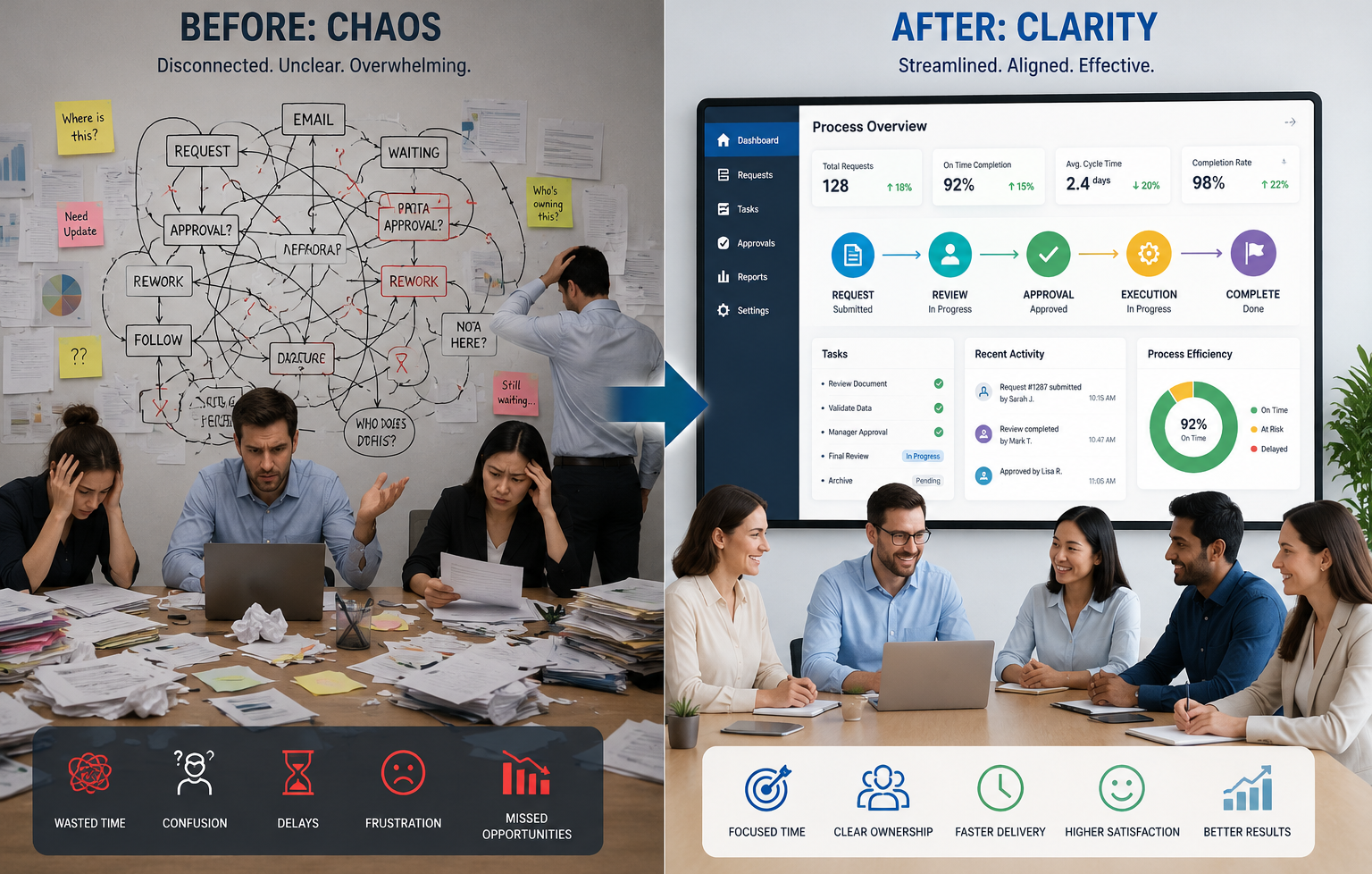
What is process optimization? It’s how growing businesses create operational clarity before chaos becomes the default. This guide walks through what process optimization actually means, when your business needs it, and how to implement it without overwhelming your team.
What is process optimization, and why does it matter
Process optimization is the practice of analyzing and refining existing business processes to eliminate inefficiencies, reduce waste, and improve outcomes. It’s not about working harder. It’s about identifying where effort is being wasted and restructuring workflows so teams can execute faster and more consistently.
For most growing businesses, operational problems start when processes that worked at 10 employees no longer work at 30. What many founders don’t realize is that scaling exposes operational weaknesses. Tasks that once took minutes now require approvals, handoffs, and rework. Bottlenecks appear in places that used to run smoothly.
Process optimization matters because it creates operational visibility. When you can see where delays happen, where errors originate, and where resources are being misallocated, you can fix problems before they compound. Without that visibility, you’re managing by intuition instead of data. The reason is simple: you can’t improve what you can’t measure, and you can’t measure what you can’t see.
In reality, most businesses already have the capacity to perform better. They just need clearer business systems. Process optimization helps you use what you already have more effectively before adding more people, tools, or budget.
Benefits and business value of process optimization
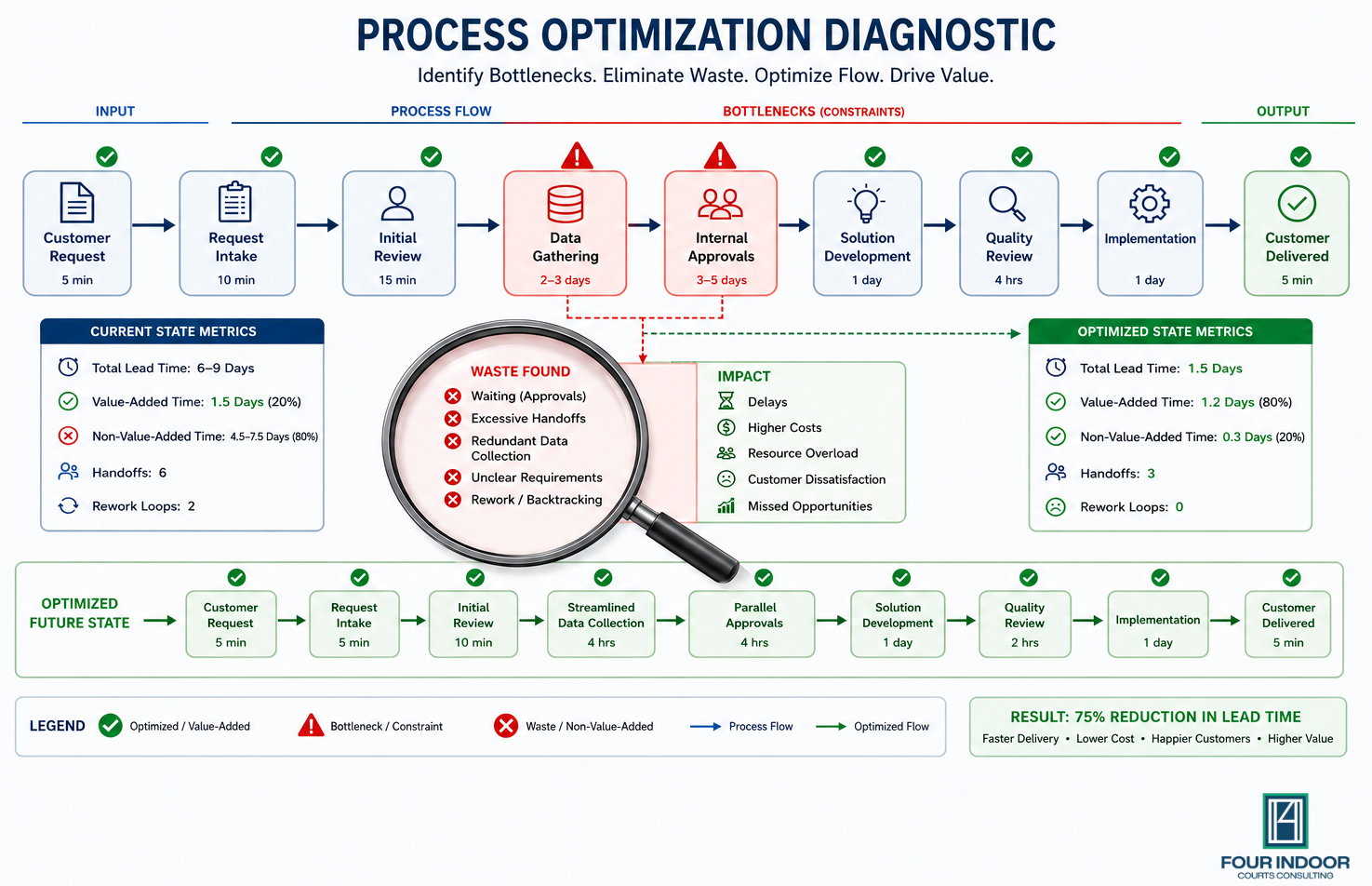
The business value of process optimization shows up in three areas: time, cost, and quality.
Time savings come from eliminating redundant steps and automating repetitive tasks. When you optimize operations, teams spend less time on coordination and more time on execution. Faster cycle times mean you can serve more customers without increasing headcount.
Cost reduction happens when you reduce waste and improve resource management. Many businesses are spending money on workarounds, rework, and inefficiencies they don’t even track. Process optimization identifies where resources are being misused and redirects them toward higher-value work.
Quality improvement results from consistency. When everyone follows the same process, errors decrease. Customer satisfaction improves because delivery becomes predictable. Teams experience less confusion and fewer bottlenecks.
Beyond these direct benefits, process optimization creates a competitive advantage. Businesses that operate efficiently can respond faster to market changes, scale more sustainably, and maintain quality during growth. Companies that don’t optimize eventually hit a ceiling where adding more people or tools no longer solves the underlying problem.
For small business owners, process optimization also reduces founder overwhelm. When business systems run predictably, leadership teams can focus on strategy instead of firefighting daily operational issues. The reality is that roughly 20% of small businesses fail within their first year, often due to operational inefficiencies that could have been addressed through systematic process optimization.
Process optimization methods and frameworks (Six Sigma, Lean, Kaizen, DMAIC)
Several proven frameworks guide business process optimization. Each offers a structured approach to continuous improvement and operational excellence.
Six Sigma focuses on reducing defects and variation in business processes. It uses data and statistical analysis to identify root causes of errors. Six Sigma projects follow the DMAIC framework: Define, Measure, Analyze, Improve, Control. This method works well when quality enhancement and consistency are the primary goals.
Lean methodology aims to eliminate waste and maximize value. Originally developed in manufacturing, Lean methodology principles now apply across industries. The focus is on identifying activities that don’t add value and removing them. Lean encourages continuous improvement by empowering teams to spot inefficiencies and suggest changes.
Kaizen method emphasizes small, incremental improvements over time. Rather than large-scale overhauls, Kaizen encourages teams to make ongoing adjustments. This approach reduces resistance to change and builds a culture of continuous improvement.
DMAIC is the structured problem-solving process used in Six Sigma. It breaks process optimization into five phases: Define the problem, Measure current performance, Analyze root causes, Improve the process, and Control to sustain gains. DMAIC provides clarity and accountability at each stage.
Most small businesses don’t need to adopt a full Six Sigma or Lean program. What matters is choosing a framework that matches your operational maturity and applying it consistently. Even simplified versions of these methods deliver measurable productivity gains.
Steps to implement process optimization in your business
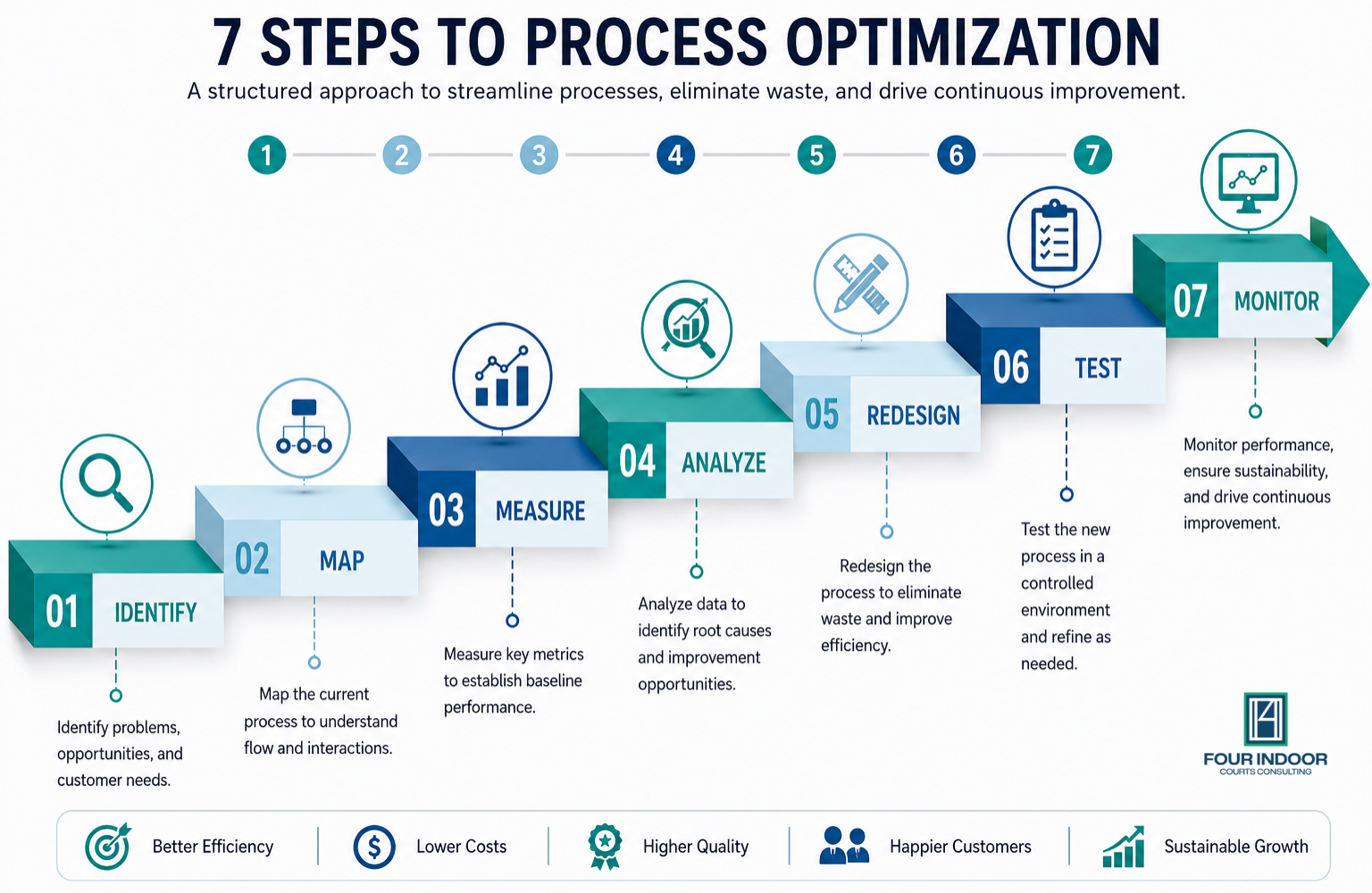
Implementing process optimization starts with understanding where friction actually exists. Many businesses skip this step and jump straight to solutions, which often means fixing the wrong problem.
Step 1: Identify the process to optimize
Start with business processes that directly impact revenue, customer satisfaction, or team productivity. Look for workflows where bottlenecks are obvious, errors are frequent, or cycle times are unpredictable.
Step 2: Map the current process
Process mapping documents every step, decision point, and handoff in the workflow. This creates visibility into how work actually gets done, not how you assume it gets done. Most businesses discover redundant steps or unclear ownership during this phase.
Step 3: Measure current performance
Establish baseline metrics before making changes. Track cycle time, error rates, resource usage, and any relevant key performance indicators (KPIs). Without measurement, you can’t prove whether optimization efforts are working.
Step 4: Analyze inefficiencies and root causes
Identify where delays occur, where rework happens, and where resources are wasted. Ask why each step exists and whether it adds value. This is where frameworks like DMAIC or Lean methodology provide structure.
Step 5: Redesign the process
Remove unnecessary steps, automate repetitive tasks, and clarify decision-making authority. The goal is to reduce cycle time and eliminate waste without sacrificing quality. According to research from McKinsey & Company, businesses that systematically redesign their core processes can achieve productivity improvements of 20-30% or more.
Step 6: Test and implement changes
Roll out the optimized process with a small team or pilot project first. Gather feedback and adjust before scaling across the business.
Step 7: Monitor and control
Process optimization isn’t a one-time project. Establish KPIs to track performance over time. Build accountability into the process so teams maintain improvements and flag new inefficiencies as they emerge.
For businesses experiencing operational chaos, working with a process improvement consultant or a fractional COO can accelerate progress. External support brings experience and objectivity that internal teams often lack.
Process optimization vs. process improvement: what’s the difference
The terms process optimization and process improvement are often used interchangeably, but they’re not the same.
Process improvement is a broad term. It refers to any effort to make a process better, whether through redesign, workflow automation, training, or restructuring. Process improvement can involve small tweaks or complete overhauls.
Process optimization is more specific. It focuses on refining existing processes to achieve measurable outcomes like faster cycle times, lower costs, or fewer errors. Optimization assumes the process structure is sound and targets inefficiencies within that structure.
Think of it this way: process improvement might mean redesigning your onboarding workflow from scratch. Process optimization means analyzing the current onboarding workflow, identifying where delays happen, and adjusting specific steps to reduce time without changing the overall structure.
For most small businesses, optimization is the better starting point. It delivers faster results with less disruption. You’re working within existing systems rather than rebuilding them entirely.
That said, some processes are beyond optimization. If a workflow is fundamentally broken or built around outdated assumptions, broader process improvement or redesign may be necessary. The issue usually isn’t effort. It’s visibility. Once you can see where the process fails, the right approach becomes clear.
5 clear signs your business needs process optimization now
Most businesses wait too long to address process issues. By the time optimization becomes urgent, inefficiencies have already compounded. Here are five signs your business needs process optimization now.
- Founder overwhelm is constant. If the business depends too heavily on the founder for decisions, approvals, or execution, you have a bottleneck. Growth without systems creates friction. Process optimization reduces dependency on any single person by clarifying workflows and decision-making authority.
- The same tasks produce inconsistent results. When different team members execute the same process differently, quality suffers. Inconsistency signals a lack of documentation, training, or accountability. Optimizing the process creates a repeatable standard that everyone follows.
- You’re hiring, but productivity isn’t increasing. Adding headcount should improve output. If it doesn’t, the problem is process, not people. Operational bottlenecks and unclear workflows prevent new hires from contributing effectively. Optimization removes those barriers.
- Errors and rework are frequent. Mistakes happen, but if your team is constantly fixing the same issues, the process is broken. Process optimization identifies where errors originate and builds quality checks into the workflow.
- You can’t explain where time or money goes. Without operational visibility, you’re managing blind. If you don’t have clear data on cycle times, resource usage, or process performance, you can’t make informed decisions. Process optimization starts with measurement and creates the visibility leadership teams need.
If any of these signs sound familiar, process optimization isn’t optional. It’s the foundation for sustainable growth. Businesses that address these issues early scale more effectively than those that wait until operational chaos forces change.
How process optimization differs for SMBs vs. enterprises
Process optimization looks different depending on business size. What works for an enterprise doesn’t always translate to a small business, and vice versa.
Enterprises have dedicated process management teams. They can invest in Six Sigma certifications, hire process consultants, and run multi-month optimization projects. They have the budget and bandwidth to implement complex frameworks and track detailed KPIs.
Small businesses (SMBs) operate more leanly. Most don’t have a full-time operations leader. Founders and leadership teams are managing process optimization alongside everything else. That means SMB process optimization needs to be faster, simpler, and more practical.
For SMBs, the focus should be on high-impact processes first. Don’t try to optimize everything at once. Start with workflows that directly affect revenue, customer satisfaction, or team productivity. Use simplified versions of frameworks like DMAIC or Lean rather than full-scale implementations.
Enterprises often optimize for incremental gains across large-scale operations. A 2% efficiency improvement across 500 employees delivers massive business value. For a small business, a 2% gain might not move the needle. SMBs need optimization efforts that deliver 20% to 50% improvements in cycle time or cost.
Another difference is flexibility. Small businesses can implement changes faster because they have fewer layers of approval and less organizational inertia. That’s an advantage. Use it. Test changes quickly, gather feedback, and adjust.
Finally, SMBs benefit more from fractional or advisory support. Hiring a full-time process consultant or COO often isn’t realistic. Working with fractional COO services gives you access to expertise without the overhead of a full-time hire.
Common process optimization mistakes founders make during growth
Founders often approach process optimization with good intentions but make predictable mistakes that slow progress or create new problems.
Mistake 1: Optimizing the wrong process first
Many founders start with processes that are easy to fix rather than processes that matter most. Optimizing your internal meeting structure won’t help if your customer onboarding workflow is broken. Focus on business operations that directly impact revenue, delivery, or customer satisfaction.
Mistake 2: Skipping measurement
You can’t improve what you don’t measure. Founders often implement changes based on intuition without establishing baseline metrics. Without data, you don’t know if optimization efforts are working or just creating the illusion of progress.
Mistake 3: Over-complicating the solution
Process optimization doesn’t require expensive software or complex frameworks. Many businesses add tools and steps when the real solution is removing unnecessary complexity. Start simple. Eliminate waste before adding automation.
Mistake 4: Ignoring team input
The people executing the process every day know where the inefficiencies are. Founders who design optimized processes in isolation often miss critical details. Involve your team early and gather feedback before rolling out changes.
Mistake 5: Treating optimization as a one-time project
Process optimization is not a one-and-done effort. Business processes degrade over time as teams grow, tools change, and priorities shift. Build continuous improvement into your operations so optimization becomes an ongoing practice, not a periodic crisis response.
Mistake 6: Assuming all processes need to be perfect
Not every process deserves the same level of attention. Some workflows are fine being “good enough.” Focus optimization efforts on high-impact areas and accept that lower-priority processes can remain imperfect.
If you’re making any of these mistakes, you’re not alone. Most founders do. The key is recognizing them early and adjusting your approach. Working with an experienced operational excellence consultant can help you avoid common pitfalls and focus on changes that actually deliver business value.
If your business is growing faster than your systems can support, understanding what process optimization is and how to apply it can be the difference between sustainable scaling and operational breakdown. Schedule a call with Four Indoor Courts to explore how fractional COO support and targeted process optimization can create the operational clarity your business needs to scale without chaos.
FAQs
Q1. What is process optimization?
A1. Process optimization is the practice of analyzing and refining existing processes to eliminate inefficiencies, reduce waste, and improve measurable outcomes like cycle time, cost, and quality. It focuses on making current workflows more effective without requiring complete redesigns.
Q2. What does process optimization actually accomplish for a business?
A2. Process optimization reduces operational costs, shortens cycle times, improves customer satisfaction, and increases productivity. It creates operational visibility, enabling leadership teams to make better decisions and scale more sustainably without constantly adding headcount or budget.
Q3. Can you give an example of process optimization in action?
A3. A small business reduced customer onboarding time from 14 days to 6 days by mapping the process, identifying approval bottlenecks, and automating repetitive tasks. The result was faster revenue recognition and improved customer satisfaction without hiring additional staff.
Q4. What are the main methods used for process optimization?
A4. The most common methods are Six Sigma, Lean, Kaizen, and DMAIC. Six Sigma focuses on reducing defects, Lean eliminates waste, Kaizen emphasizes continuous improvement, and DMAIC provides a structured five-phase problem-solving framework.
Q5. How is process optimization different from general process improvement?
A5. Process optimization targets specific, measurable outcomes within existing processes, such as reducing cycle time or costs. Process improvement is broader and can include redesigning workflows entirely, not just refining them.
Q6. What if our processes are too unique or complex to optimize?
A6. Most businesses overestimate how unique their processes are. Even complex workflows benefit from eliminating waste, clarifying decision-making, and improving visibility. If a process feels too complex to optimize, that’s often a sign it needs optimization more than simpler workflows do.

Founder of Four Indoor Courts Consulting, Leah Norris helps founders and growing businesses create operational clarity through fractional COO leadership, KPI-driven analytics, and scalable operational strategy. With a background spanning operations, finance, analytics, marketing, and technology, Leah specializes in helping businesses improve visibility, streamline processes, strengthen accountability, and build the operational structure needed for sustainable growth.