

A founder hits $1.2M in revenue and suddenly can’t take a vacation without three phone calls a day. The team is bigger, and revenue is up, yet everything feels harder to manage than it did at $400K. This is where business process optimization stops being a nice-to-have. It becomes the thing standing between you and a business that runs without you. This article walks through what optimization actually is, the steps to do it, the frameworks worth knowing, and why growth tends to break the systems that got you here.

What is business process optimization (definition)
Business process optimization is the practice of examining how work actually gets done. You then reshape those business processes to cut waste, lower costs, and get better results. It’s not about working harder. It’s about removing the friction that quietly eats hours, budget, and patience every week.
Here’s the distinction that trips people up. Many assume optimization means small tweaks to what already exists. In reality, it often means you redesign processes from the ground up when the old structure can’t support where the business is headed. Process improvement refines. Optimization is about tearing something down and rebuilding it.
The reason this matters is simple. A process built for a five-person team rarely survives a twenty-person team. The workflow that felt clever at the start becomes the bottleneck later. This is a core part of optimizing your small business operations for sustainable growth, where structure has to keep pace with scale.
The American Society for Quality provides overview of continuous improvement models and explains how structured analysis leads to lasting operational efficiency rather than one-off fixes. Optimization sits on that foundation, aimed squarely at aligning daily operations with real growth goals.
Step-by-step process to optimize a business process
The steps to optimize a process follow a consistent sequence. Skipping any of them usually means you fix the wrong thing.
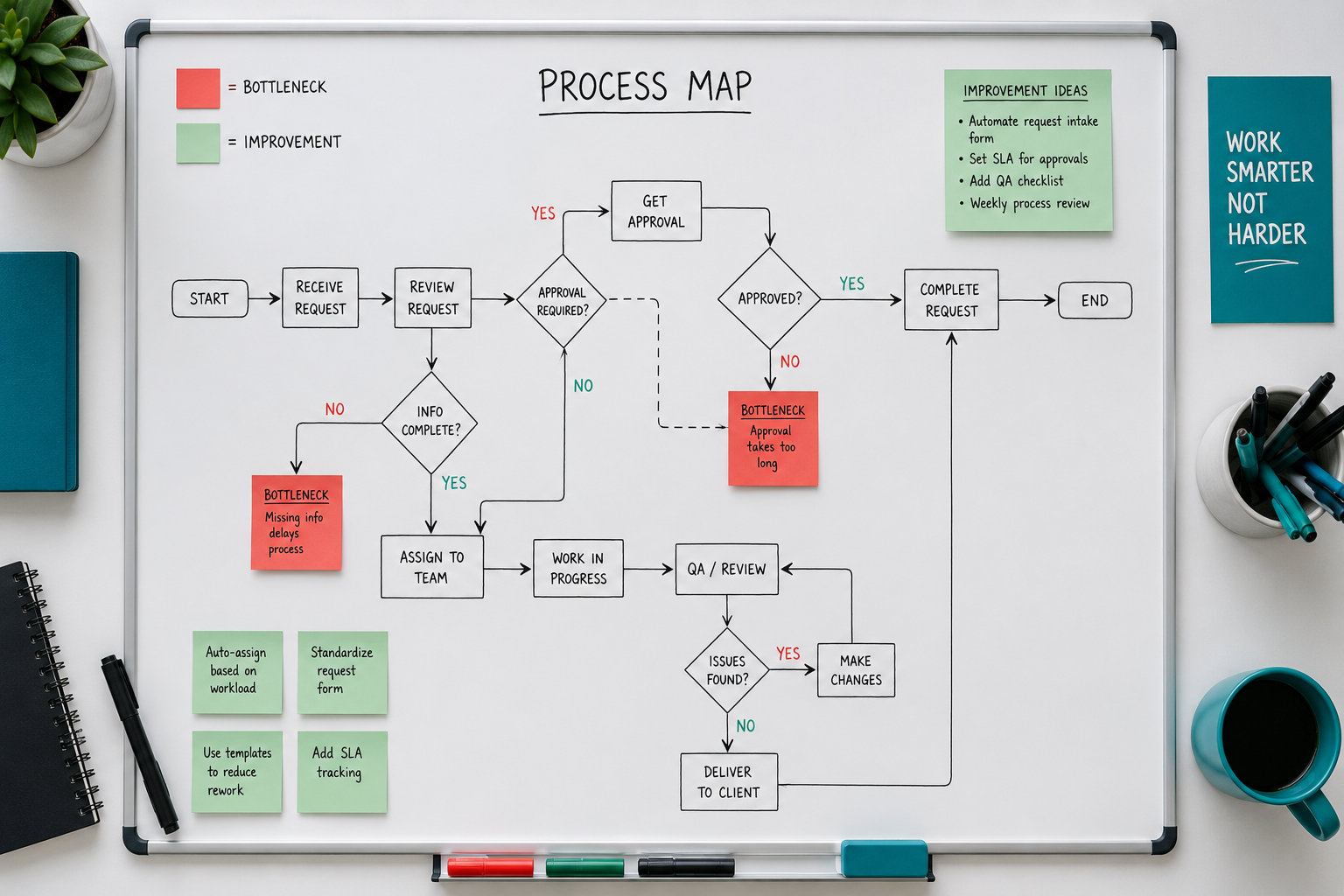
Start with process mapping. Document how the work actually flows today, not how you think it flows. What many founders don’t realize is that the real process rarely matches the handbook. Then analyze that map against your KPIs. Look for bottlenecks, redundant approvals, and manual handoffs that stall progress.
Next, set specific goals. “Faster” is not a goal. “Cut invoice approval from four days to one” is. From there, you redesign or automate the weak points, then measure the results to know whether the change worked. If you want the full sequence laid out, we’ve documented a step-by-step business process optimization strategy in 7 steps that you can follow. These steps to optimize a process are where continuous improvement lives. You don’t optimize once and walk away.
The Lean Enterprise Institute publishes practical guidance on this. Their material on value stream mapping shows how visualizing a process end to end exposes waste you’d otherwise miss.
One caution: performance monitoring rules and reporting requirements can vary by industry and jurisdiction. Verify any regulated processes with the relevant authority before you redesign them.
Benefits of business process optimization (cost, time, satisfaction)
The benefits of business process optimization show up in three measurable areas: cost, time, and satisfaction.
Regarding cost, removing redundant steps and automating repetitive tasks can lower operational costs. You stop paying skilled people to do work a system could handle. On time, shorter cycle times mean orders ship faster, invoices clear sooner, and clients get answers without a three-day delay.
Then there’s customer satisfaction. When your workflow is consistent, the client experience no longer depends on which employee picked up the work. Consistency builds trust, and trust supports retention.
There’s a fourth benefit founders underrate: operational visibility. Once a process is mapped and monitored, you can see where things break instead of guessing. That visibility lets you make decisions based on data rather than gut feeling.
The through-line across the benefits is the value of your own time and stronger operational efficiency across the company. A founder who isn’t approving every invoice or answering every operational question has room to lead. That’s the difference between a job you own and a business you run, and it’s one of the proven ways to grow a small business past $1M without burning out.
Optimization methods and frameworks (Lean, Six Sigma, Kaizen, DMAIC)
You don’t need to master every framework. You need to know which one fits the problem in front of you.
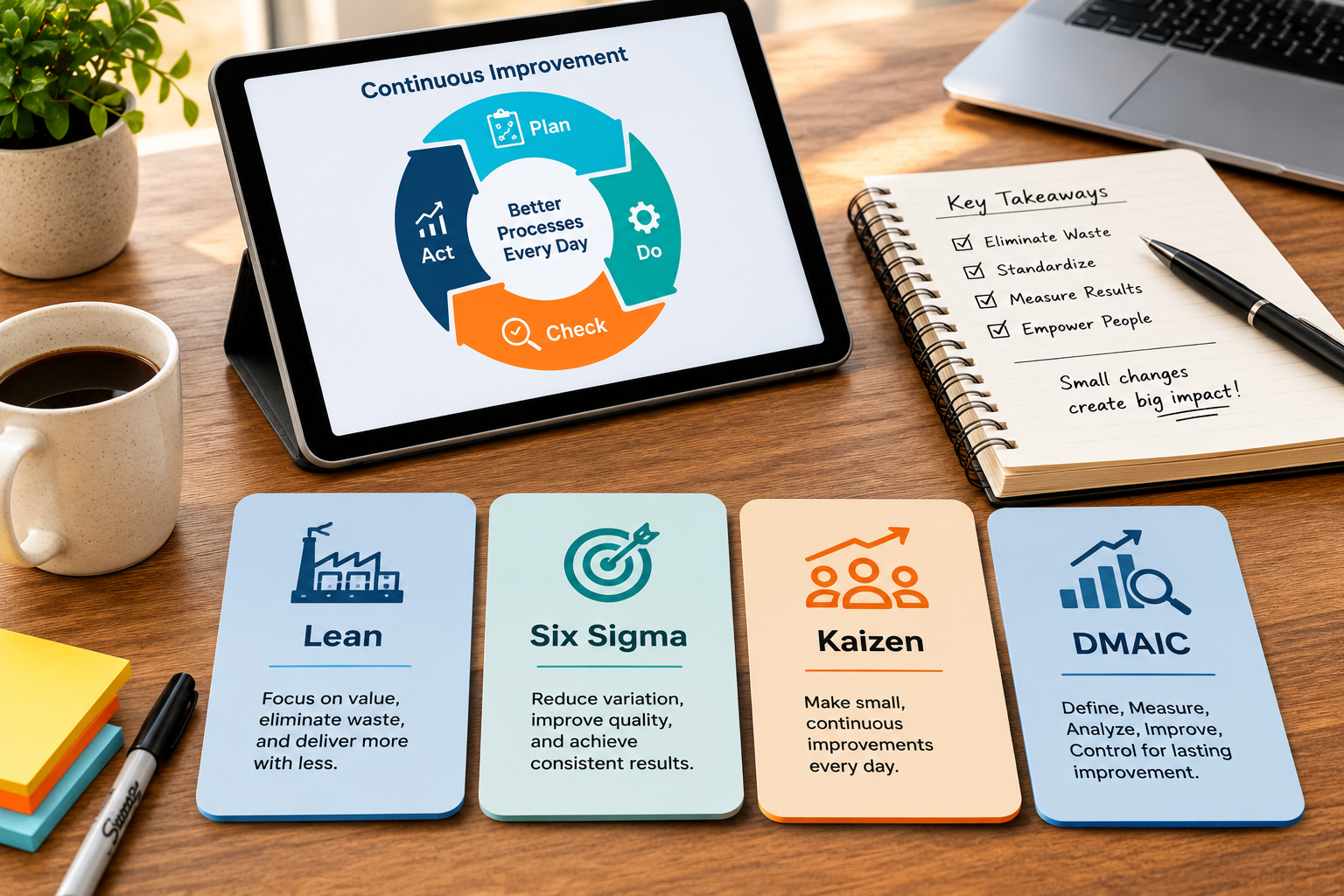
Lean is about eliminating waste, anything that doesn’t add value for the customer. It’s the right lens when your process is bloated with unnecessary steps, waiting, or rework. Six Sigma attacks variation and defects, so it fits when your problem is inconsistency: the same task producing different results depending on who does it.
Six Sigma’s engine is DMAIC: Define, Measure, Analyze, Improve, Control. Define the problem, measure current performance, analyze the root cause, improve the process, then control it so the gains stick. That last step is where most efforts fail. People fix the issue and never build the guardrails to keep it fixed, so the process drifts back to its old state within months.
The kaizen method takes a different angle. Instead of one big overhaul, it’s continuous improvement through small, ongoing changes made by the people doing the work. It’s culture as much as method.
Most real-world process optimization strategies draw on several of these. You might use Lean thinking to spot waste, DMAIC to structure the fix, and kaizen to keep improving after the consultant leaves. A sound process optimization strategy serves the goal, not the other way around.
Mapping and analyzing current processes to find inefficiencies
Process mapping is where optimization either succeeds or dies. You can’t fix what you can’t see.
Sit with the people who do the work and trace a single process end-to-end. Every handoff, every approval, every “then I email it to Sarah who forwards it to accounting.” Write it down exactly as it happens. The gap between the official process and the real one is where inefficiencies hide.
Once the map exists, analyze it against your KPIs. Where do things wait? Where does the same information get re-entered three times? Where does one person’s inbox become a wall the whole workflow slams into? Those operational bottlenecks are your targets.
I once worked with a services firm around $2M in revenue where onboarding took eleven days, and nobody knew why. The map showed it plainly. Three separate people were manually copying the same client data into three different systems, each waiting on the one before. As process optimization examples go, this was textbook. The work was real. The design was the problem. It echoes a familiar pattern we’ve written about: when soaring sales masked a failing operational foundation.
What actually happens is that businesses normalize these delays. They feel routine, so they stop looking like problems. Mapping makes them impossible to ignore, which is the first real step toward process redesign.
When to involve a process optimization consultant
Some problems you can solve internally. Others need an outside operator who isn’t emotionally attached to how things have always been done.
Bring in a business process optimization consultant when the same bottlenecks keep resurfacing, when growth has outpaced your systems, or when your leadership team is too buried in daily execution to step back and redesign anything. That last one is common. You can’t fix the engine while driving at full speed.
A good business process optimization consultant does what your team can’t easily do from the inside. They see the inefficiencies quickly, map the current state without ego, and build a plan you can execute to sharpen operations. The value isn’t just the strategy. It’s the objectivity, because someone who didn’t build the current process has no reason to defend it.
For founders drowning in operations, this is exactly the gap four-indoor-courts fills with fractional COO support and senior operational leadership on a part-time basis, so you get the expertise without the full-time executive cost. If you’re weighing this option, it helps to understand what fractional COO services actually include before you commit.
One honest caveat: a consultant works only if leadership commits to implementation. Results vary based on execution, market conditions, and the extent to which the new business systems are adopted.

Why growth outpaces and breaks operational systems
Growth without systems creates friction. That’s not a slogan. It’s a mechanical reality.
Here’s the root cause. The business processes that carry a company from zero to $1M are usually held together by the founder’s memory and a handful of loyal employees who “just know” how things work. That’s fine at small scale. But every new hire, new client, and new product multiplies the handoffs, and undocumented processes don’t scale. They snap.
Most operational problems start when volume grows faster than structure. Revenue climbs, the team expands, and suddenly nobody has full visibility into what’s actually happening. Decisions bottleneck at the top because the founder is still the only person who understands the whole picture. That’s founder overwhelm in a sentence.
Scaling exposes operational weaknesses that were always there, just hidden under lower volume. The reactive workarounds that felt scrappy at ten clients become chaos at fifty. These scaling challenges aren’t failure. They’re the predictable result of growth arriving before business systems were built to hold it.
The fix isn’t more effort. It’s the operational visibility and structure that let the business scale responsibly instead of running on adrenaline.
How fractional COO leadership drives sustainable optimization for SMBs
Most SMBs need senior operational leadership long before they can justify a full-time COO salary. That’s the gap a fractional COO closes.
A fractional COO brings experienced operational leadership on a part-time basis. This is someone who has seen founder overwhelm before and knows the path forward. They install business systems, build KPIs, and lead the work needed to sharpen operations. The company then runs on structure and can achieve operational efficiency rather than relying on the founder’s constant attention. This isn’t theory. It’s execution.
The reason this model works is economics plus focus. You get senior expertise applied exactly where bottlenecks are slowing you down, without the overhead of a full executive hire. Digital transformation efforts, automation rollouts, and performance monitoring all land better when someone owns them end to end, because scattered ownership is exactly what lets improvements stall.
four-indoor-courts delivers this through tiered fractional COO engagements, from advisory support for overwhelmed founders to full strategy-to-execution alignment, matched to where your operations actually hurt.
The goal isn’t a one-time cleanup. It’s sustainable growth built on continuous improvement and business process optimization that becomes routine, where the business can get steadier and more scalable as it grows, not more chaotic.

If your business is growing faster than your systems can support, the friction usually isn’t a people problem. It’s a visibility and structure problem. A short conversation with four-indoor-courts can help you pinpoint where operations are slowing your growth and map out a practical path to fix it. You can also start with a free 30-minute Readiness Audit with Leah Norris to see where the biggest opportunities are.
FAQs
Q1. What is business process optimization, and how does it actually work?
A1.
Business process optimization is the practice of analyzing existing workflows to eliminate waste, reduce costs, and align operations with your business goals. It works by identifying bottlenecks, redesigning or automating inefficient steps, and measuring results against clear performance targets.
Q2. What are the steps to optimize a business process?
A2.
Start by mapping your existing process to see how work actually flows, then analyze performance using KPIs to spot bottlenecks and redundancies. From there, set improvement goals, redesign or automate the weak points, and track the results so you can keep refining over time.
Q3. What's the difference between business process optimization and business process improvement?
A3.
Business process improvement (BPI) makes incremental fixes to existing workflows without changing their underlying structure. Business process optimization takes a broader view, often redesigning processes, integrating new technology, or automating tasks to achieve optimal performance.
Q4. How is BPM different from BPR?
A4.
Business Process Management (BPM) focuses on running and improving your existing processes more efficiently. Business Process Re-engineering (BPR) goes further by replacing processes with entirely new ones to cut day-to-day operating costs and rethink how work gets done.
Q5. What if my team is already stretched thin; won't optimizing processes just add more work?
A5.
Done right, optimization removes work rather than adding it by cutting redundant steps and automating repetitive tasks. The upfront effort is mapping and analysis, which a fractional COO or consultant can lead so your team isn’t pulled off their core responsibilities.
Q6. What do optimized processes look like in practice?
A6.
Common examples include streamlining supply chain and procurement with just-in-time inventory, consolidating overlapping departments, and automating manual handoffs between teams. In service businesses, it often means standardizing client onboarding or reporting to keep quality consistent as volume grows.

Founder of Four Indoor Courts Consulting, Leah Norris helps founders and growing businesses create operational clarity through fractional COO leadership, KPI-driven analytics, and scalable operational strategy. With a background spanning operations, finance, analytics, marketing, and technology, Leah specializes in helping businesses improve visibility, streamline processes, strengthen accountability, and build the operational structure needed for sustainable growth.