
A founder crosses $1M in revenue, hires three people to keep up with demand, and six months later works more hours than before the growth happened. The sales strategy worked. What broke was everything underneath it. That gap between deciding where the business is headed and building the internal machine to get there is exactly where corporate planning and strategic planning separate. Most small business founders only learn the difference the hard way. This article breaks down what each one is, how they fit together, and where the real work sits for a business outgrowing its own systems.

What is strategic planning, a plain-language definition for founders
Strategic planning is the process of deciding where your business is going over the next three to five years. It also decides how you will win against everyone else trying to serve the same customers. That’s it. Everything else is detail hanging off that decision.
So what is strategic planning in practice? It answers a small set of hard questions. Who exactly do we serve? What do we do better than the alternatives? Where will we not compete? A strategic plan captures those answers along with your mission and vision, your strategic goals and objectives, and the measures you’ll use to tell whether you’re getting there.
This matters for small business founders because growth forces choices you can’t avoid. Say yes to every opportunity, and you dilute the business into mediocrity. Strategic planning is where you make those trade-offs on purpose instead of by accident. The U.S. Small Business Administration’s guide to writing a business plan walks through many of these same building blocks, which tells you how foundational they are. This is also closely tied to building an operational excellence strategy, where those trade-offs get translated into how the business actually runs.
Many founders assume strategic planning is a once-a-year offsite that produces a document nobody opens again. In reality, a useful plan is a living reference for decision-making. You revisit it whenever the market shifts or a big resourcing question comes up.
What is corporate planning and how does it differ from strategic planning
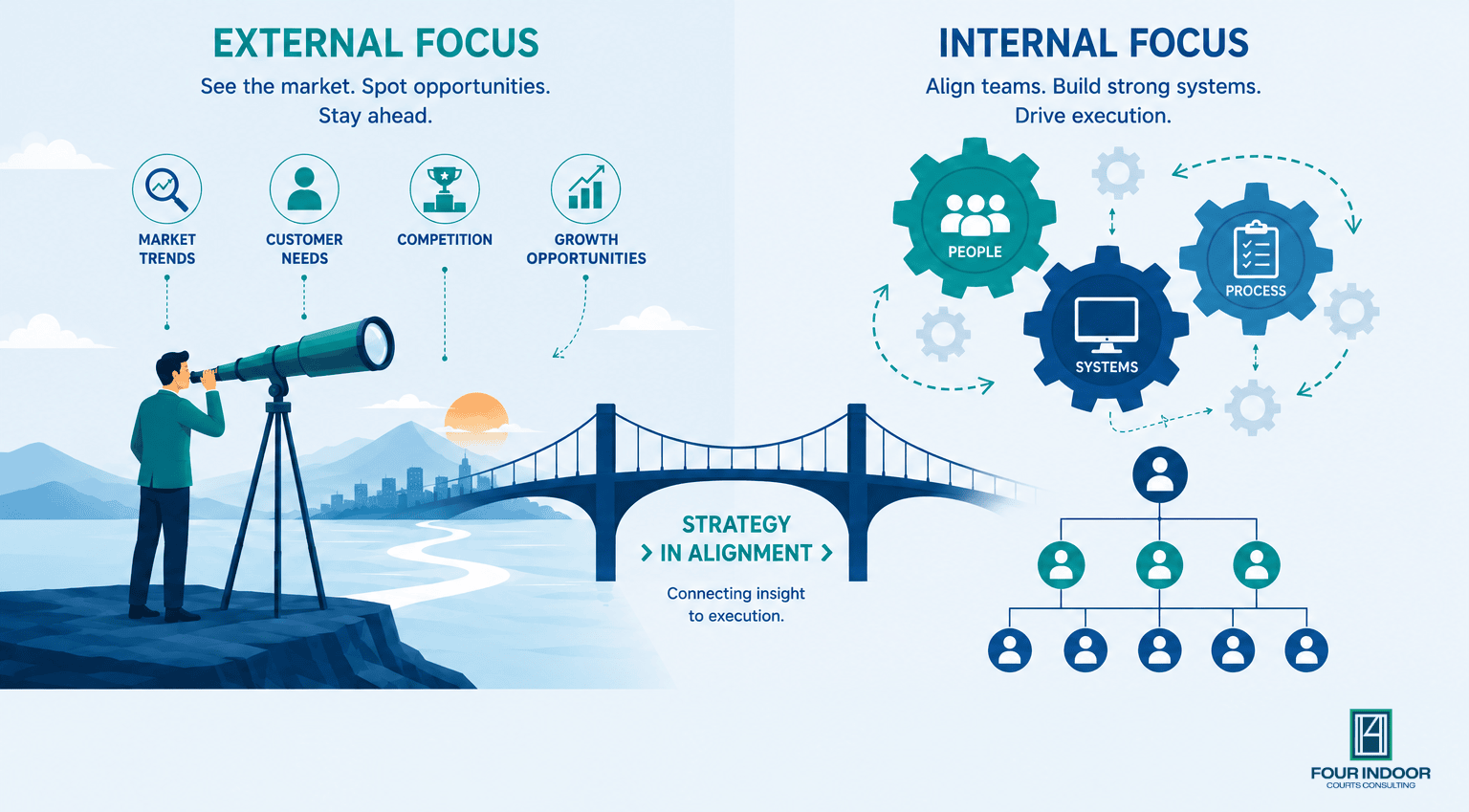
Corporate strategic planning starts where strategic planning leaves off. Strategy decides where to go and how to compete. Corporate planning organizes the inside of the business to deliver it: the structure, the departments, the policies, and the shared services like finance, HR, and marketing that every part of the company draws on.
Here’s the cleanest way to see the split. Strategic planning is outward-facing and often targets a specific business unit or product line. Corporate strategic planning is inward-facing and covers the whole organization at once. One asks “how do we win the market?” The other asks “how do we arrange ourselves so we can?”
What happens when a business skips the corporate layer is that strategy stays trapped in the founder’s head. Decisions still route through one person, because no structure exists to distribute them. This is the founder-dependency trap, and it stalls more sub-$5M businesses than any market problem does. Research from McKinsey on organizational health and performance points to how much internal design drives long-term success.
The practical upshot: corporate planning is what converts a strategic plan into an operating company. It’s less glamorous than strategy, and far more often the thing that’s missing. If you want a fuller picture of the operational side, our breakdown of the 6 steps to grow a small business past $1M walks through exactly where this corporate layer tends to break first.
Corporate planning vs. strategic planning vs. business planning
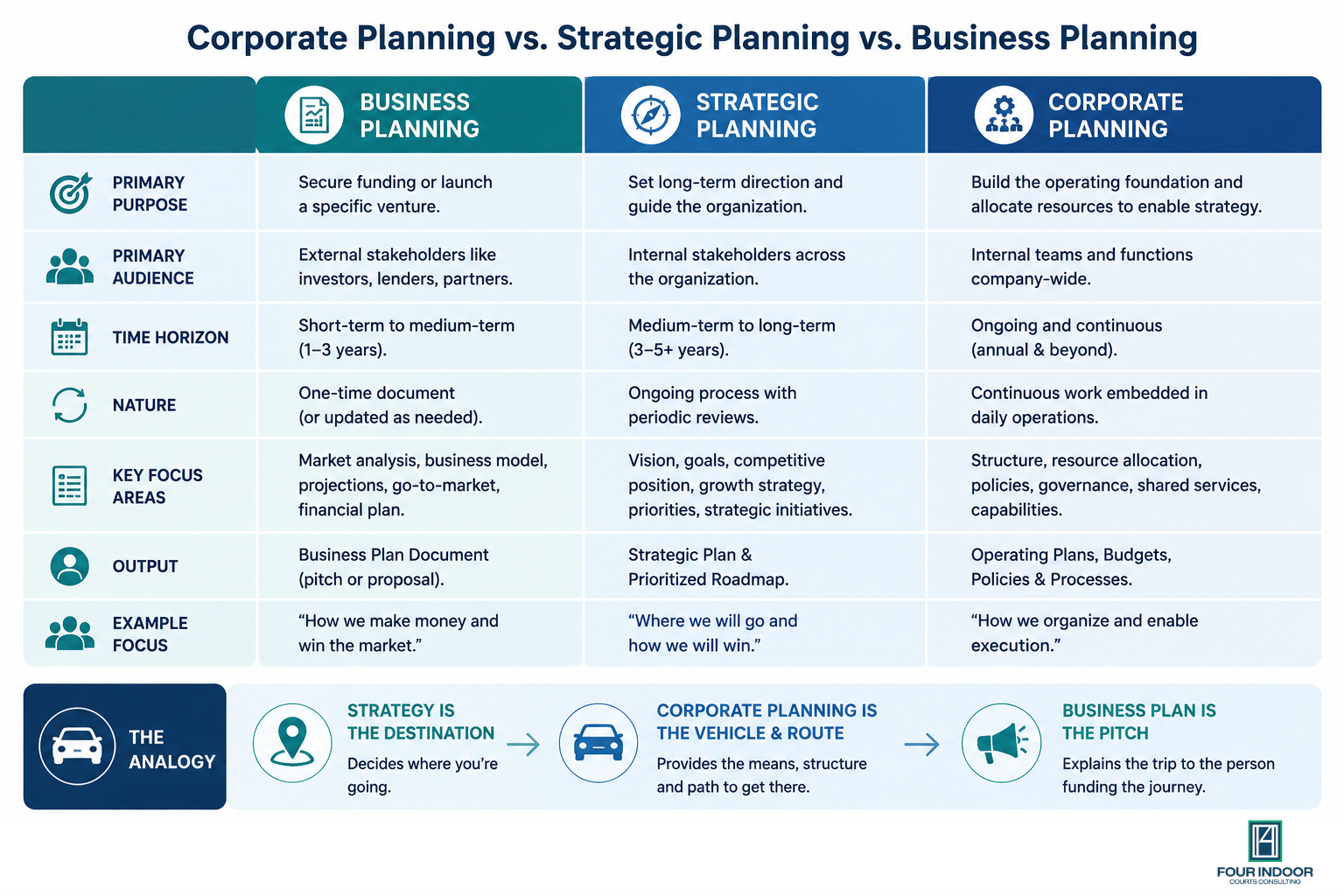
Founders often treat these three as one thing. They aren’t, and the confusion costs time. Here’s the business plan vs strategic plan distinction laid out simply.
A business plan is a specific document, usually written to raise money or launch a venture. It covers the model, the market, projections, and how the company makes money. It’s often a one-time artifact aimed at outsiders like lenders or investors.
A strategic plan is different. The business plan vs strategic plan comparison comes down to audience and purpose. The strategic plan is internal, ongoing, and about direction over years rather than a snapshot for a bank. It sets the business strategy the whole company steers by.
Corporate planning sits underneath both. It’s the ongoing work of organizing structure, resource allocation, and shared services so strategy can happen. Think of it as the operating layer connecting long-term direction to who does what.
A rough analogy: strategy is the destination, corporate planning is the vehicle and route, and the business plan is the pitch you give the person funding the trip. You can name the destination all day, but without a working car and a route, nobody moves. Different types of corporate strategy, from growth strategies to consolidation, all still need this operating layer beneath them, or they never leave the page.
Why strategic planning matters (especially for growing businesses)
Growth exposes operational weaknesses. A business at $500K can run on the founder’s instinct and a group chat. At $2M, that same approach produces bottlenecks, missed handoffs, and a leadership team pulling in different directions because nobody wrote down the priorities.
Strategic planning matters here for a specific reason. It gives you a shared answer to “what are we actually optimizing for?” Without it, teams make locally reasonable decisions that don’t add up. Sales chases revenue that operations can’t fulfill. Marketing generates leads for a product the roadmap is quietly killing. The root cause is almost never lazy people. It’s the absence of a strategic plan everyone can point to when priorities collide. We saw this play out in a case study where soaring sales exposed a failing operations gap: demand outran the systems meant to fulfill it.
Strong strategic management also protects you from the opposite failure: reacting to every shiny opportunity. The discipline of strategic management makes clear strategic goals and objectives easier to hold. That’s where much sustainable growth tends to come from.
Consider a service agency that doubled headcount to chase every inbound lead. Within a year, margins collapsed because half the new work didn’t fit their model, and the founder spent nights firefighting delivery. A strategic plan naming which clients to pursue would have prevented most of it. That’s the difference between growth and sustainable growth.

The steps in the strategic planning process
The strategic planning process isn’t mysterious, but it does have an order that matters. Skip a step and the later ones wobble.
- Run a situational analysis. Understand your market, customers, and internal capabilities honestly. Most teams use a SWOT analysis here: strengths, weaknesses, opportunities, threats. A SWOT analysis is only useful if you’re brutally honest in the weaknesses quadrant, where founders tend to flatter themselves.
- Set your mission and vision. Mission is why you exist today. Vision is where you’re going. These aren’t wall decorations. A clear mission and vision act as the filter every later decision passes through.
- Define strategic goals and objectives. Turn direction into three to five concrete targets with numbers and dates. Doing this well means you also need to identify the right KPIs to track progress, or those targets stay aspirational rather than measurable.
- Decide the strategy itself. Set the business strategy for how you’ll reach those goals, including which growth strategies you’ll bet on and which you’ll pass up.
- Translate it into action plans: who does what, by when, with what resource allocation. Action plans are where strategy stops being a slide.
These key components of the strategic planning process aren’t optional. Skipping any of them, especially the action plans, leaves you with ambition but no accountability. That’s where most strategic planning quietly dies.
From strategy to execution: connecting plans to daily operations
A finished strategic plan is worth nothing until it changes what people do on Tuesday morning. Strategy execution is the part everyone underestimates. Most strategies fail in execution, not in design, because a plan built in a conference room rarely comes with the operating structure to carry it out.
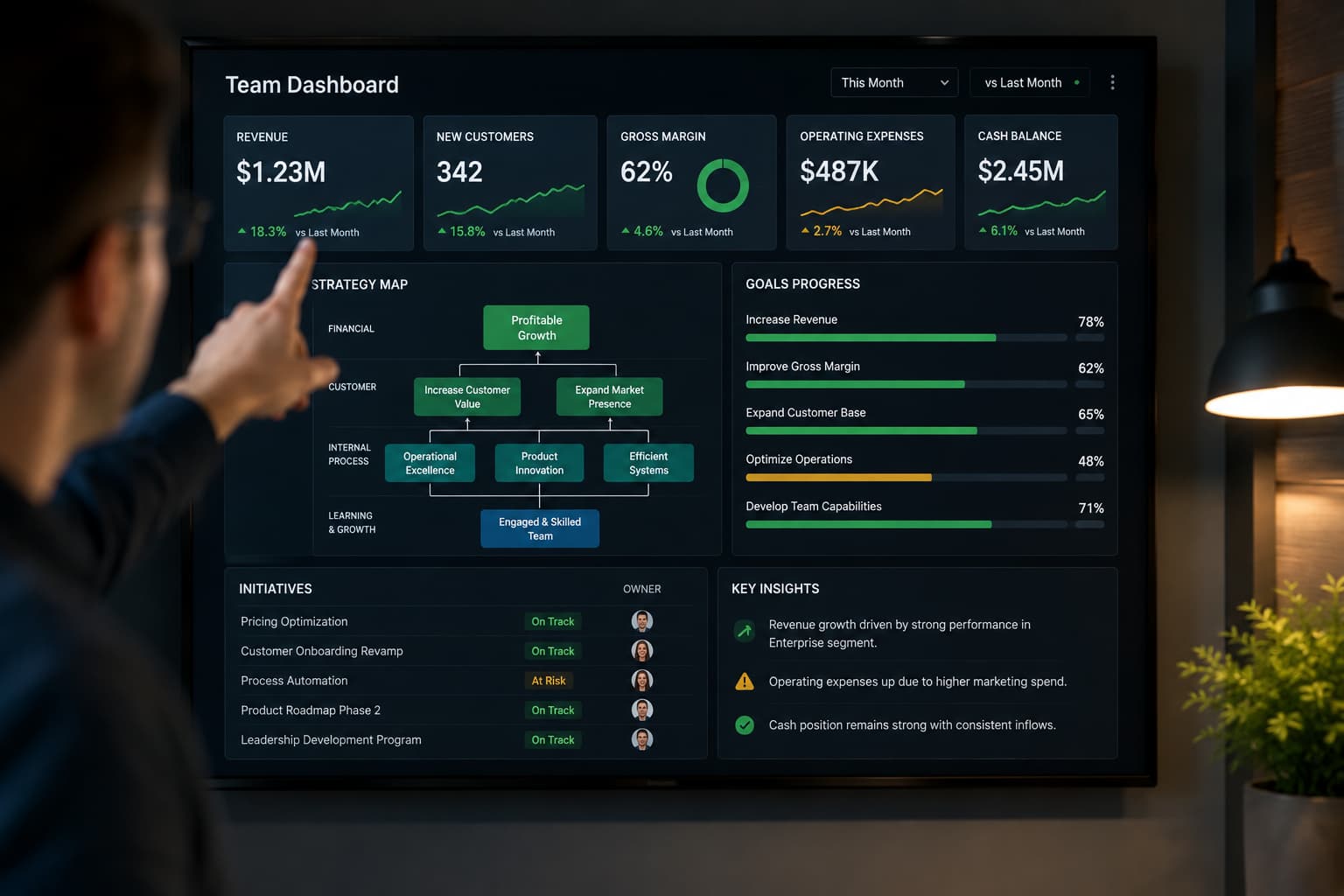
Two tools bridge the gap. A balanced scorecard translates high-level goals into measures across finance, customers, internal processes, and learning. That keeps you from over-optimizing revenue while everything else rots. Pair the balanced scorecard with a strategy map, a one-page visual showing how each objective feeds the next. Then the whole team can see how their work ladders up to the goals at the top.
The mechanism that makes strategy execution work is aligning teams and resources to the same short list of priorities, then choosing metrics to measure progress. This is corporate strategic planning in its most practical form: turning direction into daily operational efficiency rather than a prettier wish list.
This is where operational clarity earns its keep. Aligning teams and resources means each person knows their piece. The business systems behind them, from reporting cadence to KPI tracking, make progress visible. Much of this comes down to aligning strategy with day-to-day execution, which is precisely the discipline most founders lack the bandwidth to own. When you can measure progress weekly, decision-making gets faster, and the founder stops being the only one who knows if things are on track.
How fractional operational leadership turns a plan into progress
Here’s the trap most founders hit. The strategy is sound, the goals are written, and nothing moves. Turning a plan into daily operations is a full-time job nobody at the company actually owns. Founder overwhelm sets in. The plan becomes another document collecting dust while the founder handles it all personally.
That ownership gap is what a fractional COO fills. A fractional COO brings executive-level operational leadership: the person who builds the business systems, installs the reporting, and drives strategy execution, without the cost of a full-time C-suite hire. For a business between $1M and a few million in revenue, that model matches the scaling challenges to the budget.
This is the space Four Indoor Courts works in. Their fractional COO engagements align strategy with execution, design the management systems and KPI tracking that create operational clarity, and take ownership off the founder’s plate so the business can scale responsibly. If you’re unsure where the friction sits, a free 30-minute Readiness Audit is a low-commitment way to see whether the gap is strategic, structural, or both.
The mechanism is simple. Someone experienced translates vision into action, clears the bottlenecks, and holds the organization accountable to the plan. Founder-dependency and founder overwhelm both drop. Operational efficiency rises, which can support long-term success. Results vary based on leadership execution, market conditions, and implementation, so it’s honest to say the model supports sustainable growth rather than guarantees it.
If your business is growing faster than your systems can support, a short conversation can pinpoint where the operational friction actually sits. You can book a clarity call with Leah Norris to map out where your strategic plan is stalling and what structure would move it forward.
FAQs
Q1. What's the actual difference between corporate planning and strategic planning?
A1.
Strategic planning defines the organization’s long-term direction and how it will compete externally, typically over a three-to-five-year horizon. Corporate planning is more internally focused, aligning the company’s structure, policies, processes, and shared services like marketing and HR to support those goals.
Q2. Which one should come first, corporate or strategic planning?
A2.
Strategic planning comes first because you need to establish long-term objectives and market direction before you can organize internal resources around them. Corporate planning then translates that direction into the structure, departments, and resource allocation needed to execute it.
Q3. Why does a business need both instead of just one?
A3.
Strategic planning tells you where to go and how to compete in your market, while corporate planning determines how your teams, processes, and resources actually get you there. Without the corporate layer, a strategy stays theoretical; without strategy, corporate planning organizes activity that isn’t pointed at any real goal.
Q4. What components do corporate and strategic plans share?
A4.
Both typically include a mission statement, vision statement, goals, and the actions and resources needed to reach them. The difference is scope: the strategic plan often drills into specific business units or functions, while the corporate plan covers the whole organization and its shared services.
Q5. Isn't this just corporate jargon for a small business under $1M?
A5.
The terminology is corporate, but the underlying problem is universal: founders scaling past $1M often have a growth strategy in their head with no operational structure to execute it. Even a lightweight version, a clear direction plus the systems and roles to deliver it, prevents the founder-dependency trap that stalls most SMBs.
Q6. What if I only have time to do one type of planning?
A6.
Start with strategic clarity on where you’re headed, then build just enough corporate structure to remove your biggest operational bottleneck. Trying to do both fully at once usually produces two half-finished documents that never get used; sequencing them keeps the effort tied to actual execution.

Founder of Four Indoor Courts Consulting, Leah Norris helps founders and growing businesses create operational clarity through fractional COO leadership, KPI-driven analytics, and scalable operational strategy. With a background spanning operations, finance, analytics, marketing, and technology, Leah specializes in helping businesses improve visibility, streamline processes, strengthen accountability, and build the operational structure needed for sustainable growth.