

A founder scaling toward $1M in revenue hires three new people and wins bigger clients. Suddenly everything takes longer. Orders get missed. The same question gets answered five different ways depending on who you ask. That friction isn’t a people problem. It’s a process operations problem, and it shows up the moment growth outpaces the systems holding the business together. This article breaks down what process operations actually are, why they quietly slow founder-led companies, and how the right systems restore clarity.

What process operations actually mean (definition and scope)
Process operations move materials or work through a continuous, ordered set of steps to produce a consistent output. Picture a chemical plant, a food producer, or a beverage line. Raw inputs enter one end, pass through standardized stages, and leave as a finished product that follows the same recipe every time. That repeatability is the whole point.
But the thinking behind process operations reaches well beyond factories. Any business that runs the same sequence over and over is running process operations, whether it calls them that or not. Think of onboarding a client, fulfilling an order, or closing the books. This is where operations management comes in. It’s the discipline of designing, running, and improving those sequences so output stays reliable as volume grows. If you’ve ever wondered how growth eventually breaks your business processes, this is the mechanism at work.
According to the American Society for Quality’s overview of process management, organizations that manage work as defined processes rather than isolated tasks see more predictable results and fewer defects. The scope covers production processes, service workflows, and the business systems tying them together. Here’s why this matters: when steps aren’t defined, every person improvises, and workflow inconsistency becomes the default. Defined process operations remove that guesswork.
How process operations drive efficiency and reduce operating costs
Efficiency in process operations comes from one thing: removing the steps, delays, and rework that don’t add value. When a process is mapped and measured, you can see exactly where time and money leak out. Most founders assume their operating costs are just the price of doing business. In reality, a large share is waste hiding inside undocumented workflows.
Methodologies like Lean and Six Sigma exist precisely to find that waste. What tends to happen is this: a consistent process reduces variation. Less variation means fewer errors, less rework, and lower operating costs per unit of output.
Operational efficiency also compounds. Shave two hours off a weekly process and you free roughly 100 hours a year. That time goes back into serving customers or planning. Many assume efficiency means working faster. In reality, it means removing work that shouldn’t exist. This is where Four Indoor Courts process improvement and operational excellence consulting fits: mapping the workflows where costs quietly pile up, then redesigning them for cleaner throughput. This is the heart of optimizing your small business operations for sustainable growth.
Process design and system improvement fundamentals
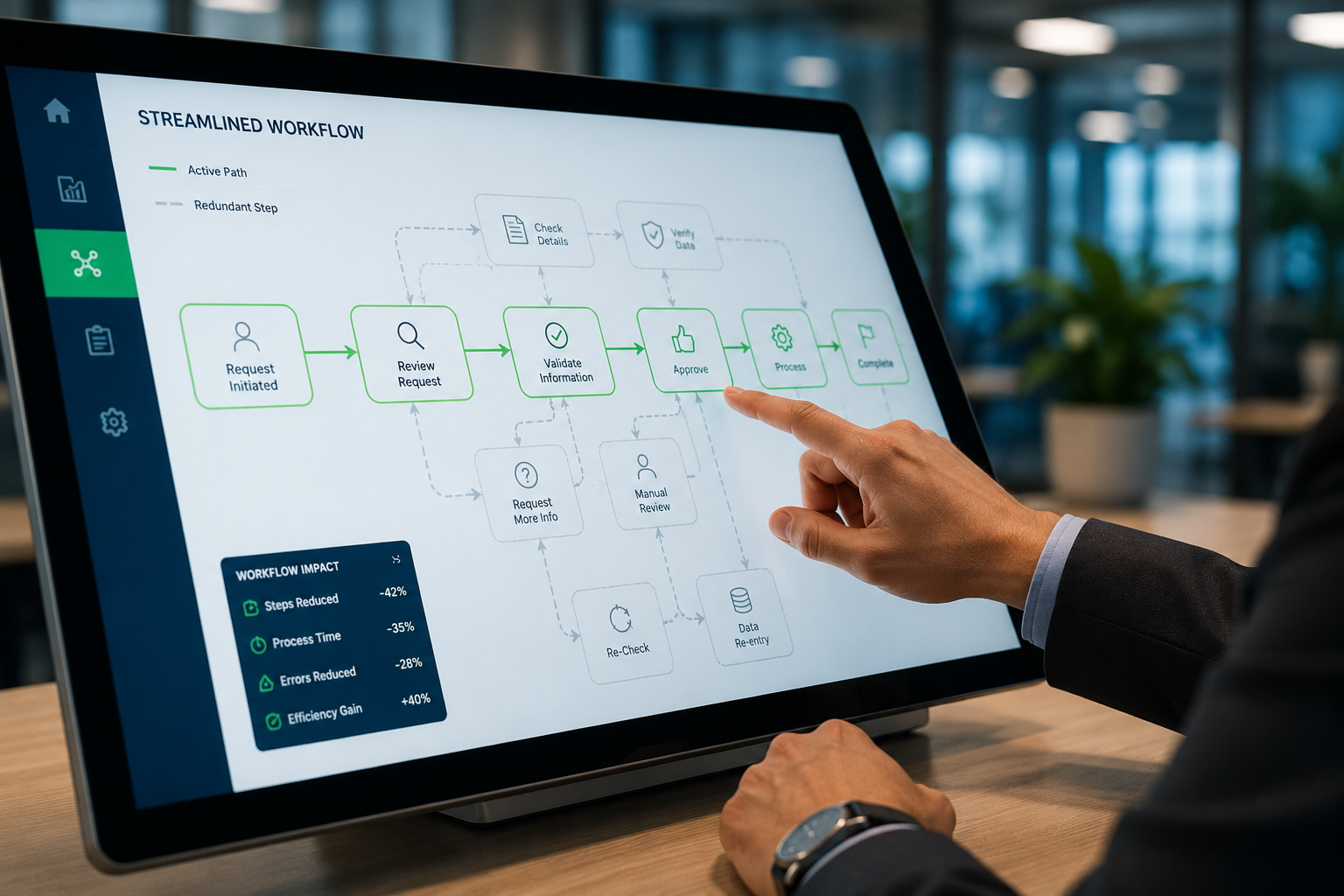
Good process design starts with a blunt question: what is this process supposed to produce, and how do we know it worked? If you can’t answer both, you’re managing on hope. Process design maps each step, defines who owns it, sets the standard for “done,” and builds in a way to measure the result.
The fundamentals are simpler than most consulting language makes them sound. Document what currently happens, not what you wish happened. Find the handoffs, because handoffs are where work stalls and accountability disappears. Then remove or combine steps that don’t move the output forward.
System improvement is continuous, not a one-time project. A process you designed at $500K in revenue will strain at $1.5M because volume exposes weaknesses invisible at smaller scale. Building process systems with room to flex is how you meet scaling challenges instead of rebuilding under pressure. That matters more than chasing the “perfect” system today.
The root cause of most failed improvement efforts is skipping documentation and jumping straight to tools. New software layered onto a broken process just automates the mess faster. Sound process design comes first. Business systems and ERP tools support it, they don’t replace it. Get the sequence right, then let the technology carry the load.
Spotting and fixing operational problems and bottlenecks
Operational bottlenecks announce themselves if you know the signs. Work piles up in front of one person or one step. Deadlines slip in the same place every time. A single approval holds up everything downstream. That constraint sets the pace for the entire process, no matter how fast the other steps run.
I worked with a founder-led services firm around $1.2M in revenue where every client deliverable routed through the owner for final sign-off. Turnaround times had crept to three weeks, and two clients left over it. The fix wasn’t more staff. It was moving approval authority to a senior team member for anything under a set threshold. Turnaround dropped to five days within a month. It’s worth reading a real example of sales outpacing operations at $1M to see how quickly this pattern escalates.
That’s the pattern with most operational bottlenecks: the constraint is rarely a lack of effort. Many owners respond by hiring, when the real issue is centralized decision-making or a missing rule. To spot them, track how long work sits at each stage. The stage with the longest wait is your bottleneck. Fix that one, and the whole flow speeds up. Fix a non-constraint, and nothing changes.

Best practices for managing and optimizing operations
The best practices for managing operations aren’t complicated, but they demand discipline. Start with documentation. If a process only lives in someone’s head, it isn’t a process, it’s a risk. Written workflows create operational clarity and let anyone step in without the whole system breaking.
Next, set clear objectives and measurable performance metrics for each process. You can’t optimize what you don’t measure, and vague goals like “be more efficient” give teams nothing to aim at. Attach a number to it: cycle time, error rate, cost per unit, on-time delivery.
Build accountability into the structure. Every process needs a single owner who is responsible for its output. Shared ownership almost always means no ownership. Then commit to continuous process improvement rather than treating operations as something you fix once and forget.
Finally, keep the system visible. Real-time operational visibility, through dashboards or simple weekly reviews, lets you catch drift before it becomes a crisis. Operational excellence isn’t a destination. It’s the habit of measuring, adjusting, and measuring again. Apply these best practices consistently and process operations stop being a source of stress. They start being a source of real advantage as you scale.
Most founder-led businesses don’t fail from lack of demand. They stall because the systems that got them to $500K can’t carry them to $2M. Growth without systems creates friction, and that friction shows up as founder overwhelm, missed handoffs, and a business that can’t run for a day without its owner.
The hidden gaps are rarely obvious from inside the business. Knowledge lives in the founder’s head, not in documented process systems. Decisions bottleneck at the top because no one else has the authority or the information to act. Reactive decision-making replaces strategic planning because everyone’s fighting fires.
What many founders don’t realize is that operational complexity grows faster than revenue. Double your customers and you might quadruple the coordination required. Without process design keeping pace, these scaling challenges become the ceiling on growth, long before the market does.
Here’s the uncomfortable truth: these gaps are usually invisible until they cause damage. That means a lost client, a burned-out key employee, or a quarter of flat results despite a full pipeline. This is exactly where fractional COO support helps. If you’re unsure what fractional COO support actually includes, it’s senior operational leadership for small business owners who need executive-level structure but can’t justify a full-time hire, closing those gaps before they cap your growth. If you’re not sure where yours stand, you can book a free 30-minute Readiness Audit to find out.

Signs your business systems have outgrown your growth
There are clear signals that your business systems can no longer keep up. The most telling one: nothing moves without you. If the business stalls when you take a week off, your operations depend on a person, not a system. That’s a scaling challenge waiting to happen.
Watch for these signs. The same mistakes repeat because no process prevents them. New hires take months to become productive because nothing is documented. You’re making the same decisions over and over instead of setting rules once. Reports arrive late, or don’t arrive at all, leaving you guessing about performance.
Workflow inconsistency is another red flag. When two people handle the same task two different ways, you have no baseline to improve from. Scaling exposes operational weaknesses, and inconsistency multiplies every problem as volume rises.
The deeper issue is usually visibility, not effort. Founders working brutal hours often assume they need to push harder. In reality, they need clearer business structure and better operational visibility. When you can’t see what’s happening across operations, you can’t lead it. You can only react to it. Recognizing these signs early is the difference between adjusting your systems on your terms and being forced to rebuild them under pressure.
How KPI frameworks and data visibility close operational gaps
You can’t fix what you can’t see. A KPI framework gives founders the visibility to lead by data instead of gut feel. The right performance metrics turn a vague sense that “things feel off” into a specific, fixable answer: this process is slow, this step has errors, this cost is climbing. That is the operational efficiency data unlocks. Start by choosing the right KPIs to spot bottlenecks early before they become expensive.
A useful KPI framework stays lean. Track a handful of metrics that actually drive the business, like cycle time, on-time delivery, cost per unit, and customer retention. Don’t drown in numbers nobody reviews. Each metric should tie to a decision. If a KPI doesn’t change what you do, drop it.
Data visibility also distributes decision-making. When your team can see the same numbers you do, they act without waiting for you. That reduces founder overwhelm and the leadership bottleneck that slows companies chasing sustainable growth. Good data replaces “ask the founder” with “check the dashboard,” and pairs well with the leadership support of a seasoned operator.
Four Indoor Courts develops KPI frameworks and provides data and analytics consulting so small business owners get the clarity to make faster, better calls. Note that the right metrics vary by industry and business model. What works for a product company won’t map cleanly onto a service firm, so build your framework around your own operations, not a generic template. Sound process operations depend on that fit.

If your business is growing faster than your systems can support, the gaps rarely announce themselves until they cost you a client or a key employee. A short conversation can help pinpoint where operational friction is slowing progress and what to prioritize first. Book a free clarity call with Four Indoor Courts to see where your process operations are quietly capping your growth.
FAQs
Q1. What are the four types of processes in operations management?
A1.
The four main types are job shop (low-volume, high-variety), batch processing (moderate volumes and varieties), repetitive processing (higher standardized volumes), and continuous systems (very high volumes of standardized output). The right choice depends on how much variety versus volume your business needs to produce.
Q2. How is process operations different from discrete operations?
A2.
Process operations transform raw materials through chemical, thermal, or similar methods using formulas or recipes, and the finished products can’t be broken back into their original components; think gasoline or beverages. Discrete operations assemble distinct parts into products that can be disassembled, like electronics or furniture.
Q3. How does managing process operations improve efficiency?
A3.
It works by systematically designing, monitoring, and optimizing production so workflows stay consistent and aligned with business goals. Methodologies like Lean and Six Sigma help identify and eliminate waste, while real-time monitoring keeps quality within specified limits.
Q4. Do I really need a formal process for operations, or can my team just wing it?
A4.
Reactive, inconsistent workflows are one of the most common reasons growing businesses hit friction:the issue usually isn’t effort, it’s visibility. Mapping your current processes and setting measurable KPIs gives you the clarity to spot bottlenecks before they slow your growth.
Q5. What are the best practices for running process operations well?
A5.
Start by documenting current workflows to expose inefficiencies, then set clear objectives and measurable KPIs for each process. From there, apply continuous improvement methods and real-time monitoring to keep performance aligned with your business strategy.

Founder of Four Indoor Courts Consulting, Leah Norris helps founders and growing businesses create operational clarity through fractional COO leadership, KPI-driven analytics, and scalable operational strategy. With a background spanning operations, finance, analytics, marketing, and technology, Leah specializes in helping businesses improve visibility, streamline processes, strengthen accountability, and build the operational structure needed for sustainable growth.