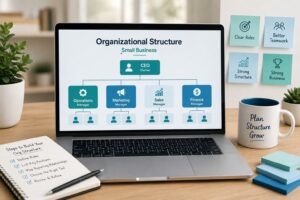

A founder doing $1.4M in revenue called us last spring. She hadn’t taken a full day off in fourteen months. Her team was busy, her revenue was climbing, and yet every decision still routed through her inbox. That’s the trap a fractional chief operating officer is built to break. You get executive-level operational leadership without writing a $300K salary check. This article walks through what the role does, when it makes sense, and how engagements run. It also shows how the right structure helps you scale beyond $1M without burning out the founder.

What is a fractional COO (definition and role)
So what is a fractional COO, exactly? A fractional COO is a senior operations leader who runs part of your business part-time or on contract instead of joining full-time. You get the same caliber of operational judgment a full-time COO would bring. It’s applied to the specific problems slowing your company down, at a fraction of the cost and commitment.
The role sits between strategy and execution. A founder usually owns the vision. A fractional COO owns whether that vision actually happens day to day: the systems design, the team management, the decision systems that let work move without the founder approving every step. If you’re weighing the role, it helps to understand what fractional COO services actually deliver before comparing it to a full-time hire.
Many founders assume a COO is something only larger companies need. In reality, the strain that justifies the role shows up well before a business is “big.” It often arrives around the $1M mark, when informal habits start cracking. Fractional COO services exist so a smaller, founder-led company can access cost-effective operational leadership without the overhead of a permanent executive. According to the U.S. Small Business Administration, management and operational structure are among the most common pressure points for a small and medium-sized business as it grows, and their broader guidance on managing business growth reinforces why this gap matters. That’s exactly the gap this role fills.
Core responsibilities and what a fractional COO actually does
The job is unglamorous and concrete. A fractional COO documents how work actually flows, finds the operational bottlenecks, and rebuilds the parts that break under volume. Process improvement is the backbone of the work, not slide decks.
In practice, the responsibilities cluster into a few areas. Operations management means turning ad-hoc workflows into repeatable business systems. Financial management means building visibility into margins, cash flow, and where money leaks. Risk management means spotting single points of failure, usually the founder. Project management means making cross-functional work land on time. And KPIs mean defining the handful of numbers that predict whether the business is healthy.
The reason this matters is mechanical. When a team has no operational visibility, every decision gets escalated. Nobody else can see enough to make the call. Build the reporting and the decision systems, and decisions push down to where the work happens. That single shift frees a founder’s calendar. There’s a reason research on why scaling startups outgrow their early systems points to this exact escalation trap as a common failure point.
A good operator also brings best practices from companies that have already solved your problem. The principles behind disciplined operations are well documented by groups like the American Society for Quality. A fractional COO translates that into something an SMB can run.

When and at what stage to hire a fractional COO (signs you need one)
The clearest signs you need a COO are usually behavioral, not financial. You’re the bottleneck for decisions you shouldn’t be touching. Revenue keeps climbing, but nothing feels more under control. You’re firefighting instead of planning. We’ve seen this play out in a $1M business where sales outpaced operations until the cracks forced a reckoning.
Most operational problems start when growth outpaces structure. A team of five runs on conversation and instinct. A team of twenty-five running on the same habits creates operational chaos: missed handoffs, unclear ownership, work redone twice. Founder overwhelm isn’t a personality flaw at that stage. In founder-led companies, it’s a predictable symptom of a business that scaled revenue without scaling its operating model.
Watch for a few specific triggers. You can’t answer basic performance questions without digging through three tools. New hires take months to become productive because nothing is documented. You’re scaling beyond $1M, and the scaling challenges feel operational rather than market-driven. Knowing how to hire a fractional chief operating officer often starts with recognizing these patterns in your own week.
A common misconception is that messy operations mean you need better employees. In reality, capable people stuck inside broken systems still produce inconsistent results. Fix the system first. That’s the moment a fractional COO earns its keep, before founder overwhelm hardens into burnout or a stalled growth curve. Often the answer is also better delegation strategies for founder-dependent businesses, since the founder’s own habits are frequently the constraint.
How a fractional COO engagement works (process and structure)
A real engagement doesn’t start with solutions. It starts with an operational audit: understanding what’s actually creating friction before changing anything. We’ve seen founders rush to buy software for a problem that turned out to be unclear ownership, not a tooling issue.
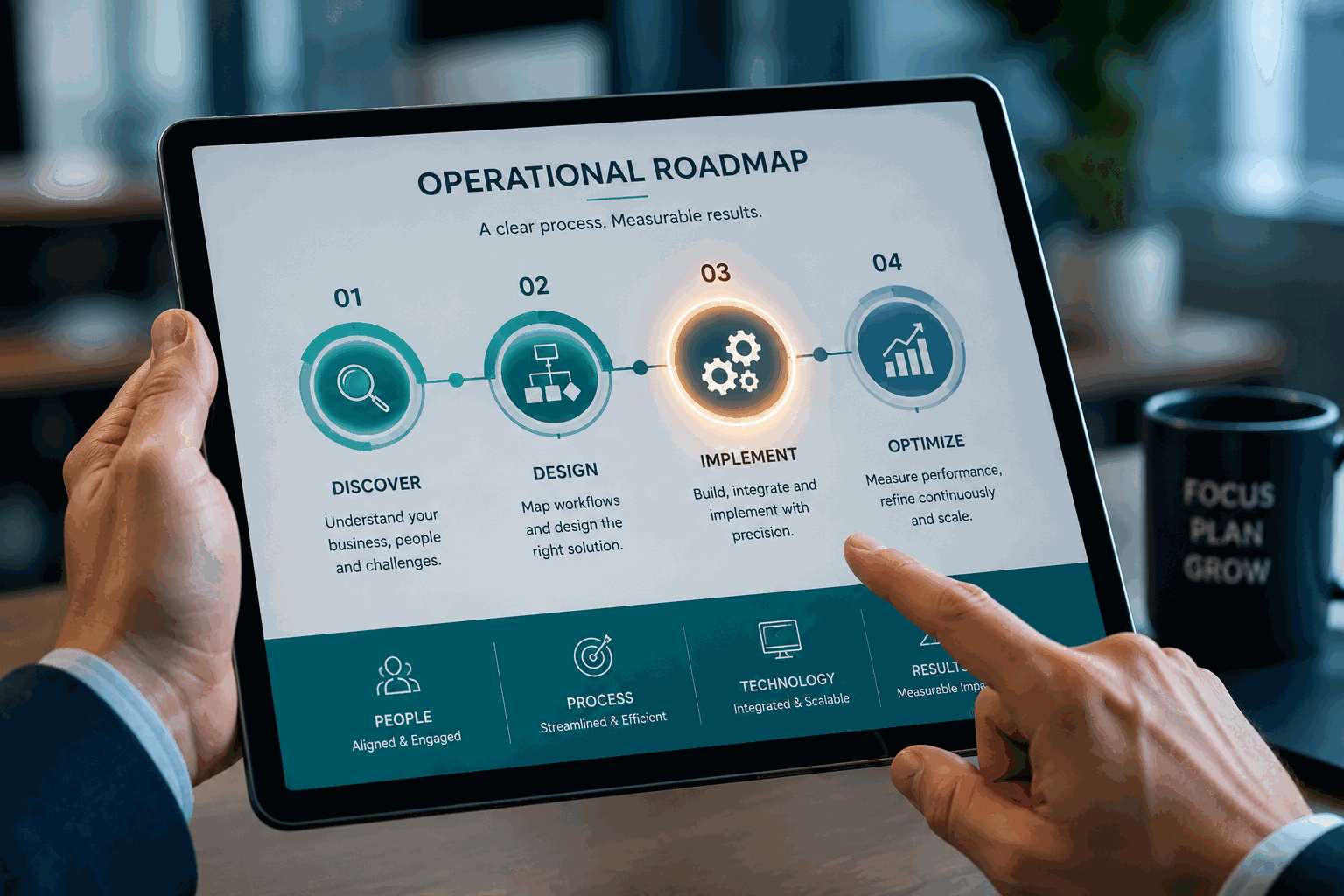
The structure is straightforward, and it answers how to hire a fractional COO in practice. First, a diagnostic phase to map current operations, surface bottlenecks, and establish baseline KPIs. Then a prioritized plan, because fixing everything at once stalls improvement. Then implementation, where the operator embeds with your team to roll out the changes.
That embedded leadership piece matters. A fractional COO isn’t a consultant who hands over a report and leaves. They sit inside the business and drive execution alongside your team. Time commitment usually runs 15 to 25 hours a week, enough to lead without the full-time price tag.
This is where cost-effective leadership becomes real. You’re paying a part-time executive for senior judgment applied to your problems. That typically runs 25 to 40 percent of a full-time COO’s salary, which keeps fractional COO cost proportional to the value you need. Four Indoor Courts structures this around an initial clarity call to identify where friction is slowing progress. From there, it moves into strategic planning and ongoing support that flexes to your stage.
How a fractional COO drives growth and scaling
Growth without systems creates friction. A fractional COO drives scalable growth by building the operating machinery that lets revenue increase without proportionally increasing chaos. The goal is a scalable operating model, not just a busier team.
The mechanism is simple once you see it. Every business has a few operational bottlenecks that cap how fast it can grow safely. Maybe it’s onboarding, maybe fulfillment, maybe the founder’s bandwidth. A fractional chief operating officer finds those constraints, removes them in order of impact, and installs the measurement to keep them from re-forming. Strong operations management is how operational efficiency translates directly into capacity for more revenue.
There’s also a strategic planning layer. Scaling responsibly means deciding what not to do, sequencing investments, and aligning the team around a small number of priorities. Many operators function effectively as an EOS integrator here, owning execution while the founder stays visionary. This is closely tied to how strategic consulting supports scaling past $1M, where the planning and the execution have to move together.
Sustainable growth is the difference between a business that just grows and one that grows while keeping its margins, its culture, and its founder’s sanity intact. The point isn’t to grow at any cost. It’s to build the efficiency and structure that turn scaling beyond $1M into something each new dollar of revenue supports more easily than the last.
Service tiers matched to founder stage (Advisor, Integrator, Architect)
Not every founder needs the same depth of support. That’s why fractional COO services usually scale to where you are rather than forcing one model on everyone. Four Indoor Courts organizes its work into three tiers built around founder stage.
The Advisor suits founders overwhelmed by daily operations who need senior guidance more than a full embed. You get an experienced operator to pressure-test decisions, prioritize, and bring operational clarity without a heavy time commitment. It’s good for founders who can execute but lack a sounding board, which is exactly why we built The Advisor package for founders drowning in daily operations.
The Integrator is for businesses with a clear vision but a gap between strategy and execution. This tier focuses on alignment: translating the founder’s goals into accountable workflows, business systems, and team management that get the plan done.
The Architect is the deepest engagement, flexible fractional leadership for companies in active scaling. It covers systems design, decision systems, and the structural work and process improvement needed to support sustainable growth at higher volume.
The logic behind tiering is honest about cost. A founder approaching $1M doesn’t need the same investment as one pushing past $5M. Matching the engagement to the actual problem keeps fractional COO cost proportional to the value you need now, not the value you might need in three years.
Operational frameworks for SMBs (Lean, Six Sigma, KPIs, ERP) in plain language
These frameworks sound intimidating. Stripped down, they’re all answering the same question: how do you do consistent work and know whether it’s working?
Lean is about cutting waste. Look at any process and remove steps that don’t add value: duplicate approvals, reports nobody reads, and handoffs that sit in a queue. For most SMBs, lean thinking alone unlocks meaningful operational efficiency without buying anything.
Six Sigma is about reducing variation, making sure the same task produces the same result every time. You don’t need belts and certifications. You need to find where outcomes swing wildly and tighten those. That’s the core of real process improvement.
KPIs are simply the numbers that tell you the truth about your business at a glance. The trap is tracking forty metrics and acting on none. Pick the handful that predict health and review them on a rhythm. That’s how you build the operational visibility decisions depend on.
ERP and other business systems are the tooling that connects it all. The mistake is buying the software first. Define the process, then choose the system that supports it. A fractional chief operating officer keeps these frameworks practical, fitting them to the business strategy and stage of a small and medium-sized business rather than dropping enterprise complexity on a 20-person team. In founder-led companies, this discipline is what turns scaling challenges into a clear roadmap rather than constant guesswork.
If your business is growing faster than your systems can support, a conversation with Four Indoor Courts can surface exactly where operational friction is slowing you down. The team starts every engagement with a clarity call, so you can see where your operations actually break before committing to anything bigger.
FAQs
Q1. What does a fractional COO actually do?
A1.
A fractional COO is an experienced operations executive who works with your business part-time or on contract to lead daily operations, improve processes, and build scalable systems. They handle things like workflow documentation, KPI setup, and team structure without the cost of a full-time hire.
Q2. Is hiring a fractional COO actually worth it for a growing company?
A2.
For founders stuck in operational chaos, it often is, a fractional COO typically costs 25-40% of a full-time COO’s salary and can deliver measurable improvements within 60-90 days. The value comes from buying senior operational judgment for the specific problems slowing your growth, not paying for a full-time seat you don’t yet need.
Q3. What if my business is too small to justify a fractional COO?
A3.
Most fractional COOs are built for SMBs, not enterprises, and engagements flex to your stage and budget rather than a fixed full-time commitment. If you’re a founder approaching $1M in revenue and operations are the bottleneck, a scaled-down advisory engagement is usually more affordable than the cost of staying disorganized.
Q4. What's the difference between a fractional COO and a fractional CSO?
A4.
A fractional COO focuses on operations, processes, systems, daily execution, and scaling capacity. A fractional CSO (Chief Sales Officer) focuses on revenue, building growth plans, finding new market opportunities, and optimizing sales streams.

Founder of Four Indoor Courts Consulting, Leah Norris helps founders and growing businesses create operational clarity through fractional COO leadership, KPI-driven analytics, and scalable operational strategy. With a background spanning operations, finance, analytics, marketing, and technology, Leah specializes in helping businesses improve visibility, streamline processes, strengthen accountability, and build the operational structure needed for sustainable growth.