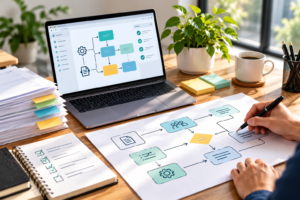
Most businesses don’t struggle because founders lack ambition. They struggle because growth eventually breaks the systems that got them there. Scaling beyond $1M in revenue exposes operational weaknesses that were manageable at smaller sizes.
Strategic business consulting helps leadership teams address these gaps before they slow progress or create founder overwhelm.
How Strategic Business Consulting Differs from Other Consulting Types
Strategic business consulting addresses the bigger picture. It focuses on where the business is headed, not just how it operates today. While management consulting often centers on process improvement and operational efficiency, strategic consulting examines market positioning, competitive advantage, and long-term vision.
Many founders assume all business consulting is the same. In reality, strategy consulting prioritizes the direction of business growth over tactical fixes. A management consultant might help improve your invoicing process. A strategic business consultant helps you decide which markets to enter next and how to structure the business for scalable business growth.
The distinction matters because operational improvements alone won’t solve strategic misalignment. If your business strategy doesn’t match market conditions or your team lacks clarity on strategic objectives, better processes won’t fix the underlying problem. This is why strategic business consulting establishes the framework that operational work depends on, a foundation that consulting services are built upon.
Strategic consultants also help leadership teams make difficult trade-off decisions that operational consultants typically don’t address. Should you invest in geographic expansion or product diversification? Should you pursue organic growth or consider acquisitions? These strategic choices shape the business’s trajectory for years and require a different analytical framework than process optimization.
Aligning Business Strategy with Operational Execution and Growth Goals
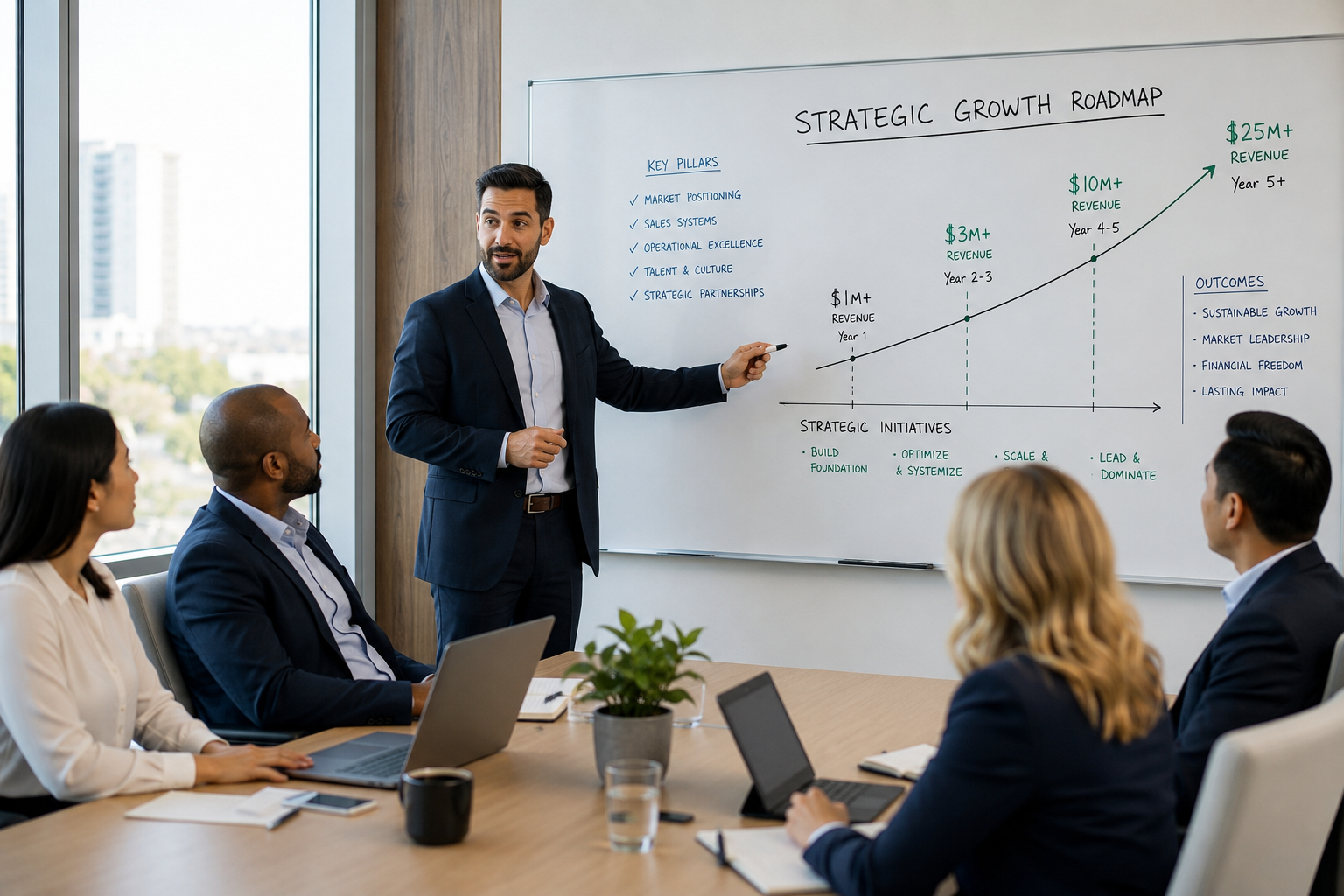
Growth without systems creates friction. A clear business strategy means nothing if the team can’t execute it. Strategic business consulting bridges this gap by connecting high-level business goals to daily operations.
Strategic alignment breaks down as teams grow. Early-stage businesses often operate on informal communication and founder-led decision-making. That approach stops working around $1M in revenue because the founder becomes the bottleneck for every decision. Teams need visibility into priorities, accountability structures, and frameworks for data-driven decision-making that don’t rely on the founder being in every conversation.
Strategic planning establishes the direction. Operational execution delivers business results. According to research on strategic planning effectiveness, organizations with aligned strategy and execution outperform those with strategy alone. This includes defining strategic objectives, clarifying roles, building accountability systems, and creating data visibility so leadership can track progress without constant founder intervention.
Consider a software company that sets a strategic goal to move upmarket to enterprise clients. Without operational alignment, the sales team continues pursuing small deals because that’s what they know, marketing creates content for the wrong audience, and product development prioritizes features that small customers request. Strategic consulting helps translate that upmarket goal into specific operational changes: new sales compensation structures that reward larger deals, marketing campaigns targeting enterprise decision-makers, product roadmaps aligned with enterprise requirements, and customer success processes designed for complex implementations.
Four Indoor Courts helps businesses create this alignment through fractional COO support that combines strategic planning with operational implementation. The focus is on sustainable growth, not just revenue targets. This means ensuring that as revenue increases, profit margins remain healthy, team capacity scales appropriately, and systems can handle increased complexity without breaking.
Strategic Planning for Market Challenges and Competitive Positioning
Market challenges expose businesses that lack strategic direction. Economic shifts, new competitors, and changing customer expectations all require strategic responses, not just operational adjustments.
Strategic business consulting helps leadership teams anticipate these challenges and position the business to respond effectively. This includes analyzing competitive positioning, identifying market opportunities, and building strategic roadmaps that account for external pressures in the strategic environment.
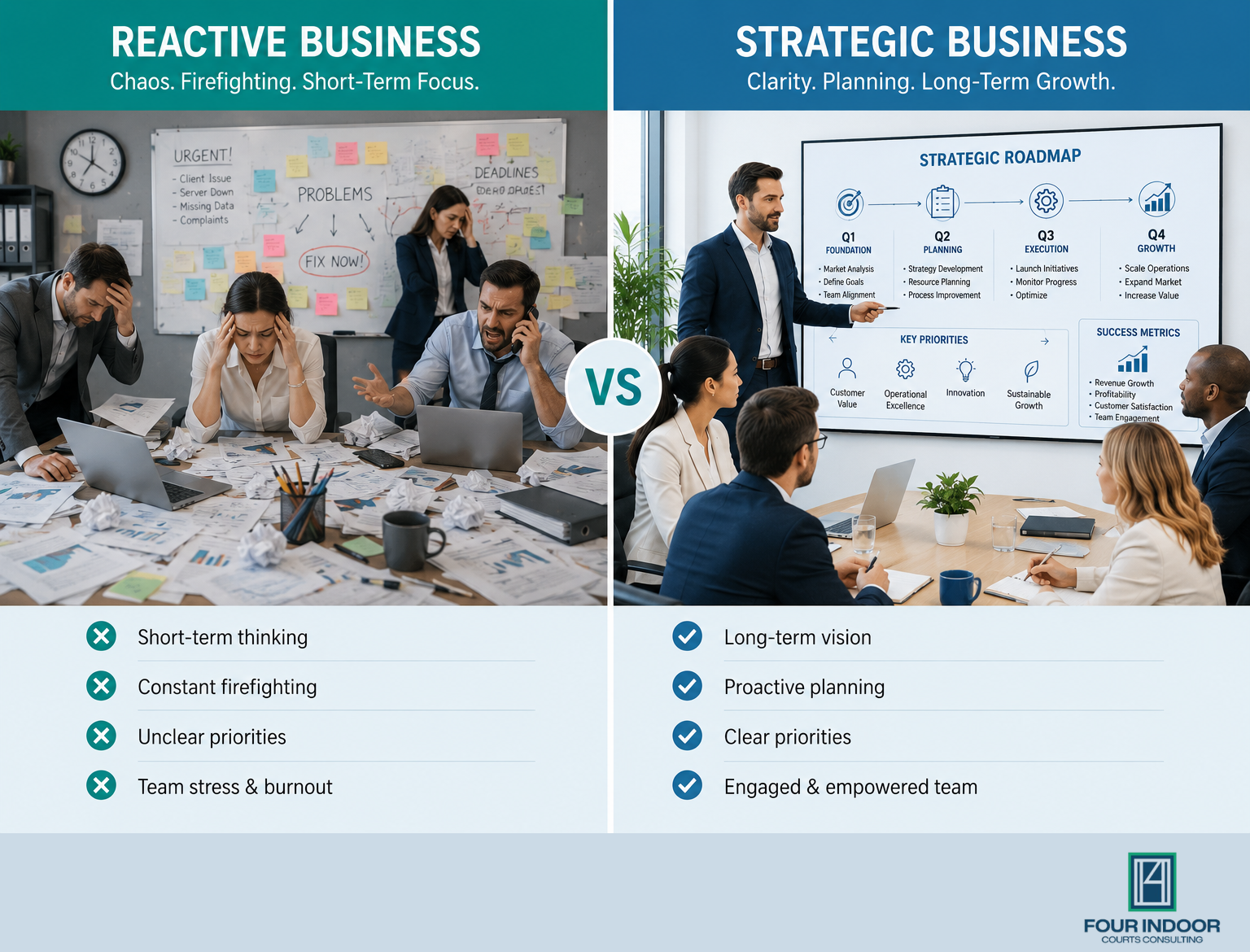
The issue usually isn’t effort. It’s visibility. Many small to medium-sized businesses operate reactively because they lack market intelligence and strategic insights. They respond to problems as they arise instead of planning for them. Strategy consulting provides the structure to move from reactive to proactive decision-making.
Competitive positioning also requires an honest assessment. Most businesses overestimate their differentiation and underestimate how quickly competitors can close gaps. Strategic consulting forces leadership teams to clarify what actually sets them apart and how to protect that advantage as they scale. Without this clarity, businesses compete on price alone, eroding margins and making sustainable growth difficult.
When Companies Need Strategic Consulting vs. When They Need Both Strategic and Operational Support
Strategic consulting alone works when the business already has strong operational leadership. If you have a capable COO or operations team and the main challenge is direction, strategic consulting can provide the clarity you need.
Most small to medium-sized businesses don’t fit that profile. They need both strategic planning and operational execution support. The founder is often the only person thinking strategically while also managing day-to-day operational challenges. That creates bottlenecks and founder overwhelm.
Here’s how to tell which you need:
Strategic consulting alone works if your operations run smoothly, your team executes consistently, and you need help with business strategy, market positioning, or long-term vision.
Strategic and operational support makes sense if you’re experiencing operational challenges, leadership bottlenecks, or a lack of accountability. If growth feels harder to manage than it should, you likely need both. Warning signs include the founder working excessive hours on tactical issues, important projects stalling due to lack of follow-through, team members unclear about priorities, or recurring operational problems that never get permanently resolved.
The fractional COO model addresses this by providing both strategic and operational leadership in a single engagement. Instead of hiring separate consultants for strategy and execution, businesses get integrated support that connects planning to implementation. This integration matters because strategy without execution is just planning, and execution without strategy is just activity.
Strategic Consulting for SMBs vs. Enterprise (Scope, Approach, Accessibility)
Enterprise strategy consulting focuses on large-scale business transformation, complex organizational structures, and multi-year initiatives. It often involves layered consulting teams and significant budgets.
Consulting services for small to medium-sized businesses look different. The scope is narrower, the approach is more hands-on, and the timeline is shorter. SMBs need practical guidance they can implement quickly, not theoretical frameworks that require dedicated transformation teams.
Accessibility also differs. Enterprise consulting often costs hundreds of thousands of dollars and requires months of engagement. Strategic consulting for SMBs should be flexible enough to fit the business’s current stage and budget. That’s why fractional models work well for growing businesses. They provide executive-level strategic support without the cost of a full-time hire. A business might engage a fractional strategic consultant for 10-15 hours per week, getting senior-level expertise at a fraction of the cost of a full-time executive salary plus benefits.
The approach also matters. SMB founders need consultants who understand operational realities, not just high-level strategy. They need someone who can move between strategic planning and execution support, helping the business implement recommendations rather than just delivering reports. This hands-on approach accelerates results because recommendations get implemented immediately rather than sitting in a binder on a shelf.
The Fractional Executive Model as Strategic Support for Scaling Businesses
The fractional COO model provides strategic and operational leadership on a part-time or project basis. Instead of hiring a full-time executive, businesses engage a fractional COO for a set number of hours per week or month.
This model works well for businesses scaling beyond $1M because it addresses both strategic planning and operational execution. A fractional COO helps define the business strategy, build systems, improve data visibility, and support leadership development. They work directly with the founder and leadership team to implement changes, not just recommend them.
Many founders hesitate because they’re unfamiliar with the fractional leadership model. They assume executive support is only for larger companies or that a part-time leader can’t make a real impact. In reality, most growing businesses don’t need a full-time COO. They need focused strategic and operational support during critical growth phases, including business coaching and change management.
The fractional model also provides flexibility that full-time hires don’t offer. As the business grows, engagement can scale. If growth slows or priorities shift, the engagement can scale down without the complexity and cost of layoffs.
Four Indoor Courts operates as a fractional COO partner, providing the strategic direction and operational structure businesses need to scale sustainably. The engagement is flexible, allowing businesses to adjust the level of support as they grow.

Strategic Road Mapping from $1M to Sustainable Multi-Million Dollar Growth
Scaling beyond $1M requires a strategic roadmap. Revenue growth alone doesn’t guarantee sustainability. Businesses need clear milestones, operational systems, and leadership structures that support multi-million dollar operations.
Strategic road mapping starts with understanding where operational friction is slowing progress. What worked to reach $1M won’t work to reach $5M. Informal processes create inconsistency. Lack of data visibility makes data-driven decision-making difficult and makes it hard to identify problems before they escalate.
A strategic roadmap addresses these challenges by defining:
- Strategic objectives for the next 12 to 24 months
- Operational priorities that support those business goals
- Leadership and accountability structures that reduce founder dependence
- Data and reporting systems that improve decision-making
- Process improvements that increase organizational effectiveness without adding complexity
Effective strategic roadmaps include specific milestones with clear success metrics. For example, a business might set a 12-month objective to expand into a new geographic market, with quarterly milestones including completing market research, acquiring the first pilot customer, documenting processes for remote delivery, and hiring regional leadership.
Four Indoor Courts helps businesses build and execute strategic roadmaps that connect vision to implementation. The focus is on sustainable growth, not just hitting revenue targets. That means addressing operational bottlenecks, improving business systems, building leadership development capacity, and planning exit strategies as the business scales.
Scaling beyond $1M is possible without strategic support, but it’s harder and riskier. According to U.S. Census Bureau data on small business growth, only about 4% of businesses reach $1M in revenue, and fewer than half of those successfully scale beyond $5M. Businesses that grow without structure often hit a ceiling where operational chaos limits further growth. Strategic business consulting helps avoid that outcome by building the foundation for scalable, sustainable growth.
The difference between businesses that scale successfully and those that plateau often comes down to whether they treat growth as a strategic initiative or just let it happen. Strategic business consulting provides the intentionality and structure that separates sustainable scaling from chaotic expansion.
Ready to scale beyond $1M with strategic clarity and operational support? Four Indoor Courts provides fractional COO services that combine strategic business consulting with hands-on implementation, helping growing businesses build the systems and leadership structures they need for sustainable growth. If your business is growing faster than your systems can support, get in touch with our team to discuss how fractional COO support can help your business scale sustainably.
FAQs
Q1. What does a strategic business consultant actually do?
A1. A strategic business consultant helps leadership teams define business strategy, improve competitive positioning, and plan for long-term growth. They focus on direction and structure, not just day-to-day operations.
Q2. How is strategic consulting different from regular management consulting?
A2. Strategic consulting focuses on long-term vision, market positioning, and scalable growth, while management consulting typically addresses operational efficiency and process improvement.
Q3. When should a company bring in strategic business consulting?
A3. Bring in strategic consulting when growth feels harder to manage, when the business lacks clear direction, or when operational systems can’t support the next stage of growth.
Q4. What are the main benefits of hiring a strategic business consultant?
A4. Strategic business consulting provides clarity on business strategy, improves competitive positioning, reduces founder overwhelm, and builds the operational structure needed for sustainable growth.

Founder of Four Indoor Courts Consulting, Leah Norris helps founders and growing businesses create operational clarity through fractional COO leadership, KPI-driven analytics, and scalable operational strategy. With a background spanning operations, finance, analytics, marketing, and technology, Leah specializes in helping businesses improve visibility, streamline processes, strengthen accountability, and build the operational structure needed for sustainable growth.