
A founder generating $2M in revenue spends four hours every Friday reconciling invoices by hand. Multiply that across a year, and you lose a full work-month to a task software could run in seconds. That is the quiet tax of manual operations. It is exactly where process automation earns its keep. It does not replace your judgment. It takes the routine, rule-based work off your plate so you can lead instead of firefighting. This article walks through when you are ready, what to automate first, the real ROI, and how to scale responsibly without breaking what already works.

What process automation is (founder-friendly definition)
So what is process automation, in plain terms? It is using software to run repetitive, rule-based work with little or no human intervention. Instead of a person copying data between systems, a defined workflow does the job. Instead of manually sending the same follow-up email fifty times a week, the workflow does it the same way every time.
Business process automation covers a wide range. It includes simple task triggers, multi-step workflow orchestration, and system integrations that pass information between your CRM, accounting tool, and inventory software without retyping. The common thread is business rules. If you can describe a task as “when X happens, do Y,” it is a candidate for automation.
Here is why this matters for founders. Manual tasks do not scale linearly. Doubling your orders roughly doubles the human hours needed to process them, until a person becomes the bottleneck. Automation breaks that link because software handles added volume with near-zero marginal effort, while a human worker cannot. Deloitte’s research on intelligent automation tracks how organizations use these tools to handle volume without adding headcount. Many founders assume this is enterprise-only tech. In reality, the most useful business process automation today runs on affordable tools any growing company can deploy.
How founders know they’re ready to automate (signs of operational strain)
The clearest signal is founder overwhelm. You are the person who has to touch every order, approval, or client handoff before it moves forward. When decision-making stays that centralized, growth slows because you are the ceiling. That kind of founder overwhelm is the first sign your operations have outgrown their systems. This is often where delegation strategies that free founders from the day-to-day become just as important as the software itself.
Watch for these operational bottlenecks. The same manual tasks show up on your calendar every single week. Errors creep into billing or data entry, and someone spends hours fixing them. New hires take months to learn “how we do things” because the process lives in your head, not in a system. Reporting is slow or missing, so you cannot see where work actually stalls.
Growth without systems creates friction, and that friction is measurable. A Gallup analysis of employee engagement and productivity shows how much output teams lose when they operate reactively instead of using structured workflows. If your revenue is climbing but your operations feel messier than last year, that gap is the warning. Scaling exposes weaknesses. The businesses that catch these signs early build scalable systems before chaos forces the issue. The story of the $1M agency that fixed operations before growth broke it shows how much smoother scaling becomes when the systems come first.
How to get started with process automation (step-by-step path)
Do not open a tool first. Start with the process. Here is the sequence that keeps projects from underdelivering.
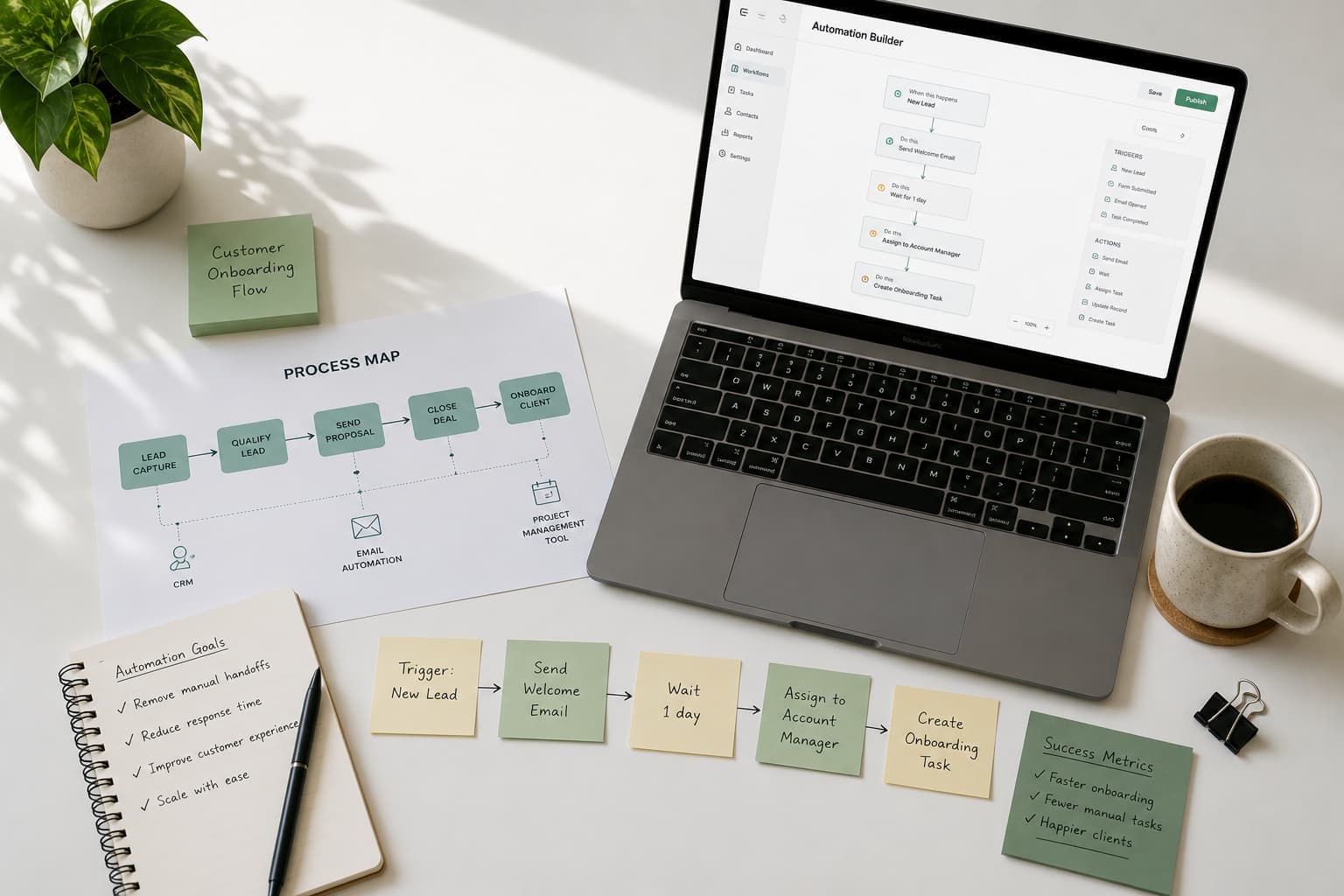
First, pick one painful, repetitive workflow with clear rules. Invoice approval or lead routing works well. Map it exactly as it runs today, including every handoff and exception. This mapping stage is where most of the value gets decided. Skipping it is the most common reason process automation implementations fail.
Second, clean the process before you automate it. Remove redundant steps and define what happens in edge cases. Automating a messy workflow just produces bad results faster. Following a structured business process optimization strategy at this stage keeps the cleanup deliberate rather than ad hoc.
Third, choose a tool that matches the complexity you mapped, then build the workflow for that one process. Test it against real cases, not ideal ones.
Fourth, connect it to your existing business systems so data flows without manual re-entry, then monitor and adjust. Knowing how to automate processes is less about technology and more about disciplined sequencing: analyze, standardize, build, integrate, maintain. Automating processes well means getting one running end to end before touching the next. That focus is what separates process improvement that sticks from a pile of half-finished experiments.
Choosing the right processes and tools to automate first
Not every task deserves automation. The best first candidates share three traits. They repeat often, they follow clear business rules, and they carry meaningful volume. Invoicing, data entry, order processing, and lead routing usually top the list because the payoff is immediate and the logic is simple.
Rank your options by frequency multiplied by time spent. A task that takes ten minutes but runs two hundred times a month beats a two-hour task you run twice a year. That ranking is your roadmap.
Then match automation tools to the process, not to hype. Simple linear workflows run well on no-code platforms. Multi-step processes with conditions and exceptions need stronger orchestration. Your team’s skill matters too. Automation tools no one can maintain become a liability the moment something breaks. The U.S. Small Business Administration’s business management guidance is a useful reference for keeping systems compliant as they grow. Keep in mind that compliance and record-keeping rules vary by state and industry, so confirm the requirements that govern your specific jurisdiction with the relevant authority before you automate anything touching tax, payroll, or customer data.
A word on customer onboarding and intelligent document processing. These often look automatable but hide judgment-based steps. Map them carefully before committing. This is where a structured approach to business process optimization pays off. This is exactly the kind of systems design work Four Indoor Courts handles when founders aren’t sure which processes to tackle first. Choose fewer processes, execute them completely, and you build momentum instead of a graveyard of abandoned tools.
Types of process automation founders actually use (RPA, workflow, AI)
There are a few distinct types of process automation, and knowing which is which keeps you from overbuying.
Robotic process automation, or RPA, mimics human clicks and keystrokes across applications that were never designed to talk to each other. If your team copies data between a legacy system and a spreadsheet, RPA can run that exact sequence unattended. It is a practical bridge when proper system integrations are not available.
Workflow automation is different. It orchestrates a sequence of steps across people and systems, routing approvals, triggering emails, and moving records based on business rules. This is the backbone of most business process automation because it handles the “who does what next” logic. As volume grows, this is also where ERP systems help small businesses scale, tying these workflows into a single source of truth.
Then there is artificial intelligence. AI is expanding automation into judgment-heavy work: reading unstructured documents, classifying support tickets, drafting responses. In practice, AI doesn’t replace rule-based systems. Many founders assume AI makes RPA obsolete. In reality, most businesses run robotic process automation, workflow orchestration, and AI together, each covering the work the others cannot.
Concrete outcomes and ROI of automating operations
Numbers make this concrete. Rule-based automation projects commonly return 200 to 400% over three years, with payback landing somewhere between 6 and 18 months. That range assumes one thing: the underlying process was already clean before you automated it.
The gains come from three places. You cut labor hours on repetitive tasks. You reduce the 1 to 5% human error rate that generates rework and billing corrections. And you remove the throughput ceiling that a manual bottleneck creates. One study on lead processing cut average execution time from 185 seconds to 1.23 seconds, roughly a 151-fold decrease. Among the benefits of business process automation, that shift is a different operating model, not a nudge.
Just as important is what you cannot put in a spreadsheet: operational visibility. When work runs through defined workflows, you finally see where things stall. That supports sharper strategic planning and faster decision-making.
Results vary based on leadership execution, market conditions, and implementation discipline. Automation does not guarantee growth. It does, however, typically improve operational efficiency and free capacity for the work that actually moves the business forward.

Examples of process automation that scale a small business
Consider a distribution company processing four hundred orders a week by hand. Every order touched three people and a spreadsheet. After automating order processing, the same volume ran with one reviewer handling exceptions, and the founder stopped losing Saturdays to catch-up work. That is the pattern. Automation absorbs the volume that would otherwise demand another hire.
Here are other examples founders actually deploy. Customer onboarding sequences that automatically trigger welcome emails, account setup, and first-task scheduling. Invoice generation and dunning reminders that run without anyone watching a due-date calendar. Lead routing that assigns inquiries to the right rep in seconds instead of hours.
Intelligent document processing is a strong use case for service businesses drowning in contracts or intake forms. It pulls key fields into your systems without manual keying. Each example takes founder-dependent, repetitive tasks and turns them into a repeatable business process. Stack a few together, and you simplify operations across the whole company. These are the benefits of business process automation in practice: not one overhaul, but small, well-chosen wins that compound into steadier growth and real operational efficiency. This is the heart of optimizing small business operations for sustainable growth, not chasing every shiny tool.
Common automation mistakes and objections founders raise
The most expensive mistake is automating a broken process. If the workflow is inconsistent, automation just produces wrong output faster and at scale. Standardize first, always.
Second mistake: buying tools before mapping processes. Founders get sold a platform, then reverse-engineer their operations to fit it. That backward order creates rigid systems no one wants to use.
Now the objections. “We’re too busy to implement changes.” Fair, but that busyness is the symptom automation treats. Blocking a few hours to map one process can pay back within months. “We just need better employees.” Many businesses mistake system problems for personnel problems. The issue usually isn’t effort. It is the absence of a repeatable process. “Things are messy but manageable.” Leaders normalize operational inefficiency over time until a growth spike exposes it, and by then the fix costs more.
A quieter risk is automating too much, too fast, with no clear owner. When something breaks and nobody understands the workflow, you have traded one problem for a worse one. Good business process management means every automated workflow has a documented owner and a maintenance plan. Automation gives you a real edge, and that edge works against you without discipline.
How a fractional COO helps founders automate and scale responsibly
Most founders know their operations are strained. What they lack is the operational leadership to sequence the fix without stalling the business. That gap is exactly what a fractional COO fills. It brings senior operational judgment to your day-to-day operations, without the cost of a full-time executive hire.
The work starts with clarity, not tools. A fractional COO maps where friction actually lives, identifies which operational bottlenecks are costing you the most, and decides which processes to automate first based on impact rather than novelty. That prioritization is often the difference between automation that scales and automation that gathers dust.
From there, the focus shifts to building scalable systems. That means defining KPIs so you can measure whether the automation is working, designing the process before the technology, and creating the operational visibility founders lose as they grow. Four Indoor Courts supports founders through exactly this, combining process improvement, systems design, and KPI strategy so growth doesn’t outrun structure. If you’re not sure where to begin, you can book a free 30-minute Readiness Audit to pinpoint the highest-impact fixes first.
The goal is not to automate everything. It is to scale responsibly, using practical methods that keep the business stable while you step back from the daily grind and lead.

If your business is growing faster than your systems can support, the fastest way forward is knowing exactly where the friction lives before you spend a dollar on tools. Four Indoor Courts helps founders map their operations, prioritize what to automate, and build the structure to scale sustainably. Book a clarity call with Leah Norris to see where operational friction is quietly slowing your growth.
FAQs
Q1. What does process automation actually mean for a small business?
A1.
Process automation uses software to handle routine, rule-based tasks with minimal human involvement, so operations stay consistent even when the founder steps back. A common example is employee onboarding, where welcome emails, system access, and training schedules trigger automatically instead of being managed by hand each time.
Q2. Which tasks should I automate first?
A2.
Start with repetitive, high-volume, rule-based tasks like data entry, invoice processing, and lead routing, since these deliver the fastest error reduction and time savings. In one study, automating lead-processing cut average execution time from 185 seconds to 1.23 seconds: roughly a 151-fold decrease.
Q3. How does process automation actually lower operating costs?
A3.
It reduces costs three ways: cutting manual labor on repetitive tasks, minimizing the 1-5% human error rate that creates rework, and removing bottlenecks that slow throughput. Freeing staff from data entry and billing corrections lets them focus on higher-value work instead of fixing mistakes.
Q4. What if my processes are too messy or inconsistent to automate?
A4.
Automating a broken process just makes bad output faster, so map and standardize the workflow before adding any tool. This is why automation should follow process optimization: clear steps and defined rules first, technology second.
Q5. How do I choose the right process automation platform?
A5.
Match the platform to your process complexity and your team’s technical skill: no-code tools like Zapier (which connects 6,000+ apps, from $20/month) suit simple linear workflows, while multi-step processes with conditions and exceptions need more robust orchestration platforms. Evaluate integration with your existing systems before committing.
Q6. What are the four stages of implementing process automation?
A6.
The four stages are analysis (mapping which tasks to automate), implementation (building the workflows), integration (connecting the automation to existing systems), and maintenance and support (monitoring and adjusting over time). Skipping the analysis stage is the most common reason automation projects underdeliver.

Founder of Four Indoor Courts Consulting, Leah Norris helps founders and growing businesses create operational clarity through fractional COO leadership, KPI-driven analytics, and scalable operational strategy. With a background spanning operations, finance, analytics, marketing, and technology, Leah specializes in helping businesses improve visibility, streamline processes, strengthen accountability, and build the operational structure needed for sustainable growth.